





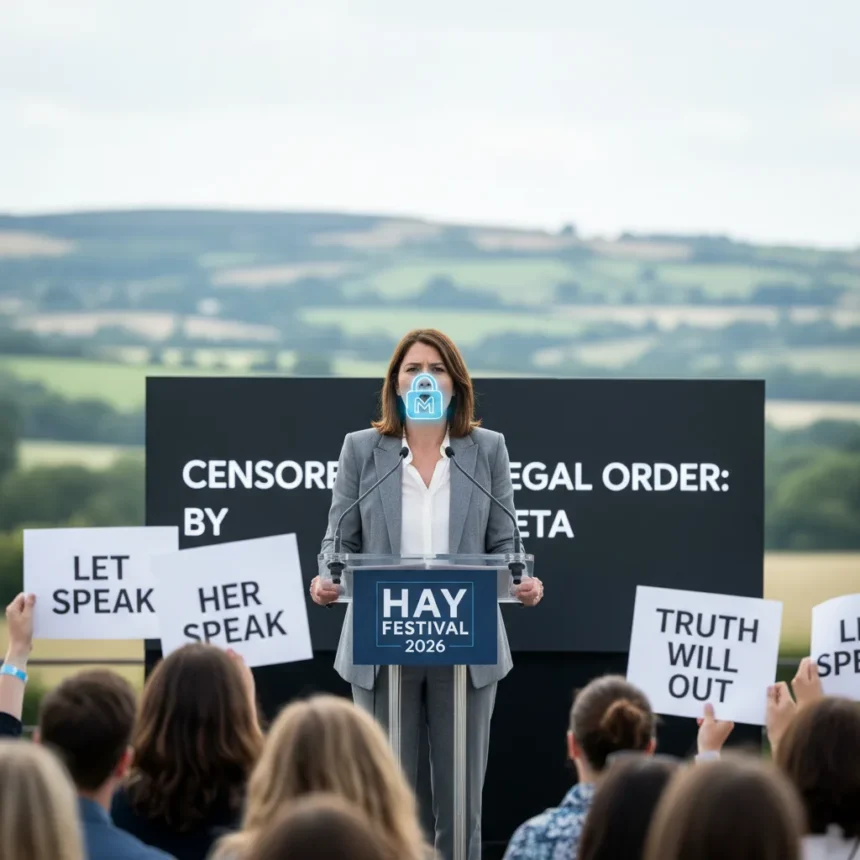
Whistleblower legal silencing has entered a new frontier: a former Facebook executive sat mute on a literary festival panel while others discussed her book, prevented by Meta’s court-enforced gag order from defending herself or even nodding in response.
Key Takeaways
- Sarah Wynn-Williams, former Facebook executive and whistleblower, was barred from promoting her book at 2026 Hay Festival due to Meta’s legal order.
- Meta’s temporary order prohibits Wynn-Williams from discussing her book or certain topics regardless of whether her statements are true.
- Breaching the order carries a $50,000 fine per violation, according to her legal team.
- The Hay Festival paused book sales and Wynn-Williams appeared silently on a panel with investigative journalist Carole Cadwalladr and legal scholar Tim Wu.
- Meta claims the restriction stems from a binding arbitration award, not company censorship.
How Meta’s Legal Order Created a Silenced Whistleblower
Sarah Wynn-Williams, a former Facebook executive turned whistleblower, was forced into silence at the 2026 Hay Festival after Meta obtained a temporary legal order that prevented her from promoting her bestselling book Careless People or discussing certain topics in public. The book contains accusations that a senior Meta executive engaged in sexual harassment, making the restriction particularly contentious. When Wynn-Williams appeared on a Sunday panel alongside investigative journalist Carole Cadwalladr and legal scholar Tim Wu, she could not speak, nod, or shake her head—any gesture risked triggering the legal sanction.
Wynn-Williams’s lawyer submitted a letter, read aloud by Cadwalladr, that captured the absurdity of the moment: Meta obtained a temporary order preventing Wynn-Williams from promoting her book or speaking about certain topics regardless of whether what she says is true. This phrasing cuts to the heart of the whistleblower legal silencing issue. The restriction does not hinge on factual accuracy or falsehood—it blankets all public discussion of her work, true or otherwise. The $50,000 fine per breach creates a financial chilling effect that few whistleblowers can afford to challenge.
Whistleblower Legal Silencing and Corporate Arbitration Power
Meta’s position is that whistleblower legal silencing is not their doing but rather the result of a binding arbitration award that Wynn-Williams agreed to during her employment. The company stated clearly: this is an arbitrator’s order, not Meta deciding to silence anyone, and that it is entitled to ask that the terms of that order be observed. By framing the restriction as an independent arbitrator’s decision, Meta distances itself from the appearance of corporate censorship. Yet the company actively pursued enforcement of that order, citing Wynn-Williams’s planned Hay Festival appearance as an example of conduct that should be formally sanctioned.

This distinction between arbitration award and corporate enforcement is crucial to understanding modern whistleblower legal silencing. Many tech employees sign arbitration clauses that include non-disparagement and confidentiality provisions—agreements that can outlast their employment and restrict public speech years later. Meta’s motion also reportedly named both Cadwalladr and Wu as critics of the company, suggesting the company views the entire panel as a threat worthy of legal intervention. The Hay Festival itself complied with the order by pausing sales of Careless People, demonstrating how corporate legal pressure cascades beyond the individual whistleblower to affect publishers, venues, and allied voices.
What Whistleblower Legal Silencing Means for Free Speech
The Wynn-Williams case exposes a gap between legal rights and practical ability to exercise them. Whistleblower legal silencing through arbitration orders creates a paradox: a person can be factually correct, legally prevented from saying so, and financially ruined if they try. The $50,000-per-breach penalty is not incidental—it is a tool designed to make speech prohibitively expensive. For a whistleblower without deep resources, the fine becomes a de facto permanent gag.



Comparatively, traditional defamation law at least requires a plaintiff to prove falsity and harm. Whistleblower legal silencing via arbitration operates in reverse: the restriction applies regardless of truth, placing the burden on the silenced party to risk financial catastrophe if they dare speak. Meta’s framing of the order as an arbitrator’s decision, not the company’s choice, is legally sound but ethically hollow. The company could choose not to enforce it aggressively, could negotiate a release, or could allow limited speech in the public interest. Instead, Meta pursued formal sanctions and paused book sales, escalating rather than de-escalating.
Is Meta Legally Entitled to Enforce the Arbitration Order?
Yes, according to Meta’s argument. The company claims Wynn-Williams agreed to binding arbitration terms during her employment that explicitly prohibit her from promoting her book or discussing certain topics. If that arbitration award is valid and enforceable under applicable law, Meta has a legal right to seek its enforcement. However, legal entitlement does not answer the question of whether such enforcement serves the public interest or whether arbitration clauses should be permitted to restrict speech on matters of genuine public concern, such as allegations of sexual harassment within a major tech company.
What Happens Next to Whistleblower Legal Silencing Cases?
The outcome of Wynn-Williams’s situation remains unresolved in the research available. What is clear is that whistleblower legal silencing through arbitration enforcement is likely to become more common as tech companies face increased scrutiny and employee departures. Other former executives and whistleblowers may face similar restrictions, and the precedent set by Meta’s aggressive enforcement could embolden other corporations to pursue comparable orders. The question for regulators and lawmakers is whether arbitration clauses should be permitted to restrict public speech on matters of corporate wrongdoing, or whether whistleblower protections should supersede confidentiality agreements.
The image of Wynn-Williams sitting silent while others discussed her work and her legal predicament is a stark illustration of what whistleblower legal silencing looks like in practice. It is not dramatic or violent—it is quiet, procedural, and backed by the weight of corporate legal resources. For anyone considering becoming a whistleblower, the Hay Festival moment is a warning: even if you are right, even if your allegations are true, arbitration clauses and legal orders can prevent you from ever telling your story publicly.



Edited by the All Things Geek team.
Source: TechRadar




