Tesla Full Self-Driving safety has become the flashpoint in a growing legal and technical reckoning over autonomous vehicle marketing and real-world performance. Uber’s former head of self-driving has sounded a public alarm after a personal near-death experience in a Tesla, joining mounting criticism from attorneys and federal safety officials over the technology’s limitations and its misleading name.
Key Takeaways
- Tesla Full Self-Driving is SAE Level 2 automation, requiring constant driver monitoring—not true self-driving despite its name.
- August 2025 Houston Cybertruck crash on Eastex Freeway shows vehicle veering without warning; driver Justine Saint Amour suffered serious neck, back, and shoulder injuries.
- February 2026 lawsuit claims Tesla FSD marketing is misleading and lacks adequate emergency braking override for AI freezes.
- NTSB Chair Jennifer Homendy called Tesla FSD marketing “misleading and irresponsible” in 2021; Elon Musk admitted a FSD version was “actually not great”.
- Separate 2024 Cybertruck crash in Piedmont, CA killed three college students; survivor filing lawsuit in March 2026 claiming vehicle became a “trap” after hitting tree.
What Happened in the Houston Cybertruck Crash
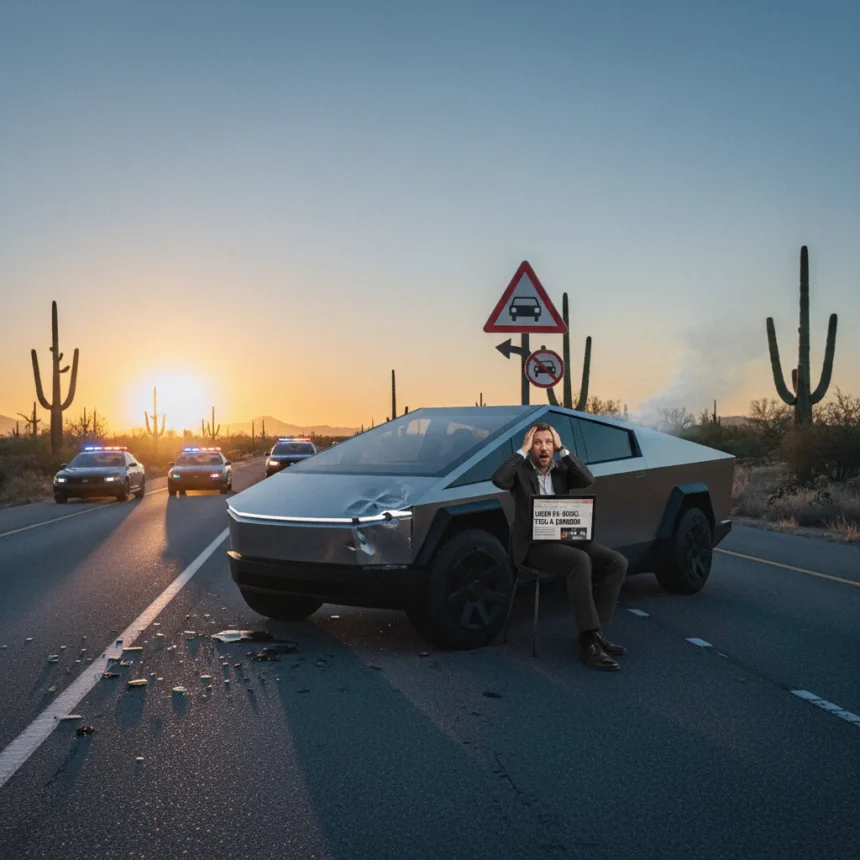
On August 18, 2025, a Cybertruck traveling on the Eastex Freeway (Highway 69) overpass in Houston suddenly veered toward the edge without warning while operating on Autopilot. The vehicle misjudged the turn sharply, and the driver, Justine Saint Amour, attempted to intervene but the vehicle was moving too fast to regain control. The Cybertruck crashed into a concrete barrier, leaving Saint Amour with serious injuries to her neck, back, and shoulder. Dashcam footage released as part of the subsequent lawsuit shows the precise moment the vehicle lost its path, capturing the driver’s desperate attempt to correct course before impact.
This incident exposes a critical vulnerability in Tesla Full Self-Driving safety: the system is classified as SAE Level 2, meaning it theoretically requires constant driver monitoring and readiness to intervene at any moment. In practice, the name “Full Self-Driving” creates a false impression of autonomy that encourages drivers to relax their vigilance—a gap between marketing and engineering that has now become the centerpiece of legal action.
The Legal Case Against Tesla FSD Marketing
Attorney Bob Hilliard, representing Saint Amour, filed suit in February 2026 against Tesla for liability, negligence, and misrepresentation. The core claim is damning: Tesla’s Full Self-Driving marketing is fundamentally misleading, and the system lacks adequate driver alert mechanisms and effective automatic emergency braking (AEB) override capability when the AI freezes or lags. Hilliard’s statement—”She tried to take control, but crashed into the barrier”—captures the precise failure mode: by the time the driver recognized the danger and acted, the vehicle’s momentum and trajectory made correction impossible.

The lawsuit also highlights that Tesla FSD is not self-driving in any meaningful sense. Hilliard was blunt: “That’s not self-driving”. SAE Level 2 automation requires human oversight, yet Tesla’s branding, pricing structure (which includes a premium fee), and public statements have positioned FSD as a near-autonomous system. This gap between what the name implies and what the technology actually does has drawn criticism from the highest levels of vehicle safety regulation.
Federal Safety Officials and Industry Warnings
This is not the first time Tesla FSD safety has faced official scrutiny. In 2021, NTSB Chair Jennifer Homendy directly criticized Tesla’s marketing approach, calling FSD promotion “misleading and irresponsible”. Even Elon Musk has admitted publicly that a version of the FSD software was “actually not great,” suggesting internal awareness of performance gaps.



Uber’s former self-driving chief, now speaking out after his own near-death Tesla experience, adds weight to these warnings. His critique carries particular authority because he led autonomous vehicle development at one of the world’s largest ride-hailing companies—a role that required deep understanding of safety-critical systems, regulatory frameworks, and the real-world hazards of automation failures. His public alarm, tied to personal experience rather than abstract concern, signals that the problem is not theoretical but immediate and tangible.
The Broader Pattern: Multiple Cybertruck Crashes and Deaths
The Houston crash is not an isolated incident. In 2024, a separate Cybertruck crash in Piedmont, California, killed three college students and severely injured a fourth. The survivor is filing a lawsuit in March 2026 claiming Tesla bears liability for the crash and for the vehicle’s post-impact design flaws. The legal filing includes a stark observation: a vehicle shouldn’t become a trap once an accident occurs—there should be a way to escape. This speaks to a secondary safety failure: even if FSD were perfect, the Cybertruck’s physical design may trap occupants after a crash, compounding the danger.
These incidents, separated by geography and timing, suggest a systemic issue rather than isolated driver error or mechanical anomaly. When Uber’s former autonomous vehicle leader warns about Tesla Full Self-Driving safety after a personal near-death experience, and when multiple lawsuits cite identical failure modes—sudden loss of vehicle control, inadequate driver alert systems, inability to override a frozen AI—the pattern becomes difficult to dismiss as coincidence.
Why Tesla Full Self-Driving Safety Matters Now
The legal actions filed in February and March 2026, combined with Uber’s ex-boss warning, have reignited debate over autonomous vehicle regulation and corporate accountability. Tesla has positioned FSD as a premium feature commanding significant fees, yet the technology remains fundamentally dependent on human intervention. The mismatch between marketing and capability, between the name and the actual SAE Level 2 classification, creates both legal liability and real physical danger.



For consumers, the lesson is stark: Full Self-Driving is not a substitute for human driving. It is a driver assistance system that can fail without warning, and when it does, the driver must be ready to take over instantly. The Houston crash shows what happens when that transition is too slow or the system’s failure is too severe to correct in time.
Does Tesla Full Self-Driving work as advertised?
No. Tesla Full Self-Driving is SAE Level 2 automation, which means it requires constant driver monitoring and can fail without warning. Despite its name, it is not true self-driving. The 2021 NTSB Chair called Tesla’s marketing “misleading and irresponsible,” and Elon Musk himself admitted a version was “actually not great”.
What happened in the Houston Cybertruck crash?
On August 18, 2025, a Cybertruck on Autopilot veered suddenly off course on the Eastex Freeway overpass in Houston and crashed into a concrete barrier. Driver Justine Saint Amour attempted to regain control but could not correct the vehicle’s trajectory in time, suffering serious injuries to her neck, back, and shoulder.
Is Tesla facing lawsuits over Full Self-Driving safety?
Yes. A February 2026 lawsuit filed by Saint Amour claims Tesla’s FSD marketing is misleading and the system lacks adequate emergency braking override and driver alert capabilities. A separate March 2026 lawsuit from a 2024 Piedmont, California crash survivor also names Tesla, claiming design and safety failures.
Tesla Full Self-Driving safety concerns are no longer theoretical. With Uber’s former autonomous vehicle chief warning of real danger, with dashcam footage showing catastrophic system failures, and with multiple lawsuits now in motion, the gap between Tesla’s marketing and the technology’s actual capabilities has become impossible to ignore. Drivers who purchase FSD must understand they are buying a Level 2 driver assistance system, not an autonomous vehicle—and they must remain vigilant every moment it is active. Anything less is gambling with their lives.
Edited by the All Things Geek team.
Source: TechRadar