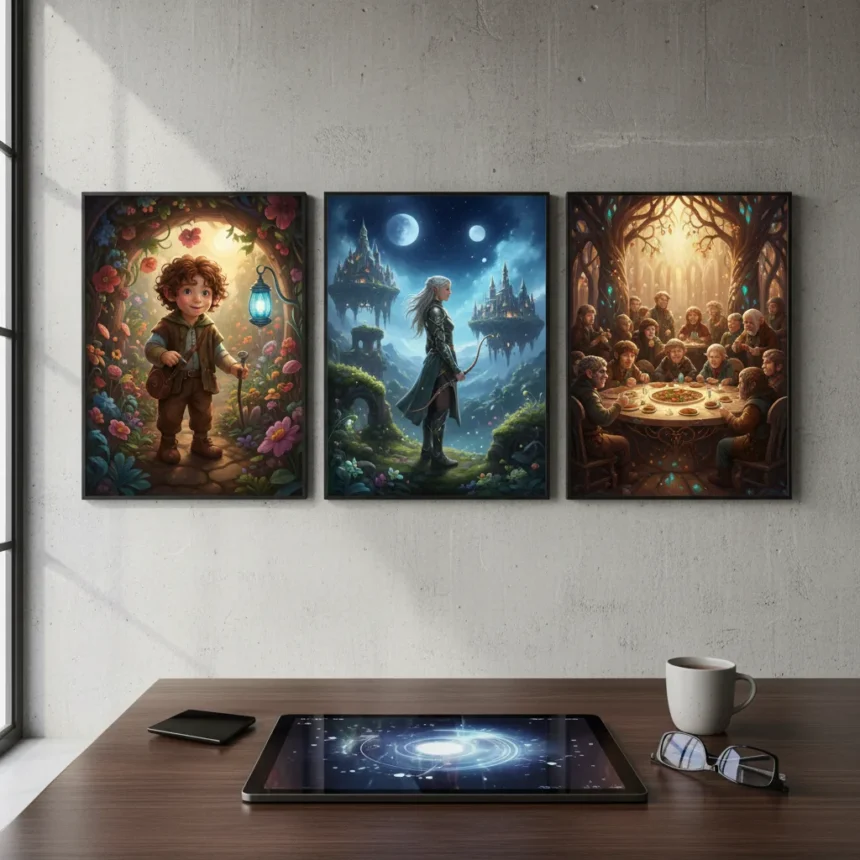
Nia Kovalevski is an artist known for character-driven imaginative realism, a style that breathes fresh life into J.R.R. Tolkien’s most beloved creations. Her work captures hobbits and elves in a magical new light, departing from conventional fantasy illustration to focus on the emotional depth and personality of each character she renders.
Key Takeaways
- Nia Kovalevski employs character-driven imaginative realism to depict Tolkien’s fantasy beings.
- Her approach emphasizes emotional depth and personality over traditional fantasy aesthetics.
- The artist’s work reimagines hobbits and elves in a fresh, contemporary visual style.
- Character focus distinguishes her interpretation from conventional Tolkien illustrations.
- Imaginative realism blends fantastical elements with grounded, emotionally resonant character design.
What Is Character-Driven Imaginative Realism in Tolkien Fantasy Art?
Character-driven imaginative realism is an approach to depicting fantasy worlds that prioritizes the emotional and psychological depth of characters over spectacle or world-building detail. In Kovalevski’s Tolkien fantasy art, this means rendering hobbits and elves as fully realized individuals with distinct personalities, inner lives, and narrative weight. Rather than treating them as archetypal fantasy figures, she grounds them in a visual language that feels both fantastical and intimately human.
This style sits at the intersection of two artistic traditions. Imaginative realism draws from classical representational painting—the technical mastery of light, form, and anatomy—while embracing fantastical subject matter. Character-driven work means every brushstroke serves the character’s emotional truth, not the spectacle of the world around them. Kovalevski’s hobbits aren’t simply inhabitants of Middle-earth; they’re individuals with agency, vulnerability, and presence that commands the viewer’s attention.
The distinction matters for how audiences experience Tolkien’s creations. Traditional fantasy illustration often emphasizes landscape grandeur, ornate costume detail, or heroic poses. Kovalevski’s method inverts that hierarchy. A hobbit’s uncertain glance becomes as visually compelling as the mountains behind them. An elf’s moment of doubt carries more weight than elaborate armor or flowing robes. This reorientation asks viewers to see these characters not as fantasy archetypes but as people whose stories deserve intimate attention.

How Kovalevski’s Approach Differs From Conventional Tolkien Illustration
Conventional Tolkien illustration has historically leaned toward two modes: grand world-building landscapes that emphasize Middle-earth’s scale and majesty, or heroic character portraits that showcase iconic moments and archetypal fantasy aesthetics. Kovalevski’s work sidesteps both. She doesn’t compete on spectacle; she competes on specificity and emotional resonance.
Where traditional fantasy art might render an elf as a timeless, ethereal being defined by elven traits—pointed ears, luminous eyes, otherworldly grace—Kovalevski asks what makes this particular elf distinct. What has she experienced? What does she fear? Her imaginative realism allows her to preserve fantastical elements while grounding characters in psychological reality. A hobbit isn’t just small and cheerful; he’s small, uncertain, brave despite his fear, shaped by specific choices and losses.



This character-forward methodology also allows for reinterpretation. Rather than simply illustrating canonical moments from Tolkien’s text, Kovalevski’s work invites viewers to imagine the interior lives of characters, to see them in moments Tolkien never depicted. Her hobbits and elves feel like people you could have a conversation with, not figures locked in mythic amber.
The Role of Imaginative Realism in Contemporary Fantasy Art
Imaginative realism has become increasingly influential in contemporary digital art and illustration. It represents a rejection of both photorealism—which can feel sterile when applied to fantasy—and stylization so extreme it distances viewers from emotional connection. Kovalevski’s work demonstrates why this middle path resonates with modern audiences.
Digital tools have made imaginative realism more accessible and powerful. Artists can layer traditional painting techniques with the flexibility of digital media, building characters with painterly depth while maintaining the precision necessary for character-driven storytelling. Kovalevski’s Tolkien fantasy art benefits from this technological moment; she can achieve the luminous, tactile quality of classical painting while working with the speed and revisability of digital tools.
The approach also speaks to a broader cultural shift in how we consume fantasy. Audiences increasingly seek character-driven narratives where emotional stakes matter as much as plot mechanics. Television shows like Game of Thrones and The Rings of Power have trained viewers to expect complex, psychologically nuanced characters in fantasy settings. Kovalevski’s visual language aligns with that expectation, making her Tolkien fantasy art feel contemporary even as it draws from timeless literary sources.



Why Tolkien’s Hobbits and Elves Benefit From This Artistic Lens
Tolkien’s hobbits and elves are particularly well-suited to character-driven imaginative realism. Hobbits, by Tolkien’s own design, are ordinary beings thrust into extraordinary circumstances. They lack the martial prowess of men or the ancient wisdom of elves. What makes them heroic is their courage in the face of fear, their loyalty despite doubt, their capacity for growth. These are interior qualities that Kovalevski’s approach highlights perfectly.
Elves, conversely, carry the weight of immortality and fading power. They’re beings caught between worlds, watching civilizations rise and fall while they endure. Traditional illustration often renders them as remote and perfect. Kovalevski’s imaginative realism allows her to show the melancholy, the complexity, the very human loneliness that immortality might impose. An elf in her work isn’t untouchable; she’s profoundly, achingly present.
By applying character-driven imaginative realism to Tolkien fantasy art, Kovalevski unlocks dimensions of these characters that text alone can suggest but visual art rarely explores. Her hobbits and elves feel like they have stories beyond the page, interior lives that extend beyond canonical narrative. This is the power of her approach: it doesn’t replace Tolkien’s vision but deepens it, inviting viewers into a richer, more intimate relationship with these beloved characters.
What Makes Imaginative Realism Different From Digital Fantasy Art Styles?
Imaginative realism differs from pure digital painting, stylized fantasy art, and photorealism in fundamental ways. Pure digital painting in the fantasy space often prioritizes technical display—rendering every scale, every thread, every atmospheric particle with equal visual weight. Stylized fantasy art (think anime-influenced character design or comic book illustration) prioritizes visual impact and readability over representational accuracy. Photorealism attempts to achieve camera-like precision, which can feel uncanny or cold when applied to fantasy beings.
Imaginative realism, by contrast, uses representational skill selectively. Kovalevski masters anatomy, light, and form, but she deploys them in service of character. A hobbit’s face might be rendered with painterly precision while the background remains suggested rather than detailed. An elf’s expression carries the weight of careful observation, but her clothing might be simplified to keep focus where it belongs. This selective realism creates hierarchy; viewers know where to look because the artist has guided them through technical choices about what deserves rendering and what deserves restraint.
FAQ
What is character-driven imaginative realism in art?
Character-driven imaginative realism combines technical representational skill with fantastical subject matter, prioritizing the emotional and psychological depth of characters over spectacle or world-building detail. It grounds fantasy beings in visual language that feels both magical and intimately human, making them feel like fully realized individuals rather than archetypal figures.
How does Nia Kovalevski’s Tolkien fantasy art differ from traditional fantasy illustration?
Kovalevski’s approach emphasizes character interiority and emotional specificity rather than grand landscapes or heroic poses. Her hobbits and elves feel like distinct individuals with inner lives, not archetypal fantasy figures. She invites viewers to imagine the psychological depth of these characters beyond what canonical text provides.
Why is imaginative realism effective for depicting Tolkien characters?
Tolkien’s hobbits are defined by interior courage and growth, while his elves carry the weight of immortality and fading power. Character-driven imaginative realism highlights these psychological dimensions, allowing artists to show the melancholy, complexity, and very human presence that traditional fantasy illustration often overlooks.
Nia Kovalevski’s work demonstrates that reimagining beloved literary characters doesn’t require departing from their essence—it requires seeing deeper into it. Her character-driven imaginative realism proves that the most magical interpretations of Tolkien’s hobbits and elves are those that honor their emotional truth.
Where to Buy
11% OFFWacomMovinkPad 11$399.99$449.95shop now | 34% OFFHuion Inspiroy H640p£28.46£42.99shop now | 20% OFFWacomIntuos Small$39.95$49.95shop now | 19% OFFXPPenArtist13.3 Pro$209.98$259.99shop now
Edited by the All Things Geek team.
Source: Creativebloq