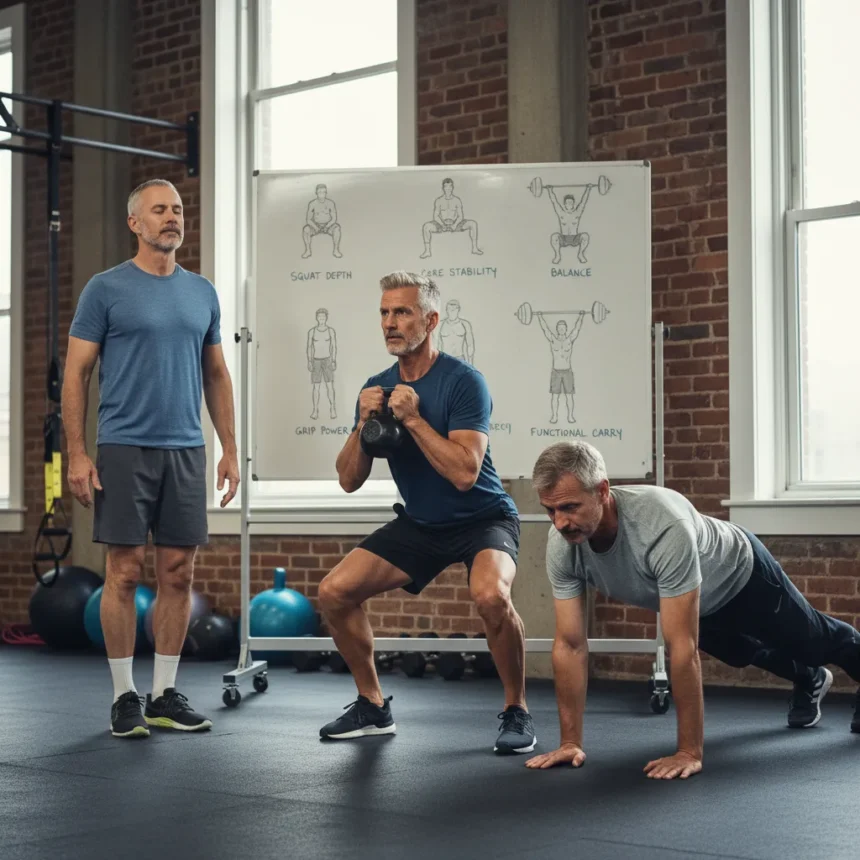
Strength tests for men over 50 serve as a practical snapshot of overall physical condition. Rather than relying on age alone or generic fitness metrics, these six moves function as real-world benchmarks that reveal whether your body can still handle the demands of daily life—climbing stairs, carrying groceries, getting up from a chair without assistance.
Key Takeaways
- Six specific strength moves act as functional fitness tests for men over 50
- These tests measure practical abilities needed for independence and daily tasks
- Passing all six indicates good overall physical condition for your age group
- The tests assess mobility, core strength, and lower-body power
- Regular testing can track fitness progress and motivate consistent training
Why Strength Tests Matter More Than Age
Age is just a number, but functional capacity is everything. A man who can perform these six moves at 55 may have better physical resilience than someone at 45 who skips the gym. The distinction matters because strength directly correlates with independence, injury prevention, and quality of life in your later decades. These tests sidestep the vanity metrics—how much you weigh, how you look—and focus instead on what your body can actually do.
The appeal of a standardized test lies in its simplicity. You do not need expensive equipment, a gym membership, or a coach watching over your shoulder. These moves are designed to be performed at home, in a park, or anywhere with basic space. If you can complete all six, you have cleared a meaningful bar. If you cannot, you have identified specific areas where targeted training will pay dividends.
What These Strength Tests for Men Over 50 Actually Reveal
The six moves function as a diagnostic tool rather than a workout. Each one isolates a different physical capacity: lower-body strength, core stability, balance, mobility, and explosive power. Together, they paint a picture of whether your musculoskeletal system is aging gracefully or whether you are losing ground to time and inactivity.

Men over 50 who pass all six tests typically demonstrate that they have maintained muscle mass, bone density, and neuromuscular coordination—three things that naturally decline with age but can be preserved with consistent strength work. The tests are not about ego or competition. They are about honest self-assessment. Can you get off the floor without using your hands? Can you hold a plank? Can you perform a single-leg squat? These answers tell you whether your training is working or whether you need to adjust your approach.
The real value emerges when you retest yourself every 8-12 weeks. Improvements in these specific movements translate directly to better performance in real life. You climb stairs faster. You carry heavy loads without strain. You recover more quickly from minor injuries. You feel more confident moving through the world.



Building a Routine Around These Strength Tests
Using these six moves as tests is one thing; building them into a regular training program is another. The most effective approach treats them as both assessment tools and core exercises. Perform them once every 4-6 weeks to measure progress, then incorporate variations and progressions into your weekly strength sessions.
Progression matters enormously. If a standard push-up feels easy, you move to archer push-ups or single-arm variations. If a bodyweight squat is simple, you add load or increase the range of motion. If a plank holds for two minutes without breaking form, you extend the duration or add movement. The goal is constant, manageable challenge—not crushing yourself, but never allowing your body to settle into comfort.
Recovery and consistency outweigh intensity for men over 50. Three focused strength sessions per week, with at least one rest day between sessions, will yield better results than sporadic high-intensity efforts. Quality of movement matters far more than quantity of reps. A single perfect rep teaches your nervous system more than five sloppy ones.
Common Mistakes When Testing Strength Over 50
The biggest mistake is ego-driven testing. You are not competing against your 25-year-old self or your neighbor. You are measuring your current capacity as a baseline for improvement. If you cannot complete a move with proper form, that is the honest answer. Cheating the movement—partial range of motion, momentum instead of control, rounded spine instead of neutral—defeats the purpose and increases injury risk.



Another frequent error is testing while fatigued or without adequate warm-up. These six moves demand full nervous system engagement. Testing after a long work day or without 5-10 minutes of light movement will skew your results downward and increase injury likelihood. Always warm up thoroughly before assessing yourself.
Finally, avoid the trap of testing too frequently. Retesting every week creates noise in your data and can become psychologically draining. Every 6-8 weeks is ideal. This interval gives your body enough time to adapt and improve, while remaining close enough to show meaningful progress.
Frequently Asked Questions
Can men over 50 improve at these strength tests?
Yes, absolutely. Muscle responds to stimulus at any age. Men over 50 who train consistently see noticeable improvements in strength and power within 4-6 weeks. The timeline may be slightly longer than for younger athletes, but the capacity for adaptation remains robust.
What if I cannot do one of the six moves?
Start with progressions. If a full push-up is impossible, begin with incline push-ups (hands on a bench) and work downward. If a single-leg squat is out of reach, practice pistol squat progressions using a TRX strap or light dumbbell for counterbalance. Every movement has a regression that builds toward the full version.
How often should I test these strength benchmarks?
Test every 6-8 weeks. This interval provides enough time for measurable adaptation without the noise of weekly fluctuations. Consistent training between tests will show clear progress, which is motivating and validates your effort.
Strength tests for men over 50 are not about proving anything to anyone else—they are about proving to yourself that you still have it. Your body adapts to what you demand of it. These six moves demand enough to trigger meaningful change. The question is not whether you can do them today, but whether you are willing to train hard enough to do them better tomorrow.
Edited by the All Things Geek team.
Source: T3