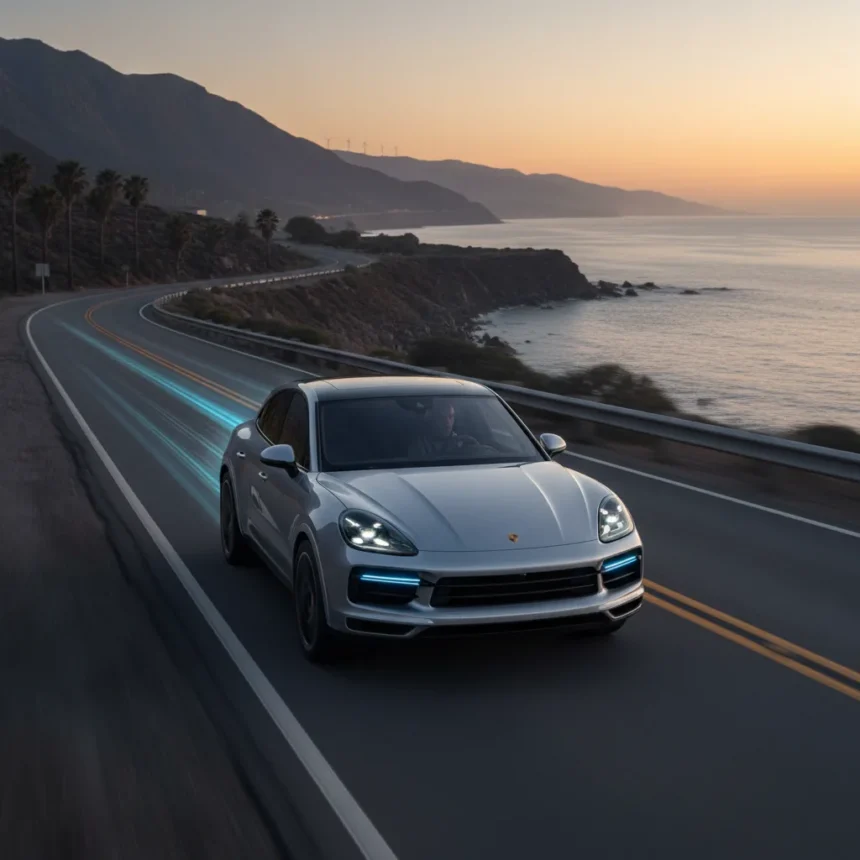
The Porsche Cayenne Coupé Electric is a fully electric SUV that rearranges expectations about what an electric luxury vehicle can do, combining the sleek roofline of a 911 with the practicality of an SUV and the acceleration of a supercar. This fourth-generation Cayenne marks Porsche’s first fully electric powertrain in its best-selling model line, and it arrives with a clear message: electric doesn’t mean compromising on performance.
Key Takeaways
- The Cayenne Coupé Electric Turbo produces 1,139 hp and hits 60 mph in 2.4–2.5 seconds, making it Porsche’s most powerful car ever.
- Built on Porsche’s modified PPE platform with an 800-volt architecture enabling 10–80% charge in under 16 minutes.
- Up to 415 miles of EPA range with regenerative braking equivalent to Formula E cars, allowing up to 97% braking without friction brakes.
- Starts at an estimated $111,350 for the base model; Turbo variant commands premium pricing.
- Features 911-inspired coupé roofline, curved OLED touchscreen, and AI Voice Pilot for control.
The Porsche Cayenne Coupé Electric Delivers Supercar Acceleration in an SUV
The Porsche Cayenne Coupé Electric’s most shocking specification is its power output. The Turbo variant produces 1,139 horsepower and 1,106 pound-feet of torque, enabling a 0–60 mph time of 2.4–2.5 seconds with a top speed of 143 mph. To put this in perspective, the rear axle motor alone outputs nearly twice the power of the original 2005 Cayenne Turbo S, which produced 521 hp total. Dual motors deliver all-wheel drive across every model, with Porsche building both the motors and battery in-house. The rear-axle motor uses oil cooling to handle extreme loads during sustained acceleration or track driving.
The base model offers 435 horsepower and 615 pound-feet, hitting 60 mph in 4.8 seconds, while the S variant delivers 657 horsepower. Even the entry-level Cayenne Coupé Electric performs like a sports car—faster than most performance sedans from a decade ago. This performance hierarchy gives buyers meaningful choices without sacrificing the core identity: a Porsche-built, Porsche-engineered electric SUV that feels quick in any configuration.
Range, Charging, and Battery Performance of the Porsche Cayenne Coupé Electric
The Porsche Cayenne Coupé Electric delivers up to 415 miles on a charge, though EPA estimates for the base model suggest around 340 miles. The battery capacity sits around 108–113 kWh usable, depending on the variant, built on Porsche’s 800-volt architecture. This is where electric charging infrastructure becomes a genuine advantage rather than a compromise. DC fast charging supports up to 400 kW via the standard NACS port (with J1772 on the opposite side), enabling a 10–80% charge in under 16 minutes or roughly 325 kilometers in just 10 minutes.

Regenerative braking sets the Cayenne Coupé Electric apart from most luxury SUVs. The system can recover up to 600 kW of energy—equivalent to what Formula E race cars achieve—allowing drivers to recover up to 97% of braking energy without engaging friction brakes. This means fewer brake services, longer pad life, and a driving experience that rewards smooth deceleration. On longer highway drives, this regenerative system extends range meaningfully compared to traditional friction-heavy braking.
Design: 911 Coupé Roofline Meets SUV Practicality
Porsche’s design choice to graft a 911-inspired coupé roofline onto an SUV frame sounds risky. It works. The lower, sleeker roofline improves aerodynamics while maintaining the aggressive stance that makes a Cayenne unmistakably Porsche. Interior space doesn’t suffer—the Cayenne Coupé Electric seats five, with 19.5 cubic feet of cargo space behind the seats, expanding to 56.1 cubic feet with the rear seats folded, plus a 3.2 cubic foot frunk. This is still a practical family vehicle, just one that looks like it escaped a race track.



Inside, a curved OLED touchscreen dominates the dashboard, paired with AI Voice Pilot for hands-free control. Mood Modes adjust seats, stereo, climate, and ambient lighting simultaneously—a feature that feels gimmicky until you realize how much it simplifies customizing the cabin environment. Optional electric rear seats and a sliding glass roof with variable light control add further customization. More heated surfaces than previous Cayennes address the reality that electric vehicles need cabin warmth without sacrificing efficiency.
Porsche Cayenne Coupé Electric vs. Traditional Luxury Performance SUVs
The Cayenne Coupé Electric’s core advantage over hybrid or gas-powered competitors lies in instant torque delivery and thermal efficiency. Traditional luxury SUVs require engine warm-up time; the Porsche Cayenne Coupé Electric delivers maximum power immediately, in any temperature. The 2.4-second 0–60 acceleration rivals dedicated sports cars, something no gasoline Cayenne variant has achieved. Additionally, the regenerative braking system—unmatched in conventional SUVs—means fewer brake replacements and genuinely different driving dynamics that reward anticipation and smooth inputs.
The PPE platform, shared with the upcoming Macan Electric, represents Porsche’s commitment to electric architecture for its core lineup. This is not a retrofitted gas platform; it’s engineered from the ground up for electric powertrains, dual motors, and high-voltage charging. That architectural clarity translates to efficiency and performance that feels cohesive rather than compromised.
Pricing and Availability for the Porsche Cayenne Coupé Electric
The Porsche Cayenne Coupé Electric arrives as a 2026 model year vehicle with a base price estimated at $111,350, though as-tested configurations reach $161,480. The Turbo variant commands significant premium pricing, positioning it among the most expensive electric SUVs on the market. At these price points, the Cayenne Coupé Electric competes directly with ultra-luxury electric vehicles that offer performance, not just efficiency. Porsche’s 1.5 million Cayenne sales over two decades demonstrate the model’s appeal; the electric variant extends that legacy into the EV era without abandoning the performance DNA that made the nameplate legendary.



Is the Porsche Cayenne Coupé Electric worth the price?
If you prioritize acceleration, instant torque, and regenerative braking efficiency, yes. The Turbo’s 2.4-second 0–60 time and 1,139 hp justify premium pricing for buyers who value performance. Base and S models offer more reasonable entry points while still delivering superb acceleration and range. The curved OLED interface and AI Voice Pilot add genuine daily-use value beyond specs.
How does the Cayenne Coupé Electric compare to the original gas Cayenne?
The electric version is faster, quieter, and more efficient. The rear motor alone outputs nearly twice the power of the original 2005 Cayenne Turbo S. Regenerative braking and instant torque delivery make the electric version feel sharper and more responsive, though the gas model offered more traditional SUV character and lower entry pricing.
What is the real-world range of the Porsche Cayenne Coupé Electric?
EPA estimates suggest around 340 miles for the base model, though Porsche claims up to 415 miles under optimal conditions. Real-world range depends heavily on driving style, temperature, and terrain. The 800-volt fast-charging system makes long trips feasible despite the range, since 10 minutes of charging adds roughly 325 kilometers of range.
The Porsche Cayenne Coupé Electric proves that electric performance SUVs don’t require compromise. It blends 911 design language, Bugatti-level acceleration, and genuine practicality into a single vehicle. At $111,350 and up, it’s expensive—but it’s also the most powerful Porsche ever built, and that performance is immediate, every single time you press the accelerator.
Where to Buy
Nextbase iQ | Nextbase 622GW | Thinkware F800 Pro | Nextbase 522GW
Edited by the All Things Geek team.
Source: T3