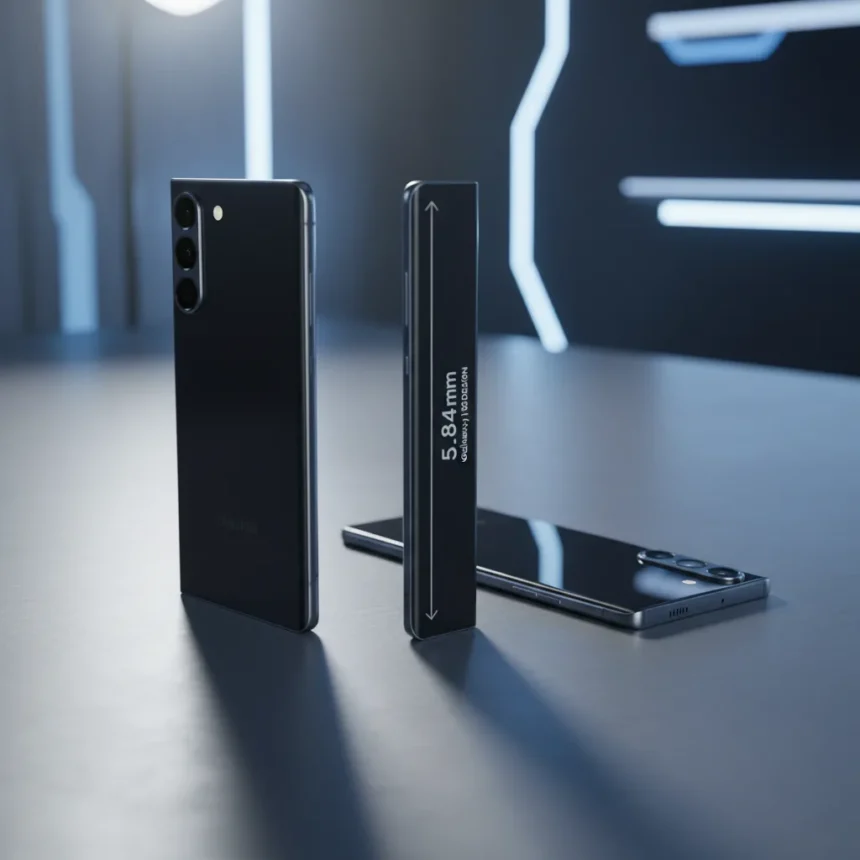
The Samsung Galaxy S25 Edge is shaping up to be the thinnest flagship Samsung has ever made, if leaked dummy units are any indication. A Korean YouTuber known as The Sinza posted footage of prototype units on YouTube, revealing a device measuring just 5.84mm thick—marginally thicker than Apple’s rumored iPhone 17 Air. Among all of Samsung’s forthcoming upgrades, this could literally be the smallest and most dramatic design shift.
Key Takeaways
- Samsung Galaxy S25 Edge dummy units measure 5.84mm thick, nearly matching the iPhone 17 Air’s reported thinness.
- Off-centered USB-C port and bottom-positioned SIM tray accommodate the slim build.
- Galaxy S25 offers 6.2-inch screen, smaller than the S25 Plus (6.7-inch) and S25 Ultra (6.9-inch).
- Samsung is developing silicon-carbon batteries for future Galaxy phones, enabling physically smaller, denser power cells.
- Galaxy Z Fold 7 features the world’s thinnest bezel on a foldable with nearly half the thickness of the original Fold.
Samsung Galaxy S25 Edge Design Breaks the Thinness Barrier
The Samsung Galaxy S25 Edge represents a departure from the thick, battery-heavy flagships that have dominated the market for years. At 5.84mm, the device is absurdly slim—so slim that Samsung had to get creative with component placement to fit everything inside. The USB-C port sits off-center at the bottom, alongside the SIM tray, a practical compromise that underscores just how constrained the internal space is. This is not a phone designed for comfort in a pocket; it is a phone designed to prove a point about what is physically possible.
What makes this thickness remarkable is the context. The Galaxy S25 Ultra, Samsung’s current flagship, is considerably thicker. The S25 Edge’s 5.84mm frame sits in a competitive zone with Apple’s rumored iPhone 17 Air, suggesting Samsung and Apple are in a quiet arms race to reclaim the title of thinnest flagship. For a company that has spent years chasing battery life and durability, this represents a philosophical shift toward design extremism over practical endurance.
How Samsung’s Smaller Compact Phones Fit Into the Lineup
The Samsung Galaxy S25 Edge is not Samsung’s only compact option. The standard Galaxy S25 comes with a 6.2-inch screen, making it genuinely small by modern flagship standards. Compare that to the Galaxy S25 Plus at 6.7 inches and the Galaxy S25 Ultra at 6.9 inches, and the S25 becomes the accessible compact choice for users who reject the oversized slab trend. The S25 Edge, however, is not about screen size—it is about thickness. It is the phone for users who want a flagship that disappears in their hand, not a phone that demands pocket real estate.


Samsung’s commitment to smaller form factors extends beyond phones. The Galaxy Z Flip 6 remains super-small when folded, with dual screens that appeal to users who value portability. The Galaxy Z Fold 7 pushes this further, featuring the world’s thinnest bezel on a foldable and nearly half the thickness of the original Fold, plus water resistance. Samsung is clearly investing in the idea that future flagships should be compact, dense, and engineered for people who are tired of phones that feel like tablets.
Silicon-Carbon Batteries Enable Thinner, Denser Devices
The Samsung Galaxy S25 Edge’s extreme thinness would be impossible without advances in battery chemistry. Samsung is actively developing silicon-carbon batteries for future Galaxy phones, a technology that enables denser, physically smaller batteries compared to traditional lithium-ion cells. This is the engineering that makes a 5.84mm phone feasible. Without silicon-carbon chemistry, fitting a usable battery into such a thin frame would mean sacrificing hours of runtime—a trade-off that would make the S25 Edge impractical for daily use.



Silicon-carbon batteries represent years of Samsung’s research and development. The shift from lithium-ion to silicon-carbon is not a minor tweak; it is a fundamental reimagining of how energy density works at the cell level. For manufacturers like Samsung, this opens the door to phones that are simultaneously thin and capable of lasting a full day without charging. The Galaxy S25 Edge is the visible proof of concept for this invisible chemistry.
What the Dummy Units Tell Us (and What They Don’t)
It is crucial to remember that these are dummy units, not final hardware. The thickness measurement of 5.84mm comes from prototype models shown in a YouTube video. Port placement, button positioning, and internal component layout may all shift before Samsung releases the actual device. Dummy units are useful for gauging design direction and confirming rumors, but they are not gospel. Samsung could refine the design, adjust the thickness, or even cancel the project entirely before launch.
The absence of pricing, availability dates, or official specs is telling. Samsung has not announced the Galaxy S25 Edge, which means everything circulating online is speculation based on prototypes and leaks. No one outside Samsung knows whether this device will actually ship, when it might arrive, or how much it will cost. The dummy units prove that Samsung is experimenting with ultra-slim form factors, but they do not guarantee a consumer product.
Is the Samsung Galaxy S25 Edge a Practical Flagship or a Design Stunt?
A phone that measures 5.84mm thick sounds revolutionary until you hold it. At that thickness, the device becomes fragile, difficult to grip, and prone to bending under pressure. The off-centered USB-C port hints at the engineering compromises required to achieve such slenderness. Battery capacity will almost certainly be smaller than thicker competitors, even with silicon-carbon chemistry. The Samsung Galaxy S25 Edge is not a phone for everyone; it is a phone for users who prioritize thinness over practicality and are willing to accept trade-offs in durability and battery life.



That said, the market has always had room for design statements. The original iPhone was not the most practical phone when it launched, but it changed the industry. If Samsung can deliver a 5.84mm flagship that actually works—that charges quickly enough, lasts long enough, and does not snap in half—then the Samsung Galaxy S25 Edge could define the next generation of flagship design. The dummy units suggest Samsung believes it can pull this off.
FAQ
What is the thickness of the Samsung Galaxy S25 Edge?
The Samsung Galaxy S25 Edge dummy units measure 5.84mm thick, according to footage posted by Korean YouTuber The Sinza. This makes it marginally thicker than Apple’s rumored iPhone 17 Air.
When will the Samsung Galaxy S25 Edge launch?
Samsung has not officially announced the Galaxy S25 Edge, and no launch date has been confirmed. All current information is based on leaked dummy units and speculation. Samsung typically announces flagship phones in January or February, but the S25 Edge’s release timeline remains unknown.
How does the Samsung Galaxy S25 Edge compare to the Galaxy S25 Ultra?
The Samsung Galaxy S25 Edge prioritizes extreme thinness at 5.84mm, while the Galaxy S25 Ultra is significantly thicker to accommodate a larger battery and more powerful components. The S25 Ultra is the performance flagship; the S25 Edge is the design flagship.
The Samsung Galaxy S25 Edge is a reminder that flagship design is not just about specs and performance—it is about pushing the boundaries of what is physically possible. Whether this ultra-slim device reaches consumers or remains a prototype, it signals that Samsung is serious about reclaiming the thinness crown from Apple. For users exhausted by oversized phones, the prospect of a 5.84mm flagship is genuinely exciting. For everyone else, the Galaxy S25 and S25 Plus offer more balanced compromises between size, battery life, and durability.
Where to Buy
Edited by the All Things Geek team.
Source: T3