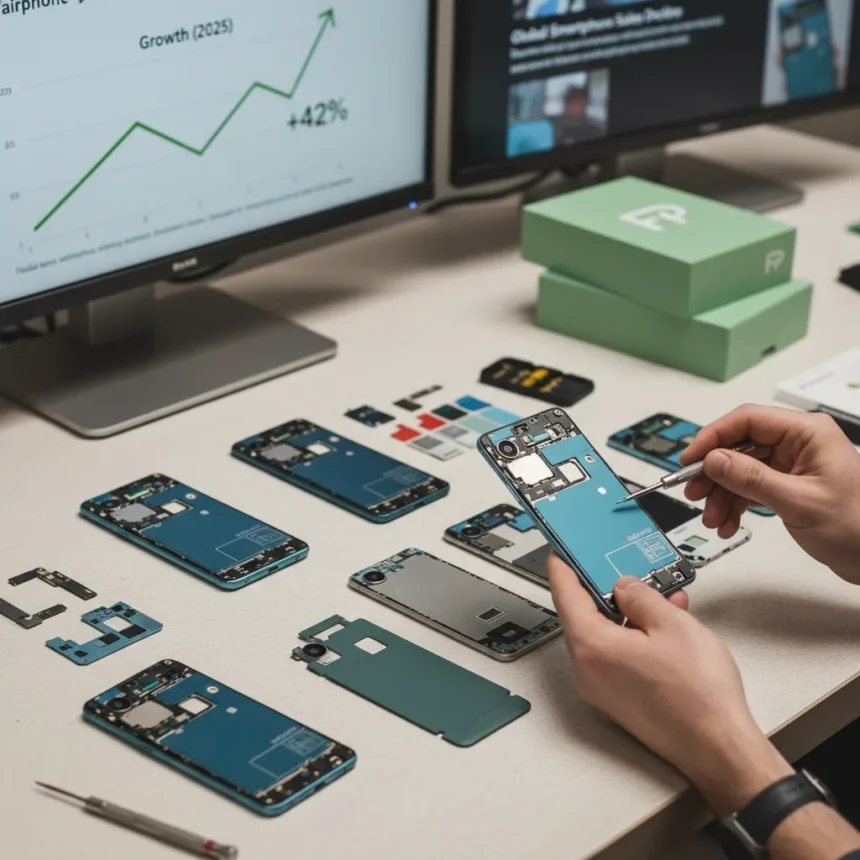
The repairable smartphone market is having its moment. While the global smartphone industry contracts and memory shortages force competitors to cut specs or raise prices, Fairphone shipped 145,259 units in 2025—a 42% jump from the previous year—proving that longevity and modularity can drive mainstream growth. The Dutch company’s 2025 performance stands as a direct rebuke to the throwaway-phone model that has dominated for two decades.
Key Takeaways
- Fairphone shipments grew 42% in 2025 to 145,259 units while global smartphone market shrank
- Revenue climbed 35% to €73.3 million; net losses halved to €1.9 million
- Q4 2025 sales jumped 83% year-over-year, signaling accelerating momentum
- 78% of Fairphone 6 buyers were first-time customers, expanding beyond early adopters
- US market entry and aggressive marketing investments fueled expansion across Europe and North America
Why the repairable smartphone market is finally breaking through
The repairable smartphone market has shifted from a niche concern to a genuine growth engine. Fairphone’s expansion directly contradicts the industry narrative that consumers only care about specs and price. Instead, rising costs and supply chain chaos have made device longevity a practical concern, not just an ethical one. When a memory shortage driven by AI demand pushes flagship prices higher, suddenly a phone designed to last five years and accept spare parts looks less like activism and more like common sense.
CFO Oscar Visser articulated the shift plainly: “The current supply chain pressures are forcing a reckoning in the electronics industry. For years, the business model has been built on frequent replacements. That is becoming an increasingly expensive and unsustainable proposition for consumers. Our growth is clear evidence that the market is ready for a different approach. Customers are choosing Fairphone because they want a well-supported, high-quality device that will last, proving that a commercially successful business can be built on a foundation of longevity and ethical values”. This is not marketing speak—Fairphone’s financials back it up. The company swung to positive operational cash flow of €5.5 million and achieved EBITDA positivity for the second consecutive year. The business model works.
Geographic expansion and first-time buyer momentum
Fairphone’s growth is not concentrated in a single market. Germany, the Netherlands, France, and the UK remain strongholds, but shipments to the Nordic region tripled in 2025. The real breakthrough came with US market entry, which opened an entirely new customer base at a critical moment when North American consumers are increasingly frustrated with repair restrictions and planned obsolescence.


The 78% first-time buyer rate for the Fairphone 6 signals that the brand has crossed from niche activist purchase to mainstream consideration. These are not people replacing a broken Fairphone 3—they are people choosing Fairphone over Samsung, Apple, or Google for the first time. That conversion matters. It means the repairable smartphone market is recruiting from the broader market, not just cannibalizing earlier Fairphone owners.
Audio products and ecosystem growth
Beyond phones, Fairphone’s ecosystem is accelerating. Sales of audio products—the Fairbuds XL and Fairbuds—surged 93% in 2025. This is significant because it shows customers are willing to build a Fairphone ecosystem, not just buy a single device. When audio products grow faster than phones, it signals genuine ecosystem loyalty and repeat purchasing behavior that most smartphone makers struggle to achieve.



The contrast with the broader market
The broader smartphone industry is in contraction mode. Memory shortages from the AI boom have squeezed supply and forced price adjustments or spec reductions across flagship lineups. Fairphone faced the same pressures but responded with a different strategy: invest in brand, marketing, and team expansion to capture share in a market suddenly receptive to longevity. While competitors tightened belts, Fairphone accelerated. The bet paid off immediately, with Q4 2025 sales jumping 83% year-over-year.
This is not a story about Fairphone winning because it is cheaper or more powerful. It is winning because it is solving a problem the industry created. As supply chains tighten and costs rise, the economics of throwaway phones flip. Fairphone is simply the first major brand to scale around the alternative.
What’s next for the repairable smartphone market
Fairphone is on track to exceed $500 million in total lifetime sales and pass 1 million devices sold since its founding. Neither milestone has been reached yet, but the trajectory is clear. If Q4 growth rates hold, the company will hit these targets within the next two years. More importantly, Fairphone’s success is validating a business model that competitors will eventually copy. Samsung, Google, and Apple have all announced repair-friendly initiatives in response to regulatory pressure and consumer demand. Fairphone is proving those initiatives can be profitable.
The repairable smartphone market will not displace the mainstream overnight. But 2025 was the year it stopped being a fringe concern and became a legitimate growth vector. Fairphone’s numbers prove it.



Is Fairphone profitable yet?
Not quite, but close. Fairphone’s net loss halved to €1.9 million in 2025, and the company achieved positive EBITDA and positive operational cash flow. The path to profitability is visible. At current growth rates, breakeven is likely within one or two years.
Which markets are driving Fairphone’s growth?
Germany, the Netherlands, France, and the UK remain Fairphone’s largest markets, but Nordic shipments tripled in 2025. US market entry in 2025 also contributed significantly to the expansion, opening a new geography with high consumer demand for repairable devices.
Why are audio products growing faster than phones?
Fairbuds XL and Fairbuds sales grew 93% in 2025, outpacing phone growth. This suggests customers who buy a Fairphone are building an ecosystem and purchasing complementary products, indicating strong brand loyalty and repeat purchase behavior beyond the initial device.
Fairphone’s 2025 results mark a turning point for the repairable smartphone market. It is no longer a niche concern—it is a growth story that challenges the entire industry’s assumptions about what consumers want. As supply chains tighten and costs rise, the economics of longevity flip in Fairphone’s favor. The company is not just selling phones; it is proving a different business model works.
Edited by the All Things Geek team.
Source: Android Central