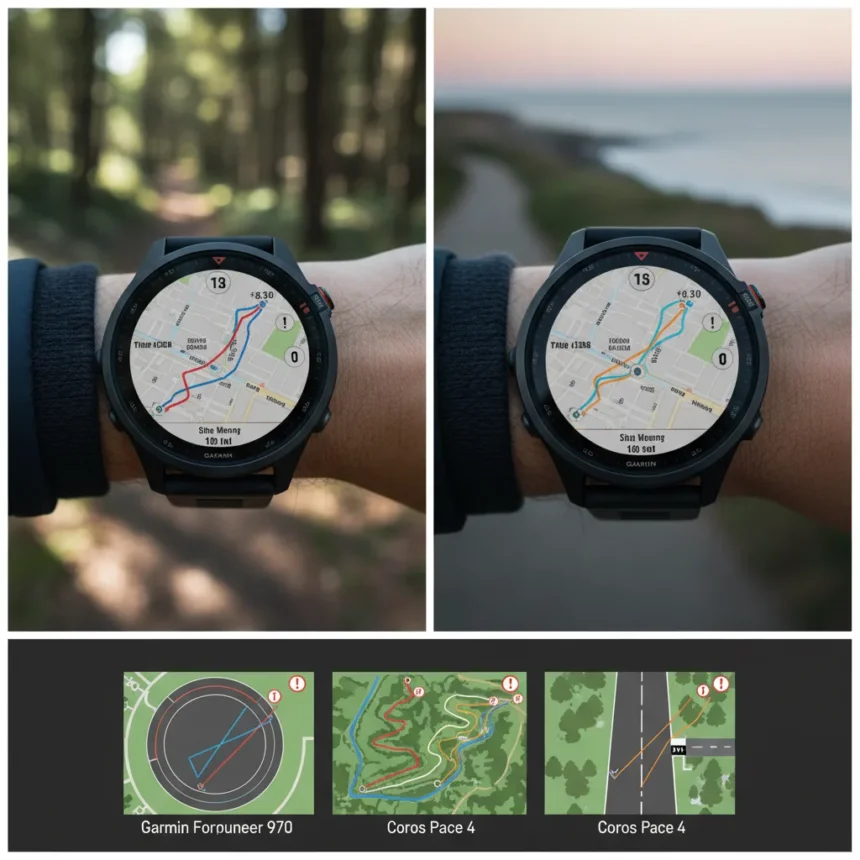
Garmin Forerunner 970 vs Coros Pace 4 GPS accuracy matters most when you are racing. Both watches claim multi-band GPS tracking, heart rate monitoring, and altitude measurement. But which one actually delivers the precision runners need when it counts? To find out, one reviewer wore both watches simultaneously through three competitive races, including the London Marathon itself, to measure real-world performance.
Key Takeaways
- Garmin Forerunner 970 includes ECG measurement; Coros Pace 4 does not
- Both watches nailed distance tracking in open countryside, logging exactly 13.1 miles on identical GPS routes
- Garmin Forerunner 970 predicted race times more accurately in a 10K test (off by 11 seconds vs 15 seconds)
- Coros Pace 4 offers treadmill correction for indoor runs; Garmin lacks this feature
- Coros Pace 4 costs significantly less while delivering comparable GPS and heart rate accuracy
Distance and Pace Tracking in Real Races
The most critical test for any running watch is distance accuracy. In a Brighton 10K race on a simple seafront course, Garmin Forerunner 970 logged the distance reliably, though it drifted wide at the turnaround point. Coros Pace 4 tracked similarly well on the same route. Both watches support multi-band GPS, which locks onto more satellite signals than single-band systems, reducing the drift that plagued older watches in tight urban turns.
In a Paris half marathon test, both watches logged exactly 21.13 kilometers (13.12 miles) against an official course distance of 21.1 kilometers (13.1 miles). Their GPS tracks were nearly identical, with only minor early quirks before settling into reliable tracking. Later, in the Pleshey Half Marathon run through open countryside, both watches again logged exactly 13.1 miles with flawless GPS precision. When the route is straightforward and satellite visibility is clear, Garmin Forerunner 970 vs Coros Pace 4 GPS accuracy becomes almost academic—both perform at the highest level.
Race Prediction Accuracy and Heart Rate Reliability
Where the watches diverge is in how they predict your race performance. Before the Paris half marathon, Coros Pace 4 predicted 1:09:12, while Garmin Forerunner 970 predicted 1:11:10. The actual race time fell between them, with Coros closer to the mark. After the race, both watches revised their predictions slightly, with Garmin settling on 1:08:42 and Coros on 1:09:03. This suggests Coros algorithms may weight recent performance data more aggressively, while Garmin takes a more conservative approach.


Heart rate accuracy is where the watches show their first meaningful gap. On both devices, heart rate readings aligned with what the wearer expected based on past chest strap data. However, Coros Pace 4 logged slightly more errors during the tests, including one unexplained spike early in the Paris half marathon. Garmin Forerunner 970 delivered more consistent wrist-based heart rate readings, though it also showed a late rise that diverged from expectations. For runners who demand maximum reliability, a chest strap remains the gold standard—both watches can be trusted for general effort zones, but neither is perfect.
Features That Set Them Apart
Garmin Forerunner 970 includes an ECG measurement tool, a feature absent on Coros Pace 4. This allows deeper cardiac health monitoring beyond simple heart rate. Garmin also offers more granular training analysis and deeper integration with fitness platforms. For serious athletes, these extras justify the premium price.



Coros Pace 4 counters with one clever advantage: a treadmill correction feature that adjusts indoor pace and distance data to match actual effort. Garmin Forerunner 970 lacks an equivalent tool, making Coros the better choice for runners who log significant indoor mileage. Coros also pairs an AMOLED screen with reliable indoor and outdoor tracking, delivering premium feel at an entry-level price point.
Which Watch Should You Buy?
For runners who demand the best overall sports watch, Garmin Forerunner 970 remains the stronger choice. Its ECG capability, superior training analysis, and slightly better heart rate consistency make it the premium pick. But if you train on a treadmill or prioritize value, Coros Pace 4 delivers impressive Garmin Forerunner 970 vs Coros Pace 4 GPS accuracy at a fraction of the cost. Both watches nailed distance tracking across three different race courses, proving that multi-band GPS has matured to the point where either watch will serve you reliably.
Does Garmin Forerunner 970 really track distance better than Coros Pace 4?
Not meaningfully. In real-world race conditions, both logged identical distances on half marathons and 10K courses. Garmin drifted slightly at one tight turnaround, but Coros showed no clear advantage. The difference is negligible for most runners.
Which watch is better for treadmill running?
Coros Pace 4 wins here. Its treadmill correction feature adjusts indoor pace and distance to reflect actual effort, a capability Garmin Forerunner 970 does not offer. If you run indoors regularly, Coros is the smarter buy.



Is the Garmin Forerunner 970 worth the extra cost over Coros Pace 4?
If you care about ECG monitoring, deeper training analytics, and maximum heart rate precision, yes. If you prioritize value and treadmill training, Coros Pace 4 delivers 90 percent of the performance at a lower price. Both are excellent watches—your priorities determine which is right for you.
The London Marathon test proved that the days of worrying about GPS accuracy are largely behind us. Both Garmin Forerunner 970 vs Coros Pace 4 GPS accuracy performed at a level that would have seemed impossible five years ago. The real choice now is whether you value premium features and deeper analytics, or whether you would rather save money and invest that difference in a better pair of running shoes.
Where to Buy
Garmin Forerunner 970: | Coros Pace 4:
Edited by the All Things Geek team.
Source: Tom's Guide