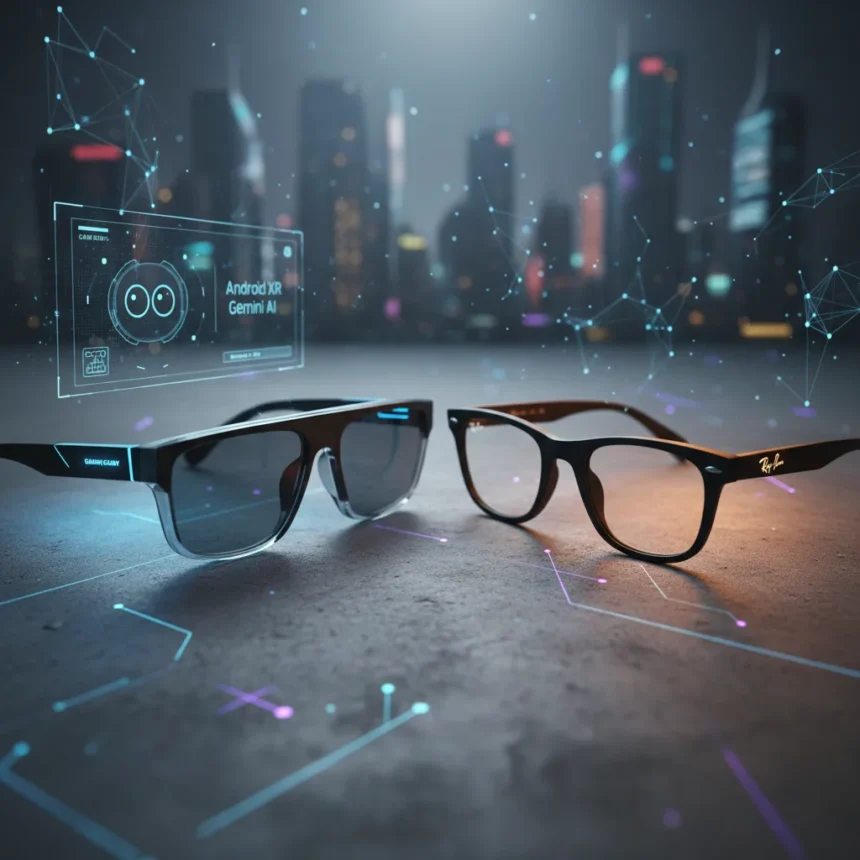
Samsung Galaxy Glasses are a pair of Android XR-powered smart glasses set to launch in 2026, directly competing with Meta Ray-Ban’s established smart glasses line. Leaked specifications reveal Samsung is pursuing at least two distinct models to capture different segments of the emerging smart glasses market, signaling a serious challenge to Ray-Ban Meta’s current dominance.
Key Takeaways
- Samsung Galaxy Glasses use Qualcomm Snapdragon AR1 processor and 12-megapixel Sony IMX681 camera, matching Ray-Ban Meta’s hardware approach
- Two models leak with different battery capacities: 155 mAh and 245 mAh, suggesting audio-only and AR display variants
- Android XR platform with Gemini 3 AI integration offers broader ecosystem access than Meta’s proprietary approach
- Samsung confirmed 2026 launch date, positioning Galaxy Glasses as a direct rival to Ray-Ban Meta Gen 2
- Display model battery capacity matches Ray-Ban Meta’s 248 mAh, targeting similar 6-hour usage window
Samsung Galaxy Glasses specs and processor details
The leaked Samsung Galaxy Glasses specifications include a Qualcomm Snapdragon AR1 processor paired with a 12-megapixel Sony IMX681 camera sensor with autofocus. These components mirror the technical foundation of Ray-Ban Meta smart glasses, suggesting Samsung is targeting hardware parity rather than outright innovation. The processor choice aligns with the AR-focused architecture needed for real-time AI processing directly on the device.
Two distinct battery configurations have surfaced in leaks: a 155 mAh model and a 245 mAh variant. The 245 mAh capacity closely matches Ray-Ban Meta Display glasses, which carry a 248 mAh battery rated for approximately 6 hours of use. This suggests Samsung’s larger model includes an integrated AR display, while the 155 mAh version likely functions as an audio-only device similar to non-display Ray-Ban models. Samsung’s dual-model strategy allows the company to test market demand across different use cases without committing to a single form factor.
How Samsung Galaxy Glasses challenge Ray-Ban Meta’s dominance
Ray-Ban Meta currently leads the smart glasses market with proven hardware and Meta’s social integration ecosystem. However, Samsung Galaxy Glasses leverage Android XR and Google’s Gemini 3 AI, offering a fundamentally different software foundation. While Ray-Ban Meta relies on Meta’s proprietary AI and social features, Samsung’s approach integrates the full Android ecosystem, potentially giving developers more flexibility and users broader compatibility with existing Android services.


The device requires a phone connection via Wi-Fi or Bluetooth, operating similarly to Ray-Ban Meta in terms of dependency on a companion smartphone. Both platforms function as extensions of the phone rather than standalone devices. The critical difference lies in ecosystem leverage: Samsung Galaxy Glasses users gain access to Google services and Gemini AI, whereas Ray-Ban Meta users are locked into Meta’s proprietary AI and social integrations. For users already embedded in Google’s ecosystem, Samsung’s approach may prove more appealing.
Samsung’s multi-model strategy also differs from Ray-Ban Meta’s more focused approach. By offering both audio-only and display variants, Samsung is hedging its bets on which form factor will win consumer acceptance. Ray-Ban Meta has committed primarily to a single design philosophy, giving Samsung flexibility to pivot if market feedback suggests audio-only glasses dominate initial demand.



When Samsung Galaxy Glasses launch and what to expect
Samsung has officially confirmed that Android XR smart glasses will launch in 2026, though exact timing within that window remains unspecified. This timeline places Samsung roughly two years behind Ray-Ban Meta’s current market presence, a significant gap that Meta will likely exploit with continued product refinement and user adoption. However, the 2026 launch also gives Samsung time to observe Ray-Ban Meta’s market performance and adjust its strategy accordingly.
The leaked specifications remain unconfirmed by Samsung, sourced from anonymous X user Jukanlosreve and Wellsen XR Research. Until Samsung officially unveils the Galaxy Glasses, treat these specs as educated speculation rather than guaranteed features. Design details remain absent from leaks, leaving questions about how Samsung will address the aesthetic awkwardness that plagues current AR display glasses like Ray-Ban Meta’s visible camera module.
Does Samsung Galaxy Glasses have display capabilities?
The 245 mAh battery capacity strongly suggests at least one Samsung Galaxy Glasses model includes an AR display, matching the battery profile of Ray-Ban Meta Display glasses. However, Samsung has not officially confirmed display specifications, and the leaked battery data remains unverified. An audio-only variant with a 155 mAh battery would compete directly with non-display Ray-Ban models, offering voice control and spatial audio without visual AR elements.
How does Samsung Galaxy Glasses compare to Meta Quest 3?
Samsung Galaxy Glasses and Meta Quest 3 serve different markets. Quest 3 is a dedicated mixed-reality headset designed for immersive gaming and spatial computing, while Galaxy Glasses are lightweight wearables intended for daily use like Ray-Ban Meta. Galaxy Glasses are not a headset replacement but rather a smartphone accessory, making them incomparable to Quest 3 on performance metrics. Samsung’s vision products will include glasses, Quest alternatives, and other XR devices, expanding competition across multiple form factors rather than directly challenging Quest 3’s immersive gaming focus.



Will Samsung Galaxy Glasses work with non-Samsung phones?
Samsung Galaxy Glasses run Android XR with Google services and Gemini 3 AI, suggesting broad Android compatibility rather than Samsung-exclusive pairing. The platform requires Wi-Fi or Bluetooth connection to a phone, but official confirmation of cross-brand support remains absent. Ray-Ban Meta works with both iOS and Android, setting a precedent for platform-agnostic smart glasses. Samsung’s Android XR foundation implies similar flexibility, but until Samsung officially announces compatibility, assume the device will prioritize Samsung Galaxy phones at launch.
Samsung Galaxy Glasses represent a calculated entry into the smart glasses market at a moment when Ray-Ban Meta has already proven consumer demand exists. The leaked dual-model strategy, Android XR integration, and 2026 launch timeline suggest Samsung is playing a long game—observing Ray-Ban Meta’s successes and failures before committing to a full product line. Whether that caution translates to market success depends on execution, design refinement, and whether Gemini AI can deliver compelling advantages over Meta’s proprietary approach. For now, Ray-Ban Meta remains the smart glasses standard, but Samsung’s arrival will force the category to mature faster.
Edited by the All Things Geek team.
Source: Android Central