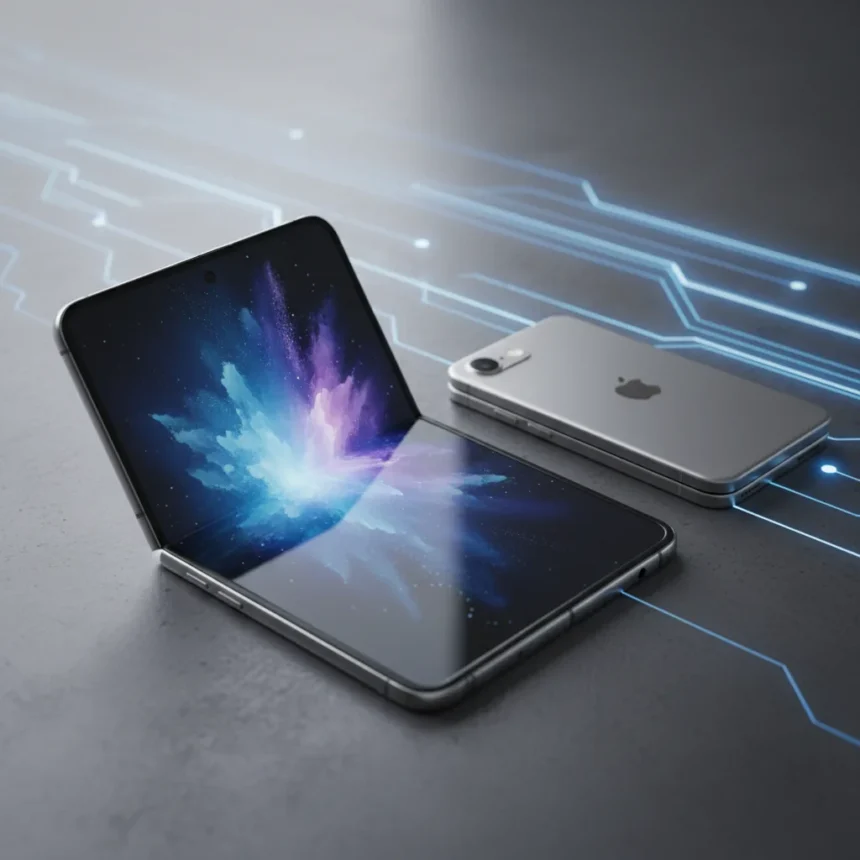
The Galaxy Z Fold 8 Wide is Samsung’s boldest foldable design yet—a dramatically wider, squarer unfolded form that flips the script on what foldables should look like when opened. Launching alongside the standard Z Fold 8 in July 2026, the Wide variant measures 4.87 x 6.35 inches unfolded, compared to the Z Fold 8’s taller 6.2 x 5.63-inch profile. This near-square aspect ratio mirrors the Google Pixel Fold and positions Samsung directly against Apple’s iPhone Fold, expected later in 2026.
Key Takeaways
- Galaxy Z Fold 8 Wide unfolds to a squarer 4.87 x 6.35-inch form, versus the standard Z Fold 8’s taller 6.2 x 5.63-inch display
- Both variants feature ~20% crease reduction via laser drilling, dual ultra-thin glass, and Foreign Material Detection debris alerts
- Z Fold Wide inner screen is 7.6 inches; Z Fold 8 standard is 8 inches—same 120Hz refresh rates
- Refined hinge, thinner body, and bigger vapor chamber cooling arrive on both models
- July 2026 launch expected with One UI 9 firmware
Galaxy Z Fold 8 Wide: Wider doesn’t mean bigger
The Galaxy Z Fold 8 Wide trades the Z Fold 8’s familiar tall silhouette for something radically different—a compact, nearly square footprint that feels less like a phone and more like a tablet when unfolded. Folded, the Wide variant is 4.87 x 3.23 x 0.38 inches, making it noticeably wider but shorter than the standard Z Fold 8. This design choice isn’t arbitrary. Samsung is clearly betting that users want the tablet-like experience of foldables without the elongated, phone-like proportions that have defined the Z Fold line since its debut.
The cover displays reflect this philosophy. The Z Fold Wide’s 5.4-inch outer screen is smaller and wider than the Z Fold 8’s 6.5-inch cover display, optimized for the squarer unfolded form. It’s a deliberate divergence—the Wide variant isn’t an incremental tweak but a fundamental rethinking of foldable proportions. For users who found the Z Fold 7 too tall and narrow when unfolded, this is the answer.
Crease reduction and durability: the real upgrade
Both the Z Fold 8 and Z Fold 8 Wide inherit Samsung’s most aggressive crease-fighting tactics yet. Laser-drilled microperforations and softer adhesives combine with dual ultra-thin glass (UTG) and optimized lamination to reduce crease visibility by approximately 20%. That’s not a magic fix—the crease will still exist—but it’s a meaningful step toward the seamless displays consumers have demanded since foldables launched.


More practical is Foreign Material Detection, a feature borrowed from Samsung’s Z Trifold concept. If debris gets caught while the device folds, the phone vibrates and alerts the user, potentially preventing costly hinge damage. It’s the kind of defensive tech that addresses real-world foldable anxiety—the fear that dust or hair will destroy the mechanism. Both variants also get a refined hinge that Samsung claims is smoother and stronger, paired with a larger vapor chamber for thermal management.
How Galaxy Z Fold 8 Wide compares to other foldables
The Galaxy Z Fold 8 Wide’s wider unfolded profile directly mirrors the Google Pixel Fold, which launched in 2023 with a similarly square-ish design. This isn’t coincidence. Google proved there’s an audience for foldables that feel more like tablets than phones. Samsung is following that blueprint while adding its own crease-reduction tech and hinge refinements. The standard Z Fold 8, by contrast, maintains the Z Fold 7’s familiar tall proportions, making it the conservative choice for users who’ve grown comfortable with the existing form factor.



Apple’s iPhone Fold, expected in late 2026, will likely target a similar wider audience as the Z Fold Wide. Samsung’s dual-variant strategy—one familiar, one radical—gives it coverage across both camps. If Apple launches only a single iPhone Fold design, Samsung’s flexibility becomes a competitive advantage.
Display specs and materials: where they differ
The Z Fold 8’s 8-inch inner display uses Dynamic AMOLED 2X technology with 120Hz refresh and 2600 nits peak brightness, protected by Gorilla Glass Ceramic 2. The Z Fold Wide’s 7.6-inch inner screen matches the refresh rate but trades diagonal inches for width—better for landscape content and multitasking on a wider canvas. Both outer displays run at 120Hz AMOLED. There’s no confirmed difference in OLED material generation between the two variants, though the Z Fold 8’s display may use older M13 material compared to newer options.
What’s staying the same, and what’s changing
The Z Fold 8 silhouette is deliberately familiar—it mirrors the Z Fold 7 in size and design, signaling that Samsung isn’t abandoning the tall-phone aesthetic that early adopters know. The real upgrades live inside: thinner overall body, lighter weight, better cooling, and crease reduction. The Z Fold Wide is the experimental sibling, proving Samsung isn’t afraid to reimagine what a foldable should be.
When will Galaxy Z Fold 8 and Z Fold Wide launch?
Both variants are expected to debut at Samsung’s July 2026 Unpacked event, shipping with One UI 9 firmware. Pricing and exact regional availability remain unconfirmed, though Samsung typically launches flagships globally across major markets.



Is the Galaxy Z Fold 8 Wide the better foldable?
That depends on your hands and habits. The Z Fold Wide’s squarer form is better for tablet-style use, media consumption, and gaming on a wider canvas. The standard Z Fold 8 is better if you want a foldable that still feels like a phone when folded and unfolded. Neither is objectively superior—they’re designed for different users.
Does the Galaxy Z Fold 8 Wide have a crease?
Yes. Samsung’s ~20% crease reduction is meaningful but not invisible. The crease is less pronounced than on older foldables, but it remains visible under direct light and tactile when swiping across it.
Samsung’s dual-variant strategy for 2026 is clever—it hedges against the uncertainty of what consumers actually want in a foldable form factor. The Z Fold 8 Wide isn’t a gimmick; it’s a genuine alternative to the tall-phone aesthetic that’s dominated foldables since day one. Whether it becomes the mainstream choice or remains a niche option depends on how Apple’s iPhone Fold performs and whether users are ready to embrace wider, squarer foldables as their primary devices.
Where to Buy
Edited by the All Things Geek team.
Source: T3