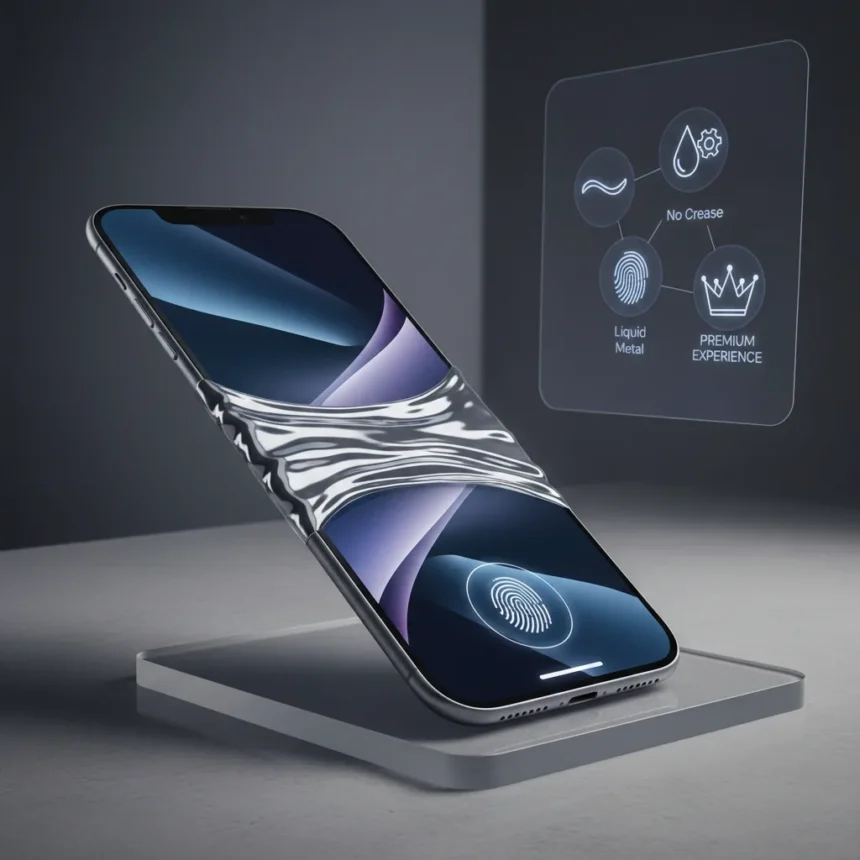
The iPhone Fold selling points are shaping up to be a masterclass in premium hardware engineering, if the rumors are accurate. Apple’s first foldable iPhone will reportedly arrive in 2026 with four key features designed to outpace Samsung and Google’s existing offerings: a nearly invisible crease, a titanium frame thin enough to feel like a regular iPhone, a liquid metal hinge rated for 1 million folds, and Touch ID authentication replacing Face ID. Bloomberg reporter Mark Gurman calls it the “most significant overhaul in the iPhone’s history”—a bold claim that suggests Apple isn’t just entering the foldable market; it’s redefining it.
Key Takeaways
- iPhone Fold uses a book-style 4:3 aspect ratio (iPad-like) with ~5.5-inch outer and ~7.8-inch inner displays, differing from taller rival foldables
- Nearly invisible crease (under 0.15mm depth, under 2.5-degree angle) uses Samsung custom OLED with integrated touch sensors and structural glass mid-frame
- Liquid metal hinge rated for ~1 million folds—double the durability of current foldables—with titanium/aluminum frame weighing less than competitors
- Touch ID side button replaces Face ID due to thinness constraints (9-9.5mm folded, 4.5-4.8mm open), with no room for TrueDepth camera
- Expected 2026 launch with A20 Pro chip, 12GB RAM, up to 1TB storage, and iOS 27 optimized for foldable multitasking
The iPhone Fold’s Design Bets on Invisibility
Apple’s obsession with the crease—or rather, its elimination—separates the iPhone Fold selling points from every foldable currently on the market. The display crease is the most visible flaw in Samsung’s Galaxy Z Fold and Google’s Pixel Fold, a constant reminder that you’re using hardware engineering compromise rather than seamless glass. Apple’s approach uses a custom Samsung OLED panel with integrated touch sensors and a structural glass mid-frame that reportedly keeps the crease depth under 0.15mm and the fold angle under 2.5 degrees. That’s not invisible—but it’s close enough to feel like a different product category.
The 4:3 aspect ratio is unconventional. Most foldables open like a tall phone; the iPhone Fold opens like an iPad. This wider-than-tall design creates more usable screen real estate for apps designed around landscape orientation, which matters for productivity and gaming. It’s a deliberate departure from the tall-foldable norm, betting that users prefer an iPad-like form factor over a phone-shaped screen that simply doubles in size.
Durability Where It Counts: The Liquid Metal Hinge
The hinge is where durability becomes a competitive advantage. Apple’s rumored liquid metal hinge—made from amorphous metallic glass—is rated for approximately 1 million folds. That’s roughly double what current Galaxy Z Folds and Pixel Folds endure before reliability degrades. A titanium and aluminum frame keeps the device thin (9-9.5mm closed, 4.5-4.8mm open) without sacrificing structural rigidity, which is the engineering challenge every foldable maker faces.


This thickness matters psychologically. If the iPhone Fold closes to 9-9.5mm, it feels more like a regular iPhone 15 Pro than a brick. Samsung’s Galaxy Z Fold 6 is noticeably thicker when folded, a constant tactile reminder that you’re carrying specialized hardware. Apple’s bet is that thinness equals acceptability—that a foldable thin enough to fit in a pocket without bulge will finally convince mainstream users to upgrade.
Authentication Without Face ID: Why Touch ID Returns
The absence of Face ID is not a downgrade; it’s a consequence of prioritizing thinness. Apple cannot fit a TrueDepth camera system into a 9-9.5mm closed device, so Touch ID on the side button (power button integration) becomes the authentication method. This is a pragmatic compromise that also sidesteps the privacy concerns some users have about facial recognition.



Touch ID is faster than Face ID when your phone is already in your hand, and it works even when the device is partially folded—a use case that Face ID cannot handle. For a foldable designed to multitask with the screen half-open, Touch ID is arguably the smarter choice.
Camera Setup and Specs: The Remaining Questions
The iPhone Fold selling points don’t stop at hardware. The device reportedly uses the next-generation A20 Pro chip, 12GB of RAM, and up to 1TB of storage. The battery capacity is estimated at 5,000–5,500mAh, larger than a standard iPhone but smaller than some Android foldables, which reflects the thinness constraint. iOS 27 will be optimized for foldable multitasking, with split-screen and app continuity features.
Camera details remain murky. Reports mention two rear cameras (main and either ultra-wide or telephoto) and front-facing cameras on both the outer and inner displays, though the exact count varies across sources. Apple will likely prioritize computational photography over raw sensor count, which is consistent with iPhone tradition.
One notable omission: no SIM tray. The iPhone Fold will rely on eSIMs only, which is increasingly standard but still a point of friction in regions where physical SIM support matters.



Self-Healing Glass: A Practical Addition
Apple’s rumored self-healing glass or display coating can repair minor scratches and stress marks automatically. This is less about magic and more about practical durability—foldable screens are prone to micro-scratches from dust and pocket debris. A coating that gradually heals these imperfections extends the visible lifespan of the display, addressing one of the biggest user complaints about current foldables.
How the iPhone Fold Compares to Existing Foldables
Samsung’s Galaxy Z Fold 6 remains the market leader in foldable phones, but it suffers from a visible crease, thicker closed profile, and a taller aspect ratio that feels less iPad-like and more like a phone that opens vertically. Google’s Pixel Fold is lighter but has thicker bezels and less refined hinge engineering. The iPhone Fold selling points are designed to address every weakness: the crease is nearly invisible, the hinge is rated for twice as many folds, the frame is thinner, and the 4:3 ratio is uniquely suited to Apple’s ecosystem of apps and services.
This is not a me-too product. It’s a deliberate architectural choice that sacrifices nothing essential (Face ID is replaced, not removed; the camera system is focused, not limited) while addressing the category’s fundamental flaw—the crease.
When Will the iPhone Fold Actually Arrive?
Apple is laying the foundation in 2025, with a 2026 launch expected. That timeline means the device is real enough to be in advanced prototyping but far enough away that specs could still shift. Gurman notes that “2025 won’t be a revolutionary year for the iPhone. But it will lay the foundation for major shifts in 2026 and 2027, making it an exciting time for iPhone fans”. The iPhone Fold is the payoff to that patience.
What About Price?
No verified pricing has been announced. Samsung’s Galaxy Z Fold 6 starts around $1,899, and the iPhone Fold will likely position itself in that premium tier or higher, given the engineering investment. Apple’s willingness to charge a premium for foldable innovation is well-established, so expect a flagship price tag.
Is the iPhone Fold worth waiting for?
If you’re a current foldable user frustrated by the crease or durability concerns, the iPhone Fold’s focus on invisible creases and a 1-million-fold hinge is worth the wait. If you’re an iPhone user curious about foldables, the 4:3 ratio and iOS 27 optimization mean the device will feel native to Apple’s ecosystem rather than a novelty.
Will the iPhone Fold support stylus input like the iPad?
Reports suggest Apple may skip stylus support for the iPhone Fold, keeping it distinct from iPad Pro. This is consistent with Apple’s strategy of maintaining product boundaries—the Fold is a phone first, iPad-shaped second.
How does the A20 Pro compare to current iPhone chips?
The A20 Pro is the next-generation flagship chip, but exact performance metrics are not yet available. Given the pattern of annual Apple chip improvements, expect significant gains in multi-threaded performance and AI-driven features.
The iPhone Fold selling points represent Apple’s clearest statement yet about where foldables belong in the smartphone market: not as experimental novelties, but as premium devices engineered for real durability and everyday use. If the rumors hold, 2026 will finally answer the question that Samsung and Google have been wrestling with since 2020—can a foldable phone feel as polished and essential as a standard smartphone? Apple is betting yes, and the engineering details suggest the company might actually be right.
Edited by the All Things Geek team.
Source: Tom's Guide