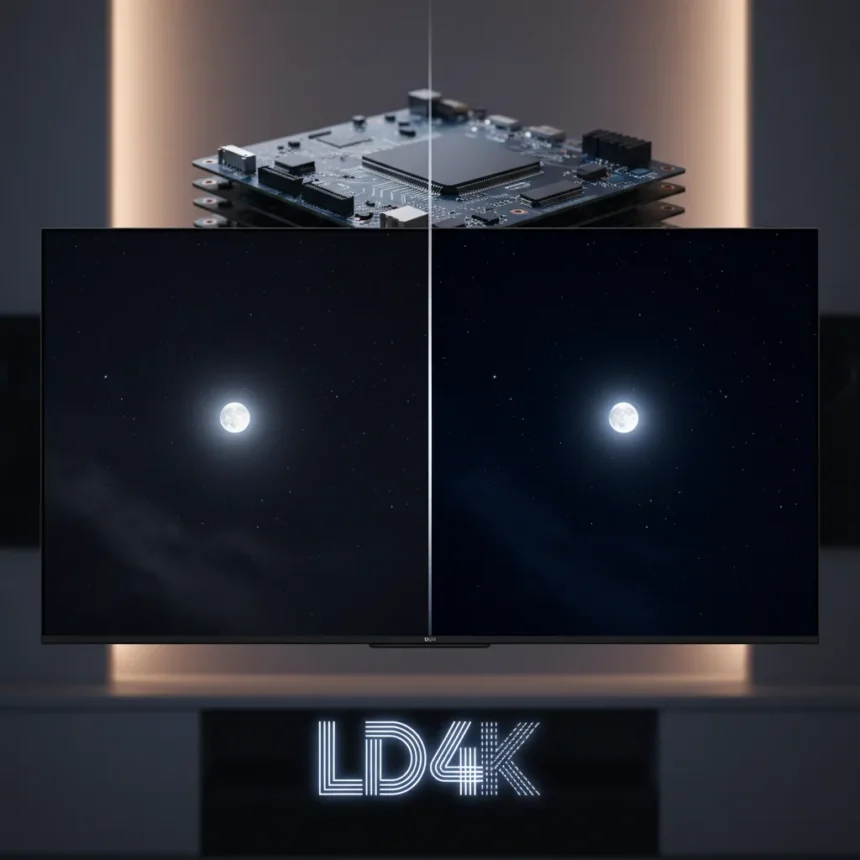
Local dimming cheap TV shopping is where most budget-conscious buyers go wrong. They chase 4K resolution and ignore the one hardware feature that actually transforms picture quality: local dimming, a technology that dynamically adjusts contrast by controlling LED zones across the screen. Without it, even a 4K TV looks flat and dull.
Key Takeaways
- Local dimming controls LED zones independently, delivering dramatically better contrast and HDR impact than edge-lit panels.
- Mini-LED TVs under $500 now offer local dimming with full HDR support, making premium contrast accessible on a budget.
- 4K resolution alone does not guarantee good picture quality; color accuracy and brightness matter equally.
- Avoid edge-lit panels in the sub-$500 range; seek full array LED or Mini-LED backlighting instead.
- Budget TVs over 40 inches should have at least 3-4 HDMI ports and support for HDR10, HDR10+, and Dolby Vision.
Why Local Dimming Beats Resolution on Budget TVs
Resolution is just one dimension of picture quality. A 4K TV with poor contrast control produces lifeless images, even if every pixel is technically present. Local dimming hardware solves this by allowing the TV to adjust brightness independently across different zones of the screen, preserving near-black detail while keeping highlights punchy. This is essential for HDR content, which demands both deep shadows and bright highlights in the same frame.
The problem with cheap TVs is that manufacturers often cut corners on backlighting. Edge-lit panels, which place LEDs only around the screen’s perimeter, create blooming and halo effects around bright objects on dark backgrounds. Full array LED backlighting with local dimming zones costs more to manufacture but delivers the contrast control that makes HDR actually look impressive. For TVs larger than 40 inches, this is non-negotiable.
Budget Mini-LED TVs like the TCL QM6K Series QLED demonstrate that local dimming no longer requires a premium price tag. This 2025 model uses tiny backlights for granular contrast control and supports the full range of HDR formats—HDR10, HDR10+, HLG, and Dolby Vision—all for under $500. That was impossible just two years ago.



The Real Cost of Skipping Local Dimming
Cheap TVs that lack local dimming often skimp on color gamut and brightness as well, creating a triple blow to picture quality. You get sharp pixels but a washed-out, colorless image. A 4K resolution cannot fix that. Reviewers who have tested TVs for a decade consistently refuse to buy sets without local dimming because the difference is immediately visible in any HDR content.
The alternative—edge-lit backlighting—saves manufacturers just enough money to undercut the competition by $50 to $100, but the picture quality gap is enormous. When shopping in the sub-$500 range, this trade-off is a trap. Seek TVs labeled with “full array LED,” “backlighting,” or “local dimming” explicitly. If the spec sheet does not mention one of these terms, the TV is probably edge-lit.



What Else Matters on a Budget TV
Once you have confirmed local dimming, verify the rest of the spec sheet. Confirm the TV actually supports 4K resolution—labeled as “4K” or “UHD”—to avoid accidentally buying a 1080p or 720p set. Check for at least 3-4 HDMI ports; cheap TVs sometimes ship with only 2-3, which limits flexibility if you own multiple devices.
For gaming, aim for a refresh rate of at least 60Hz and input lag below 20 milliseconds. A 120Hz panel is ideal if you own a PlayStation 5 or Xbox Series X, but it is not essential for budget shoppers who primarily watch streaming content. HDR support matters more than refresh rate for non-gamers; confirm the TV supports HDR10, HDR10+, and ideally Dolby Vision to unlock the full potential of modern streaming services.
Reputable brands with solid warranties are worth the slight premium over no-name alternatives. A one-year warranty is standard across budget TVs, and many credit cards extend that coverage for free.
Budget Mini-LED vs. Standard LED: The Contrast Difference
Mini-LED backlighting offers improved brightness and contrast with less blooming than standard full array LED. The difference is visible in dark scenes with bright elements—a starfield, a campfire, a neon sign. With standard LED local dimming, the glow spreads slightly beyond the bright object. With Mini-LED, the control is tighter, the image cleaner. For under $500, this is a luxury that was reserved for $1500+ TVs five years ago.



The TCL QM6K and Roku Plus Series 4K QLED represent the new budget standard. Both deliver local dimming with strong HDR performance and high brightness levels. The Hisense U6H offers similar quality at a slightly lower price point, though it lacks HDMI 2.1 support for next-gen gaming. All three are vastly superior to edge-lit budget sets from just a generation ago.
Common Mistakes Budget Shoppers Make
Prioritizing screen size over picture quality is the first mistake. A 75-inch TV with edge-lit backlighting looks worse than a 65-inch TV with local dimming, even though the bigger set costs less. Second, ignoring HDR support. If a TV does not explicitly list HDR format support, it cannot properly display HDR content, making the feature useless on your streaming apps. Third, buying extended warranties. The one-year manufacturer warranty is sufficient for most users, and credit card protection often extends coverage at no cost.
What Budget TVs Still Cannot Do
Even the best budget Mini-LED TVs do not match class-leading OLED or premium QLED models in color accuracy, upscaling quality, or motion handling. That is not a flaw—it is a price trade-off. What matters is that local dimming closes the gap on the most visible aspect of picture quality: contrast. You get punchy HDR, deep blacks, and bright highlights without paying premium prices.
Should I buy a budget TV without local dimming if it has 4K resolution?
No. A 4K TV without local dimming will disappoint you immediately. Resolution is invisible to the human eye at normal viewing distances; contrast and color are not. Spend the extra $100-150 to get local dimming and accept a slightly smaller screen size if necessary.
Do all cheap 4K TVs support HDR?
No. Confirm the TV explicitly lists HDR10, HDR10+, or Dolby Vision support before buying. Some budget sets include HDR labeling but lack the brightness or contrast control to actually display HDR content properly.
Is Mini-LED worth buying over standard LED local dimming?
If your budget allows, yes. Mini-LED delivers tighter contrast control and less blooming, making bright objects on dark backgrounds look sharper and more defined. The difference is noticeable in dark scenes and is worth the modest price premium.
Local dimming is the feature that separates a usable budget TV from a disappointing one. It transforms HDR from a marketing buzzword into an actual visual improvement. When you are shopping for a cheap TV, do not let 4K resolution distract you from this hardware fundamental. Get the local dimming, and your picture will look dramatically better than any edge-lit competitor at the same price.
Where to Buy
65-inch Hisense U65QF is $548 at Amazon | Hisense 75" U65QF 4K Mini-LED TV: | $548 @ Amazon
Edited by the All Things Geek team.
Source: Tom's Guide