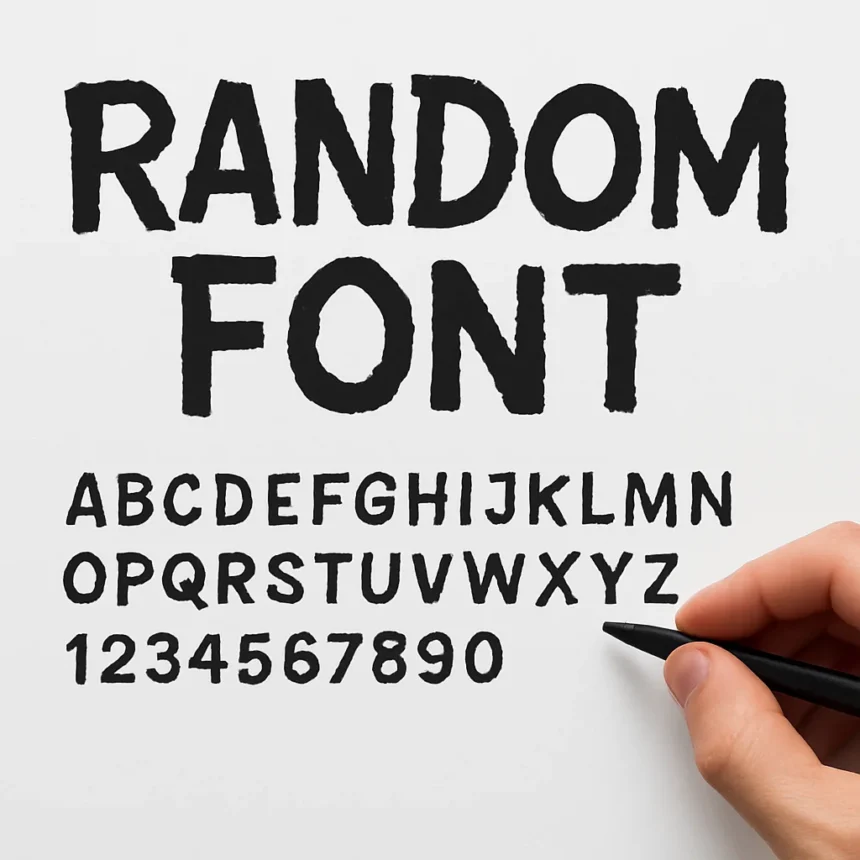
Random Font is a free experimental typeface created by type designer Tim Holman, released in 2024 and available as an open-source download via GitHub, with no regional restrictions and no license fees. It generates over 100 randomized variants per letter from a library of more than 10,000 total glyph variations, ensuring that no two instances of typed text ever look the same. It’s been described by designer Nick Saporito as “Comic Sans on steroids — equal parts hilarious and horrifying”.
TL;DR: Random Font is a free, open-source typeface by Tim Holman that pulls from a library of 10,000+ glyph variants to make every line of text look uniquely unhinged. It’s built for headlines, posters, and memes — not body copy — and you can download it free from GitHub right now.
What is Random Font and who made it?
Random Font is an experimental typeface designed by Tim Holman, also known as @twholman on social media, who specializes in pushing typography into territory most designers wouldn’t dare enter. Released in 2024, it supports the Latin character set — A-Z, a-z, 0-9, and basic punctuation — and is available free via its GitHub repository. No extended language support is currently mentioned.
Holman’s stated goal was simple and completely unhinged: build a font where no two letters are ever the same. “I wanted a font where no two letters are ever the same,” he said. “It’s like Comic Sans got lost in a funhouse mirror.” That’s not a design brief most studios would greenlight, which is exactly why it went viral across design communities on Twitter/X and Dribbble shortly after launch.

The font draws inspiration from Comic Sans, graffiti lettering, and glitch art — three aesthetic traditions that share exactly one thing: a complete disregard for typographic convention. The result is a typeface that feels simultaneously handmade, broken, and strangely alive.
How does Random Font actually work?
Random Font works by storing over 10,000 total glyph variants across its supported character set, with each individual letter carrying 100 or more distinct drawn forms. Every time text is rendered, the font pulls randomly from this library, meaning the word “hello” looks different every single time you type it. That’s not a bug — it’s the entire point.



In practice, installing it follows a familiar workflow: download the ZIP from the GitHub repository, install via your system’s font manager (Font Book on Mac, for instance), then open your design application of choice. Nick Saporito tested it in both Adobe Illustrator and Figma, noting that the font’s complexity causes rendering issues in some applications — a direct consequence of the sheer number of variants the system has to handle. If your app supports variable font axes, you can also adjust a random seed parameter for a degree of controlled chaos rather than pure randomness.
Pairing it with a clean sans-serif like Helvetica is the practical move for any layout where the font is used as a display element. The contrast between Random Font’s chaos and a neutral typeface’s order is, frankly, the whole aesthetic.
How does Random Font compare to Comic Sans and variable fonts?
Random Font sits at the extreme end of a spectrum that starts with Comic Sans. Vincent Connare’s 1994 design was controversial for its informality and irregular letterforms — but every instance of Comic Sans looks identical. Random Font amplifies that irregularity by a factor of roughly 100, making each render a genuinely new typographic event. The comparison is useful precisely because Comic Sans is the cultural shorthand for “font people love to hate,” and Random Font deliberately leans into that legacy while detonating it.
Variable fonts like Google’s Recursive offer controlled axes — weight, width, slant — that give designers predictable, parametric control over type appearance. Random Font borrows the variable font architecture but inverts its purpose entirely. Where Recursive is a precision instrument, Random Font is a blender with the lid off. Glitch-adjacent typefaces like Nuran and Hydra occupy similar experimental territory but with far less raw randomness baked into the system. Random Font’s 10,000+ variant library is genuinely unprecedented in scope, even if the “world’s most random font” claim lacks any formal verification.



House Industries’ Chalet and Seb Lester’s Soho represent the other end of the spectrum — typefaces with elaborate backstories, structured systems, and serious craft credentials. Random Font has none of that. Its credibility comes entirely from viral social proof and the sheer audacity of the concept.
What is Random Font actually good for?
Random Font is built for contexts where legibility is secondary to visual impact. Headlines, posters, memes, and experimental web graphics are its natural habitat. Saporito’s own tests confirm what the design makes obvious: it’s mostly unusable for body text. Asking someone to read three paragraphs in Random Font is an act of aggression. Using it for a single-word poster headline? That’s a legitimate creative choice.
The font has reportedly found use in indie game titles and advertising contexts where an unhinged visual register is the brief. Its free, open-source status means there’s no barrier to experimentation — designers can pull it from GitHub, test it in ten minutes, and decide for themselves whether chaos is the right call for a given project. An anonymous designer comment circulating alongside the font’s viral spread put it cleanly: “This is the font for when you want to say ‘I don’t care about readability’ but make it art.”
Is Random Font actually free to download?
Yes. Random Font is fully open-source with no license fees, available for direct download from Tim Holman’s GitHub repository at github.com/twholman/random-font. There are no regional restrictions — it’s accessible worldwide. The project was still receiving active updates based on community feedback as of the article’s publication date.
Can Random Font be used in professional design work?
It can, but with clear-eyed expectations. The font’s complexity causes rendering issues in some applications, as Saporito noted during testing in Illustrator and Figma. For display use — a poster headline, a meme, an experimental web graphic — it holds up. For anything requiring consistent, reproducible output across print and digital formats, the unpredictability that makes it interesting also makes it unreliable. Pair it with a stable typeface and treat it as a visual accent, not a workhorse.
Does Random Font support languages other than English?
Based on available information, Random Font supports the Latin character set only — A-Z, a-z, 0-9, and basic punctuation. No extended language support has been mentioned. For designers working in non-Latin scripts or requiring diacritical marks for European languages, Random Font is not currently the answer.
Random Font won’t replace any typeface in a serious design system, and Tim Holman almost certainly knows that. What it does is more interesting: it asks whether a font can be a provocation rather than a tool, a joke that’s also genuinely technically ambitious. With 10,000+ glyph variants, a free GitHub release, and a viral reception that no marketing budget could manufacture, the answer appears to be yes. If you’ve ever wanted Comic Sans energy with a glitch-art nervous breakdown layered on top, this is the only typeface worth installing this year.
Edited by the All Things Geek team.
Source: Creativebloq