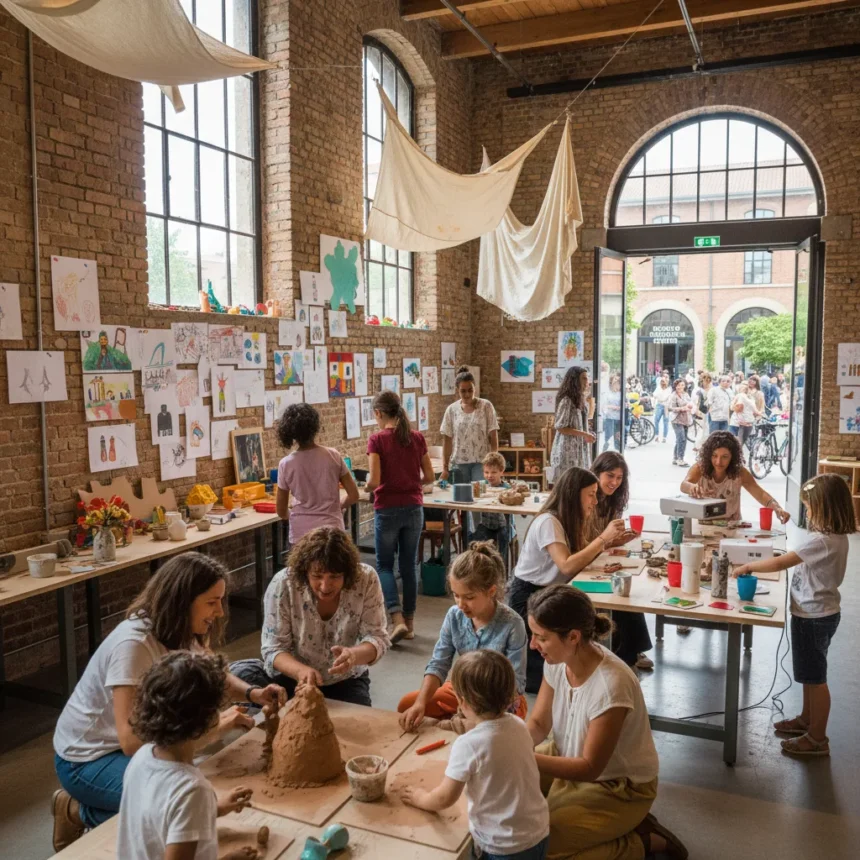
Reggio Emilia art education represents a philosophy where art and learning belong to the entire community, not just institutions or elites. The Italian city’s approach to connecting cultural life with civic engagement has drawn attention from visitors with vastly different interests—from artists seeking inspiration to educators studying child development. What unites these visitors is a discovery that Reggio Emilia’s model challenges how most of the world thinks about who art and education are for.
Key Takeaways
- Reggio Emilia art education integrates public spaces, civic participation, and community involvement into learning and cultural life
- The city’s philosophy emphasizes accessibility, positioning art as a shared civic resource rather than an elite pursuit
- The Reggio Emilia Approach, an influential early-childhood educational framework, underpins the city’s broader cultural identity
- Recent high-profile visits have renewed global interest in how the city connects art, education, and community engagement
- The model contrasts sharply with traditional approaches that separate art institutions from everyday civic life
How Reggio Emilia Art Education Differs From Traditional Models
Most cities separate art from education, placing museums in designated districts and schools in residential neighborhoods. Reggio Emilia inverts this logic. The city’s philosophy treats art and learning as integral to public life—embedded in streets, squares, and community spaces where citizens naturally gather. This is not art confined to opening hours or educational theory locked in classrooms. Instead, Reggio Emilia art education weaves both into the fabric of how people live together.
The traditional model assumes art requires expertise to appreciate and education requires formal institutions to deliver. Reggio Emilia rejects both assumptions. Public engagement with art happens organically because the city has designed spaces and cultural practices that invite participation without gatekeeping. Visitors report discovering artworks in unexpected places—not because they stumbled upon hidden gems, but because the city intentionally makes art visible and accessible to ordinary daily life.
This approach extends to how children learn. Rather than confining early education to schoolrooms, the Reggio Emilia Approach—the city’s influential educational philosophy—treats the entire community as a learning environment. Parents, artists, educators, and residents all participate in how children develop, understand their surroundings, and engage with culture.

The Reggio Emilia Approach and Its Global Influence
The Reggio Emilia Approach is not a rigid curriculum but a framework built on the belief that children learn through exploration, collaboration, and engagement with their environment. Educators and parents worldwide study this methodology because it produces measurable outcomes in how children think, create, and relate to others. The philosophy has influenced early-childhood programs across Europe, North America, and beyond.
What makes the approach distinctive is its integration with civic life. Schools in Reggio Emilia do not exist in isolation—they are community hubs where art, learning, and social participation overlap. This design reflects a broader belief: education is not something schools do to children but something communities do together. The city’s commitment to this philosophy has made it a pilgrimage site for educators, parents, and researchers seeking alternatives to standardized, test-driven models.



High-profile visitors, including those focused on early childhood development and educational innovation, have traveled to Reggio Emilia specifically to understand how the city implements these principles at scale. Their visits signal that the model is not theoretical—it works in practice, shapes how an entire city functions, and produces tangible results in how residents engage with culture and learning.
Why Reggio Emilia Art Education Attracts Diverse Visitors
The city appeals to artists seeking cultural inspiration, educators studying pedagogical alternatives, and parents looking for different approaches to child development. Each group arrives with different questions but discovers the same core insight: Reggio Emilia proves that art and education thrive when they serve the public good rather than elite interests.
For artists, the city offers proof that communities can sustain vibrant cultural life without relying on blockbuster exhibitions or tourism-driven markets. For educators, it demonstrates that learning improves when children have agency, when adults listen to their ideas, and when schools embed themselves in community life. For parents, the Reggio Emilia Approach shows that early childhood development benefits from exposure to art, culture, and collaborative problem-solving.
This convergence is not accidental. Reggio Emilia’s philosophy is fundamentally about human development and civic participation. Whether you approach it through art, education, or parenting, you are engaging with the same underlying belief: people flourish when communities invest in their growth, creativity, and voice.



What Sets Reggio Emilia Apart From Other Educational Models
Many cities claim to value education or support the arts. Few integrate them as thoroughly as Reggio Emilia does. The city treats art not as a subject or an extracurricular activity but as a language through which people communicate, learn, and understand themselves. Educators in Reggio Emilia use drawing, sculpture, painting, and design as core tools for thinking—not as supplementary enrichment.
This distinction matters. In traditional schools, art competes for time and resources against math, reading, and science. In Reggio Emilia, art is how children explore math, science, and communication. A child investigating how water moves might paint it, sculpt it, build systems to control it, and discuss it with peers. Art is not separate from learning—it is inseparable from it.
The city’s public commitment to this philosophy also sets it apart. Reggio Emilia did not develop this approach in one elite school or a private institution—it emerged from a public commitment to how an entire community educates and develops its children. This democratic foundation means the approach serves families across economic backgrounds, not just those who can afford specialized programs.
Is the Reggio Emilia Approach accessible to other communities?
Yes, the principles are adaptable, though implementation requires commitment to community involvement and rethinking how schools and public spaces interact. Many schools and programs worldwide have adopted elements of the Reggio Emilia Approach, though few have achieved the city-wide integration that makes Reggio Emilia distinctive. The approach demands that adults listen to children, that communities participate in education, and that art and learning are inseparable—changes that require cultural shift, not just curriculum updates.
Why are educators and parents visiting Reggio Emilia now?
Recent high-profile visits have drawn renewed attention to the city’s philosophy and its proven outcomes in early childhood development and community engagement. As traditional educational models face criticism for standardization and test-driven pressure, interest in alternatives like the Reggio Emilia Approach has surged. Visitors want to see firsthand how the city structures public spaces, schools, and cultural institutions to support human development and artistic expression.
What can other cities learn from Reggio Emilia’s model?
The core lesson is that art and education serve communities best when they are accessible, participatory, and embedded in daily civic life. Reggio Emilia proves that cities do not need to choose between cultural vitality and educational excellence—they can be the same thing. Other communities can adopt this principle by redesigning how schools connect to public spaces, how art is made visible in neighborhoods, and how residents of all ages participate in cultural and educational life.
Reggio Emilia’s philosophy challenges a false divide: that art belongs in museums and education in schools. The city demonstrates that when communities treat both as shared resources—visible, accessible, and collaborative—residents develop deeper engagement with culture, stronger critical thinking, and greater investment in civic life. Whether you arrive as an artist, an educator, or a parent, Reggio Emilia offers the same essential message: culture and learning are not luxuries for specialists. They are the foundation of how humans grow together.
Edited by the All Things Geek team.
Source: Creativebloq