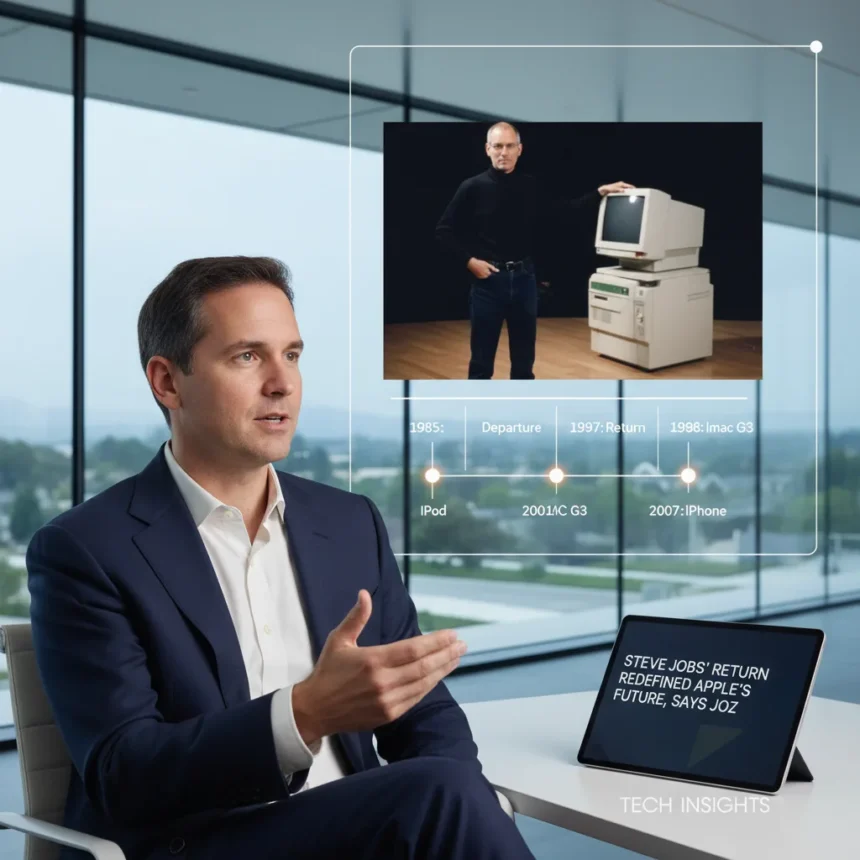
Steve Jobs return to Apple in 1997 marked a turning point that nobody at the company saw coming—least of all the people living through it. Greg “Joz” Joswiak, who has been at Apple since June 1986 directly from college, was there when it happened. Now Senior Vice President of Worldwide Marketing, Joswiak carries a unique perspective on how one executive’s comeback reshaped an entire technology company’s future.
Key Takeaways
- Greg Joswiak joined Apple in 1986 and witnessed Steve Jobs’ return in 1997 firsthand.
- Jobs’ return pulled Apple back from near irrelevance in the early 1990s to become a dominant tech force.
- Joswiak has spent nearly four decades at Apple, present for major product launches and company milestones.
- The 1997 moment fundamentally shifted Apple’s product strategy and company direction.
- Jobs’ legacy continues to define Apple’s culture, according to CEO Tim Cook.
The Moment Everything Changed
By the mid-1990s, Apple was struggling. The company had drifted without clear direction, and its market position was eroding. Then Jobs returned, and something clicked. Joswiak witnessed the exact inflection point when the company’s entire focus shifted—a moment he describes as pivotal to everything Apple would become. It was not a gradual transition but a sharp pivot in strategy and vision that set the stage for the products and innovations that would follow.
What made this moment so significant was not just Jobs’ presence but his clarity of purpose. He brought a singular focus to product development and design philosophy that had been absent. For someone like Joswiak, who had already spent over a decade at Apple, this represented a fundamental reset—a chance to build something extraordinary out of the wreckage of a company that had lost its way.
A Career Spanning Apple’s Greatest Moments
Joswiak’s journey at Apple spans nearly four decades, from 1986 to the present. He has been present for the company’s 50th anniversary activities and countless product launches that defined an era. This longevity gives him a rare vantage point: he has seen Apple at its weakest and at its strongest, and he understands the mechanics of how the company transformed.

His rise within Apple reflects the company’s own evolution. Starting at the company fresh out of college, Joswiak moved through the ranks, eventually becoming VP before his 2020 promotion to Senior Vice President of Worldwide Marketing. His career trajectory mirrors Apple’s resurgence—from the chaos of the early 1990s to becoming one of the world’s most influential technology companies. In 2018 court testimony against Samsung over iPhone patent infringement, Joswiak articulated just how much was at stake: “we were really risking everything that was making Apple successful at the time… We really were betting the company”.
Jobs’ Legacy Still Defines Apple Today
Nearly 40 years after Jobs’ return and over a decade after his death in 2011, his influence remains unmistakable. CEO Tim Cook has stated plainly: “It’s definitely still his company”. That is not mere sentiment—it reflects the deep imprint Jobs left on Apple’s culture, values, and approach to innovation.



For Joswiak, who worked alongside Jobs during the critical years following his 1997 return, this legacy is tangible. The philosophy Jobs instilled—the obsession with design, the refusal to compromise, the belief that technology should serve human creativity—continues to shape every decision Apple makes. Whether in product development, marketing strategy, or long-term vision, the fingerprints of Jobs’ thinking remain visible. As Apple approaches its 50th anniversary, that continuity of vision becomes even more remarkable.
Why This Moment Still Matters
The story of Jobs’ return and the strategic shift Joswiak witnessed is not merely historical. It offers a masterclass in how leadership, vision, and focus can reverse a company’s fortunes. Apple in the mid-1990s faced existential threats—irrelevance in the market, a bloated product line, and unclear direction. Jobs’ return solved none of those problems overnight, but it provided the clarity and direction necessary to solve them.
For anyone studying business transformation, innovation, or leadership, Joswiak’s recollection of that pivotal moment serves as a reminder that change often arrives suddenly. One person with a clear vision can redirect an entire organization. The fact that Joswiak was there—that he can point to the exact moment when everything shifted—makes his testimony invaluable to understanding not just Apple’s history but the nature of organizational transformation itself.
What Defined Jobs’ Vision for Apple?
Jobs’ vision centered on simplicity, elegance, and the intersection of technology with human creativity. While the research into that exact moment remains tied to Joswiak’s personal recollection, the outcomes speak for themselves: the iMac, the iPod developed in secret during the late 1990s, and eventually the iPhone and iPad—products that redefined entire categories. Each represented Jobs’ philosophy made tangible.



How Long Has Joswiak Been at Apple?
Greg Joswiak joined Apple in June 1986, directly from college, making him a 38-year veteran of the company. He has witnessed virtually every major chapter of Apple’s history, from the company’s founding in 1976 through its near-collapse in the 1990s, its resurgence under Jobs, and its current era under Tim Cook.
Why Does Jobs’ Return Still Influence Apple?
Jobs’ return in 1997 established principles and priorities that remain central to Apple’s identity today. His emphasis on design-driven innovation, product focus, and the marriage of art and technology became embedded in the company’s DNA. Tim Cook and the current leadership team continue to operate within the framework Jobs established, which is why his influence persists even after his death in 2011.
Joswiak’s recollection of the exact moment Steve Jobs shifted Apple’s focus serves as a reminder that transformative leadership often arrives as a pivot point—a clear, definable moment when everything changes. For nearly four decades, Joswiak has watched that vision unfold, making him one of the few people alive who can testify to the power of that single moment.
Edited by the All Things Geek team.
Source: Tom's Guide