







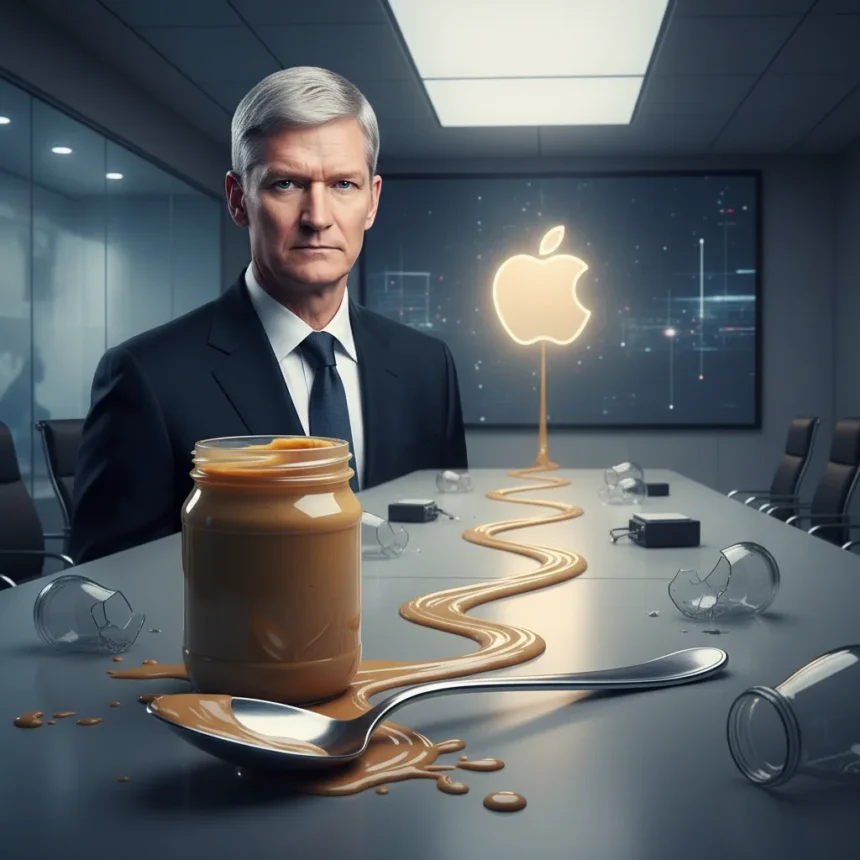
Tim Cook’s rare insight into Apple ruthless approach to new ideas cuts to the heart of how the company will compete in the next decade. In a recent interview, Cook used a striking analogy: “You can’t spread your energy like peanut butter.” That single phrase encapsulates Apple’s disciplined, almost ruthless philosophy toward which ideas get funded, which get killed, and which get the full weight of the company’s resources. As Apple marks its 50th anniversary on April 1, 2026, this candid moment from the CEO signals a strategic pivot—one that could define whether the company leads or lags in artificial intelligence, wearables, and whatever comes after the smartphone.
Key Takeaways
- Cook described Apple ruthless approach to new ideas as essential to maintaining innovation edge and avoiding diluted focus.
- The “peanut butter” analogy means Apple concentrates resources on select high-potential initiatives rather than spreading thin across many bets.
- Apple’s 50th anniversary letter stresses “building tomorrow” over “remembering yesterday,” signaling aggressive forward momentum in 2026.
- Vision Pro’s $3,500 price and lack of killer app demonstrate the cost of ideas that don’t meet Apple’s ruthless selection criteria.
- Cook emphasized AI as “profound” but cautioned that technology itself is neutral—execution and user intent determine outcomes.
Why Apple’s Ruthless Filtering Matters Right Now
Apple ruthless approach to new ideas is not new—Steve Jobs pioneered it. But Cook’s explicit articulation of the strategy arrives at a critical moment. The company is playing catch-up in AI after rivals like Google and Microsoft moved faster, and it faces genuine competition in categories it once dominated. Vision Pro, the spatial computing bet that cost billions, landed with a thud. The foldable iPhone, which analysts expect in fall 2026, represents a deliberate delay—Apple waiting for the technology and market to mature before committing resources. This is ruthlessness in action: kill the mediocre ideas, starve the “interesting but not essential” projects, and pour everything into the bets that could reshape how people interact with technology.
Cook’s peanut butter comment reflects a hard truth that most tech companies fail to internalize. Resources are finite. Attention is finite. When you try to pursue ten ideas simultaneously, you end up with ten mediocre executions. Apple’s historical strength—the iPhone, the iPad, the Apple Watch—came from saying no to dozens of other concepts so the yes-ideas could be perfected. In the AI era, that discipline becomes even more critical. Every engineer working on an AI feature that doesn’t move the needle is an engineer not working on Apple Intelligence, the company’s answer to ChatGPT and Gemini.
The 50th Anniversary Inflection Point
Cook’s 50th anniversary letter to Apple employees and customers contained a telling phrase: “At Apple, we’re more focused on building tomorrow than remembering yesterday.” That is not nostalgia. That is a mandate. As the company approaches five decades of existence, it faces a choice: rest on the iPhone’s laurels or bet aggressively on the next category-defining product. Cook has signaled through his ruthless prioritization that Apple is choosing the latter. The company is investing $600 billion in U.S. manufacturing over the next four years, including moving iPhone glass production to Kentucky by end of 2026. That is not the spending pattern of a company playing it safe.



What Apple ruthless approach to new ideas means for 2026 specifically is that any product or feature that does not meet an extremely high bar will be quietly shelved or delayed. Cook has hinted at “innovations that have never been seen before” coming in the year ahead, but he uses bold language on every earnings call. The real test is execution. Will Apple Intelligence feel like a genuine leap, or a catch-up feature wrapped in marketing? Will the rumored AI glasses—expected sometime in 2026 or later—arrive as a category-defining device or as another Vision Pro-style expensive experiment? Cook’s ruthlessness means Apple will not ship either if it does not meet internal standards.
What Gets Killed When Apple Says No
The flip side of ruthless focus is ruthless elimination. For every product that makes it to market, dozens of prototypes, concepts, and full-fledged projects are terminated. Vision Pro’s $3,500 price tag and lack of a killer application represent a failure of Apple’s ruthless filter—the company shipped a product that did not meet the bar, and it has paid the price in credibility and market share. That outcome likely stung, and it informs Cook’s current messaging. The company will not repeat that mistake by flooding the market with half-baked AI features or wearables that do not solve a real problem.



Cook has also been explicit about where Apple’s energy is not going. The company is not chasing every social media trend. It is not building a search engine to compete with Google, despite having the infrastructure to do so. It is not making a car—a project that consumed years and billions before being shelved. These are ruthless no-decisions, each one freeing resources for the bets that matter. In the interview, Cook reflected on Apple’s greatest hits: “reinventing music, reinventing the smartphone, bringing the creative arts to the table, the creative graphics. Saving people’s lives with the watch”. Notice what is absent from that list: incremental improvements, me-too features, or products built because competitors shipped them first.
AI as the Ultimate Test of Apple’s Philosophy
Cook’s comments on artificial intelligence reveal both confidence and caution. He stated: “I think AI is so profound and can be so positive, but technology doesn’t wanna be good, and it doesn’t wanna be bad. It’s in the hands of the user and the hands of the inventor”. That nuance matters. Cook is not claiming Apple will solve AI or that AI will solve everything. Instead, he is acknowledging that execution, ethics, and user intent are where the real work happens. For Apple ruthless approach to new ideas, this means AI features will ship only when they demonstrably improve user experience—not because the hype cycle demands it.
The challenge is that Apple is behind. Competitors have already integrated generative AI deeply into their ecosystems. Apple Intelligence, the company’s answer, will need to feel not just good but essential. Cook’s ruthlessness suggests Apple will take whatever time is necessary to get this right, even if it means delaying features or products that competitors ship first. That is the inverse of the “first-mover advantage” playbook—Apple’s “not first, but best” strategy, which has worked for categories like tablets and smartwatches but is harder to execute when rivals are already entrenched.
What This Means for Apple’s Next Five Years
Cook’s “peanut butter” philosophy will define Apple’s trajectory through the rest of the decade. Expect fewer product categories, more refined execution, and a relentless focus on ecosystem integration. The company will likely not chase every emerging technology. Foldables will arrive only when Apple believes it can do them better than Samsung. AI glasses will launch only if they deliver something genuinely new. New services will expand only in categories where Apple has a defensible advantage, like music education—the company is expanding its Save The Music partnership to roughly 50 schools, reaching 25,000 kids next year.



This ruthlessness has a cost. It means slower innovation in some areas, missed opportunities in emerging categories, and a company that sometimes appears to be following rather than leading. But it also means that when Apple ships something, it tends to work. The iPhone did not invent the smartphone, but it defined the category. The iPad did not invent the tablet, but it proved tablets could be mainstream. That disciplined approach—saying no to a hundred ideas so you can say yes to one great one—is what Cook is articulating now.
Is Apple’s ruthless strategy sustainable?
Yes, but only if execution matches ambition. Cook’s willingness to kill projects and delay products is a strength, but only if the products that do ship are genuinely excellent. Vision Pro proved that even Apple can miss—a cautionary tale that likely reinforced Cook’s commitment to ruthlessness. The strategy works as long as the company correctly identifies which bets matter and which do not. In the AI era, that judgment call is harder than ever.
What does “you can’t spread your energy like peanut butter” mean for Apple’s 2026 roadmap?
It means Apple will be selective. The company will not ship multiple new product categories simultaneously or rush features to market. Instead, expect a focused set of releases—likely including new iPhones with improved AI capabilities, possibly a foldable variant, and carefully considered updates to the Apple Watch and other wearables. Each product will be held to an extremely high bar. If something does not make the cut, it stays in the lab.
How does Apple’s ruthless approach compare to competitors?
Samsung, Google, and other competitors tend to cast wider nets—shipping more products, more features, more bets in hopes that some stick. Apple’s approach is the opposite: fewer products, higher confidence in each one, longer development timelines. This makes Apple slower to market in some cases but more polished at launch. In AI specifically, Apple is behind, and ruthlessness alone will not close that gap—execution must match philosophy.
Tim Cook’s rare candor about Apple ruthless approach to new ideas is a signal that the company is doubling down on discipline. The “peanut butter” analogy will likely become part of Apple’s internal lore—a shorthand for the hard choices that separate innovation from noise. As Apple enters its next 50 years, that ruthlessness may be the most important competitive advantage it has.
Edited by the All Things Geek team.
Source: TechRadar




