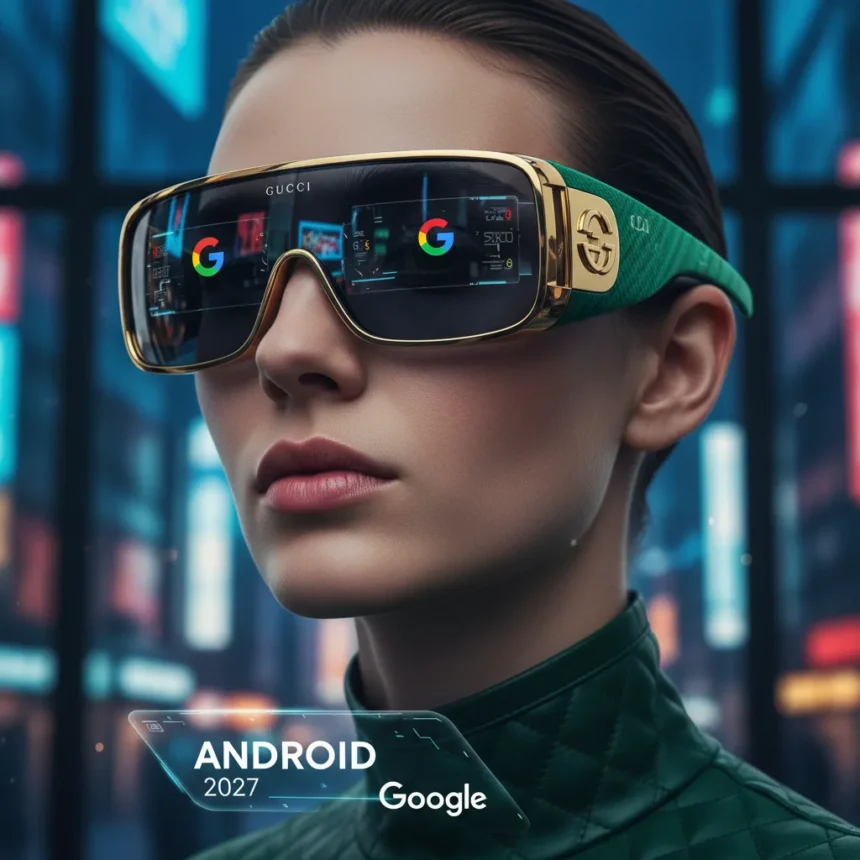
Gucci Android smart glasses are coming in 2027, and they represent the most credible challenge yet to Meta’s Ray-Ban smart glasses monopoly in the luxury eyewear space. Kering CEO Luca de Meo confirmed the partnership with Google in a Reuters interview, stating the glasses will launch “probably next year, 2027”. This is not a concept or a rumor—it is an official collaboration between one of the world’s largest luxury conglomerates and the tech giant powering the next generation of AI wearables.
Key Takeaways
- Gucci Android smart glasses launching 2027 via official Google partnership with Kering CEO confirmation
- Glasses will run Android XR platform, integrating Gemini AI with cameras, microphones, and speakers
- Gucci leverages optical expertise to design all-day wearables in multiple luxury styles
- Positions Gucci against Meta’s Ray-Ban glasses in emerging luxury AI wearable market
- Part of broader Android XR ecosystem including Samsung Galaxy Glasses and Google’s Project Aura
Why Gucci Android Smart Glasses Matter Right Now
The luxury tech market has been waiting for this moment. Meta’s Ray-Ban smart glasses have dominated consumer conversation since launch, but they lack the fashion credibility and design heritage that only a house like Gucci can bring. Gucci’s entry signals that AI wearables are no longer niche tech curiosities—they are becoming fashion statements. By 2027, when Gucci Android smart glasses arrive, the market will be mature enough to support multiple premium competitors, each with distinct design languages and brand positioning.
The partnership also reflects Gucci’s strategic pivot under Kering’s leadership. The brand has struggled with perception as a status symbol without substance; AI-integrated eyewear offers a tangible way to modernize that image and appeal to tech-forward luxury consumers. Rather than licensing its name to a tech company, Gucci is collaborating directly with Google on the platform level, ensuring the glasses feel like genuine Gucci products, not afterthought reskins.
Gucci Android Smart Glasses Hardware and Features
Details remain sparse, but Gucci Android smart glasses will integrate cameras, microphones, speakers, and Gemini AI, Google’s conversational AI system. The exact form factor—whether these include a display or function as audio-only smart glasses—has not been disclosed. This ambiguity matters because it defines the use case: audio-only glasses appeal to everyday wear and safety (no distracted-walking risks), while display-equipped versions enable real-time information overlay and visual AI features.


What is clear is that Gucci will leverage its 100-year expertise in optical frames and sunglasses design. Unlike Ray-Ban, which relies on Meta’s industrial design, Gucci Android smart glasses will ship in multiple styles and colors, treating them as fashion accessories first and computing devices second. This is a fundamental difference in philosophy. Ray-Ban smart glasses feel like tech that borrowed fashion credibility; Gucci Android smart glasses will feel like luxury eyewear that happens to be smart.
How Gucci Android Smart Glasses Fit Into the Broader Android XR Ecosystem
Gucci Android smart glasses are not an isolated product—they are part of Google’s Android XR platform, which also powers Samsung Galaxy Glasses and the upcoming Project Aura (Google’s own smart glasses expected in 2026). This ecosystem approach means Gucci glasses will have access to the same AI capabilities and app integrations as Google’s own hardware, but with distinct industrial design and premium positioning. Samsung Galaxy Glasses will likely target tech enthusiasts; Gucci Android smart glasses will target luxury consumers who would never buy a Samsung-branded wearable.


The timing is strategic. Google’s Project Aura arrives in 2026, giving developers a full year to build Android XR applications and refine the platform before Gucci’s 2027 launch. By then, the ecosystem will have matured, and Gucci can launch with a robust app library and proven use cases, avoiding the slow-adoption problem that plagued Google Glass a decade ago.
Pricing and Availability Questions
Gucci Android smart glasses are expected to be “extremely expensive” due to luxury branding, but no official pricing has been disclosed. Given Gucci’s positioning—entry-level bags start around 800 USD, while high-end pieces exceed 3000 USD—smart glasses could easily land in the 1500–2500 USD range, positioning them as premium alternatives to Ray-Ban. This would make them significantly more expensive than Meta’s Ray-Ban glasses, but that premium reflects Gucci’s brand equity and design expertise.
Global availability is presumed but unconfirmed. Gucci operates in 90+ countries, so distribution should be straightforward once manufacturing scales. However, early availability may concentrate in flagship stores and select markets before rolling out globally.
Can Gucci Android Smart Glasses Actually Win Against Ray-Ban?
Ray-Ban’s advantage is simplicity and Meta’s backing. Meta owns the social platform where smart glasses make the most sense (Instagram, WhatsApp, Messenger), and Ray-Ban glasses have proven the category works. But Ray-Ban’s weakness is that they feel like tech products first, fashion products second. Gucci Android smart glasses flip that equation. A luxury consumer might never buy a Meta product, but they would absolutely buy Gucci.


The real competition is not Ray-Ban—it is whether Gucci can convince fashion-forward consumers that AI-integrated eyewear is worth the premium price tag. If Gucci succeeds, it opens the door for other luxury houses (LVMH-owned Fendi or Celine, Richemont-owned Cartier) to follow. If it flops, smart glasses remain a niche tech product, and fashion stays separate from AI wearables.
Will Gucci Android smart glasses actually launch in 2027?
Kering CEO Luca de Meo confirmed the partnership and 2027 timeline directly to Reuters, making this far more credible than typical tech rumors. However, tech timelines slip. Google’s own Android XR glasses (Project Aura) are scheduled for 2026, and if that delays, Gucci’s 2027 launch could slip as well.
What makes Gucci Android smart glasses different from Ray-Ban?
Ray-Ban smart glasses are designed by Meta and manufactured by EssilorLuxottica; they prioritize tech features and social sharing. Gucci Android smart glasses will be designed by Gucci, prioritizing fashion aesthetics and luxury positioning, with AI as an integrated feature rather than the main draw. Gucci’s optical heritage means these will be actual eyewear first, smart devices second.
Are there other luxury brands making smart glasses?
Not yet. Gucci is the first major luxury house to partner directly with a big tech company on AI smart glasses. Other luxury groups own eyewear brands (LVMH owns Fendi, Celine, and Givenchy; Richemont owns Cartier), but none have announced Android XR partnerships yet.
Gucci Android smart glasses represent a turning point in how luxury and AI converge. By 2027, the question will not be whether smart glasses are viable—it will be whether they are fashionable enough to justify their premium price. Gucci is betting that the answer is yes, and for once, a luxury house might actually be right.
Where to Buy
Edited by the All Things Geek team.
Source: T3