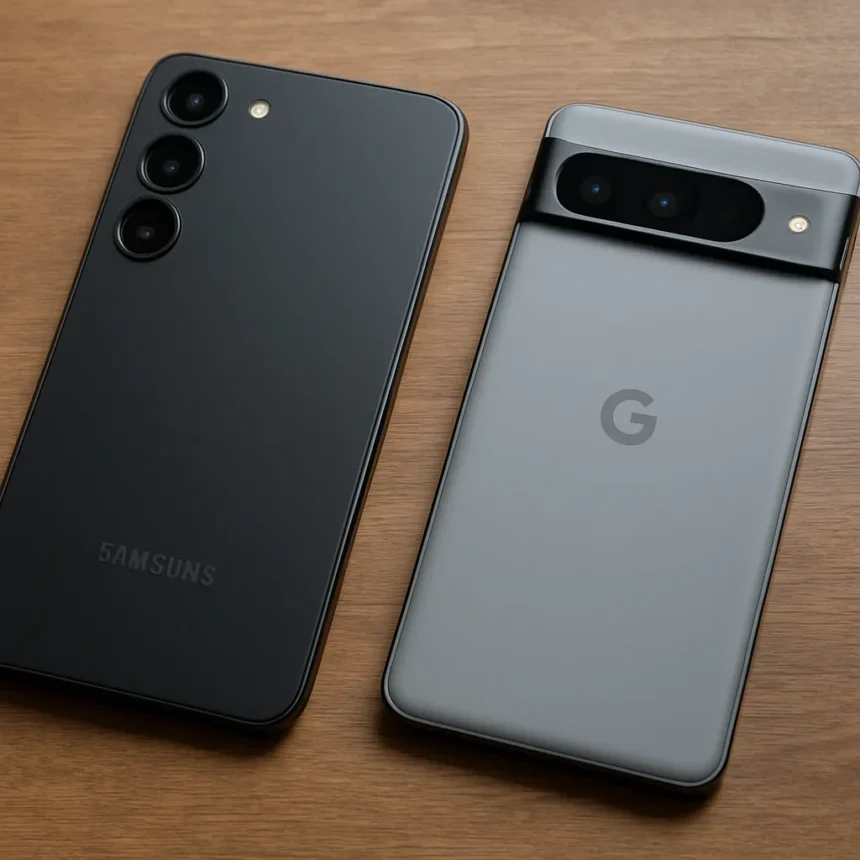
The Samsung Galaxy S26 vs Google Pixel 10 is the defining compact Android showdown of 2026, pitting Samsung’s first major release of the year against Google’s latest Pixel flagship. Both are 6.3-inch Android phones aimed at users who want flagship power without a massive footprint — but they make very different trade-offs, and picking the wrong one will leave you frustrated. Samsung brings refined hardware and Qualcomm muscle; Google counters with a richer ecosystem and a bigger battery. Neither is a clear knockout, but one is the smarter buy for most people.
Samsung Galaxy S26 vs Google Pixel 10: Design and Display
On paper, both phones share a 6.3-inch screen, but the Galaxy S26 is meaningfully slimmer and lighter. Samsung has trimmed it to 7.2mm thick and 167g, while the Pixel 10 sits at 8.6mm and 204g — a difference you will absolutely notice after a full day in your pocket. The S26 also achieves a screen-to-body ratio of around 90%, giving it a premium, modern feel in hand. The Pixel 10 is simply bulkier, and there is no way to spin that as an advantage for a phone in this size class.
Display quality is where it gets more interesting. The S26 uses a Dynamic LTPO AMOLED 2X panel with 120Hz refresh, HDR10+ support, and a peak brightness of 2600 nits, plus a Privacy Display feature for added security in public. The Pixel 10’s Actua OLED display edges ahead on brightness, rated up to 3000 nits, and it supports the same 60-120Hz variable refresh range. Both panels are excellent — the brightness gap is real but unlikely to matter in most everyday conditions.
Performance: Snapdragon 8 Elite Gen 5 vs Tensor G5
This is where Samsung pulls decisively ahead. The Galaxy S26 runs the Qualcomm Snapdragon 8 Elite Gen 5 for Galaxy, a co-developed chip with a 4.47GHz clock speed that Samsung built in collaboration with Qualcomm. The Pixel 10 uses Google’s own Tensor G5, clocked at 3.78GHz. On raw processing power, the Snapdragon architecture has a clear edge, and the S26 also ships with Wi-Fi 7 and Bluetooth 6 connectivity — the Pixel 10 is limited to Wi-Fi 6E, which is a notable step behind for a 2026 flagship.


Both phones pack 12GB of RAM in their base configurations, so multitasking parity exists at that level. Storage is another win for Samsung: the S26 offers 256GB and 512GB options, while the Pixel 10 tops out at 256GB. For power users who shoot a lot of video or refuse to rely on cloud storage, that matters.
Battery, Charging, and Ecosystem
The Pixel 10 fights back hard on battery. With a 4970mAh cell against the S26’s 4300mAh, Google has a significant capacity advantage in a phone that is only marginally larger. If battery life is your top priority among these two, the Pixel 10 is the rational choice.



Ecosystem is where the Pixel 10 makes its most compelling argument. Google has built Qi2 magnets directly into the Pixel 10, enabling compatibility with the growing MagSafe, Qi2, and Pixelsnap accessory ecosystem out of the box. Samsung has not matched this — the S26 lacks built-in Qi2 magnets, which is a genuine omission at this price point given how mature that accessory ecosystem has become. For users already invested in magnetic accessories, this is a real differentiator.
Cameras: Ancient Hardware or Smart Software?
Camera hardware is the S26’s most debated weakness. The front camera on the Pixel 10 is a 42MP shooter compared to just 12MP on the S26 — a gap that will show up in selfie detail and video calls. The research brief notes the S26 has been criticised for using older camera hardware, though that characterisation is subjective.
Where Samsung does compete is at the higher end of its lineup. Comparisons of the S26 Ultra against the Pixel 10 Pro XL show Samsung’s telephoto system — with 3x and 5x optical zoom and up to 100x digital zoom — delivering strong detail at distance, while Google leans on natural tones and computational processing. For the standard S26 vs Pixel 10 matchup, Google’s camera software reputation and the selfie hardware advantage give it the edge in photography for most users.
Is the Samsung Galaxy S26 worth buying over the Pixel 10?
For users who prioritise raw performance, a slimmer build, and the fastest wireless connectivity available, the Galaxy S26 is the better-engineered device. Its Snapdragon 8 Elite Gen 5 chip, lighter chassis, and Wi-Fi 7 support make it the choice for power users who want the most refined compact Android experience.



Why does the Google Pixel 10 win for most buyers?
The Pixel 10 costs less than the Galaxy S26 — Samsung’s phone is $100 more expensive — and delivers a larger battery, built-in Qi2 magnets, a superior front camera, and a brighter display. For the majority of Android users who care about day-to-day practicality over benchmark dominance, the Pixel 10 offers more value per dollar. Google’s exclusive software features and the Pixelsnap accessory ecosystem add further long-term appeal that Samsung simply does not match at this tier.
How do the Galaxy S26 and Pixel 10 compare on storage?
The Galaxy S26 is available in 256GB and 512GB configurations, while the Pixel 10 maxes out at 256GB. Both phones offer 12GB of RAM in standard trim. If you need the extra storage headroom — particularly for 4K or 8K video — the S26’s 512GB option is a meaningful advantage the Pixel 10 cannot match.
The Samsung Galaxy S26 vs Google Pixel 10 verdict comes down to what you value most: Samsung wins on performance, build refinement, and connectivity, but Google wins on value, battery, ecosystem, and selfie hardware. Unless raw processing power or storage capacity is non-negotiable for you, the Pixel 10 is the smarter compact flagship buy in 2026 — and it costs less for the privilege.
Edited by the All Things Geek team.
Source: Tom's Guide