Silicon-carbon battery technology represents the most significant shift in smartphone power since lithium-ion went mainstream, yet Apple and Samsung are sitting it out while Chinese brands race ahead. Honor, OnePlus, Oppo, Xiaomi, and Red Magic are already shipping phones with 6,000 to 10,000 mAh batteries that deliver two-day battery life in designs nearly as thin as the iPhone. The technology works by mixing silicon into the graphite anode—silicon holds up to 10 times more charge than lithium but swells up to 300% during charging, creating engineering challenges that the market leaders have simply chosen not to solve.
Key Takeaways
- Silicon-carbon batteries hold 10 times more charge capacity than traditional lithium anodes.
- Honor is on its fourth generation of silicon-carbon tech, already proven in production.
- OnePlus 15 reportedly uses 15% silicon in its battery anode.
- Apple, Samsung, and Google face billions in costs to retool production lines and supply chains.
- Chinese brands prioritize disruption for survival; Western OEMs lack incentive to abandon proven lithium-ion lines.
Why Silicon-Carbon Batteries Matter Right Now
Silicon-carbon battery technology solves a fundamental problem: how to fit days of battery life into phones that stay thin and light. The silicon anode stores vastly more energy than graphite, allowing manufacturers to pack 6,000 to 10,000 mAh into a device without making it noticeably bulkier. Honor’s fourth-generation implementation and OnePlus’s adoption in the OnePlus 15 prove the technology works at scale, not in labs. This is not a theoretical advantage—it is shipping today in flagships across Asia, delivering the two-day battery life that consumers have wanted since the smartphone era began.
The swelling problem is real but solvable. Silicon expands dramatically when charged, risking cracks or internal damage. Chinese manufacturers have deployed coatings and nanostructures to manage this expansion, keeping batteries stable through thousands of charge cycles. The engineering is proven enough that Honor moved past generation one years ago and is now shipping fourth-generation implementations. This is not bleeding-edge research—it is production-ready technology.
Why Apple, Samsung, and Google Are Frozen in Place
The reason Apple, Samsung, and Google have not switched to silicon-carbon battery technology is not technical—it is financial and organizational. These companies have invested billions into graphite-based production lines, supply chains, and quality assurance systems. Switching to silicon-carbon would require new manufacturing equipment, retrained suppliers, redesigned safety certifications, and software optimizations across their entire ecosystem. For a company selling millions of phones quarterly with batteries that customers find satisfactory, the cost and risk of disruption outweigh the benefit.


Honor and OnePlus face the opposite incentive structure. As smaller players competing in a crowded market, they must innovate to survive. Adopting silicon-carbon battery technology is not a nice-to-have—it is a market differentiator that lets them claim superior endurance without making phones thicker or heavier. Established OEMs have no such pressure. Their installed base is large enough that incremental improvements to graphite chemistry keep customers satisfied. The result is a classic innovation gap: disruptors move fast because they must; market leaders move slowly because they can afford to.
The Capacity Gap Is Becoming Obvious
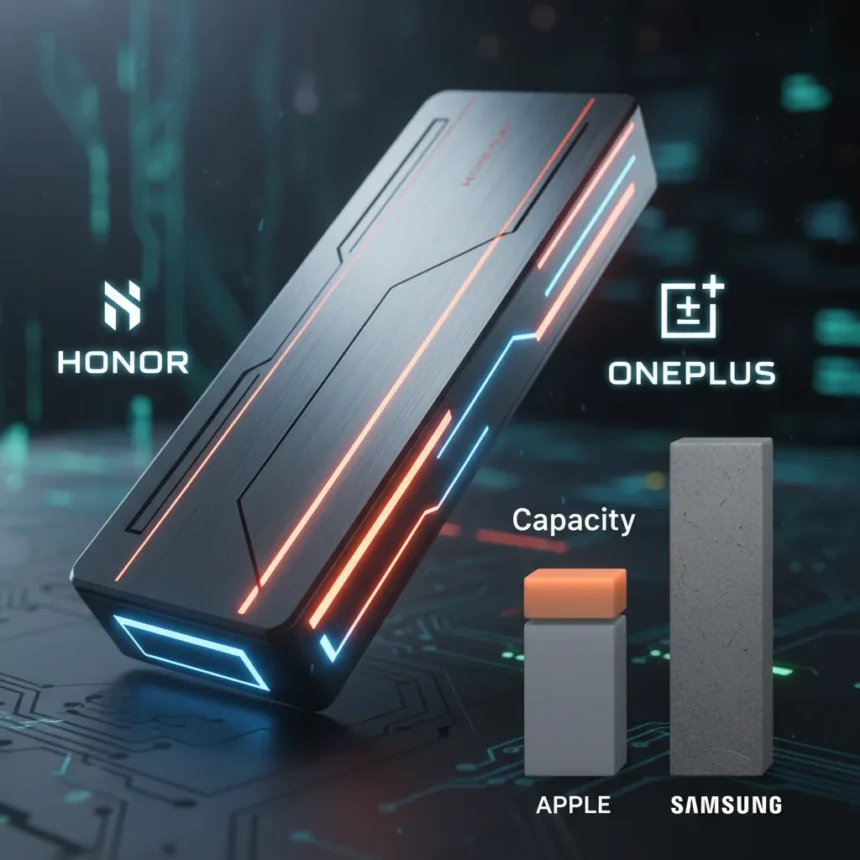
A Honor phone with a 10,000 mAh silicon-carbon battery delivers roughly twice the capacity of an iPhone, yet both devices look similar in size and weight. This is not a minor difference. It is the difference between reaching evening with 40% battery remaining versus ending the day at 10%. It is the difference between two-day battery life and one-day battery life. For users who travel, work long hours, or simply hate hunting for chargers, the gap is transformative.



Samsung and Google phones use traditional lithium-ion batteries with graphite anodes, the same technology that has dominated for over a decade. They are not worse—they are just not better. The engineering is mature, the supply chains are reliable, and the safety certifications are in place. But maturity is not an advantage when a competitor ships twice the capacity in the same form factor. Apple’s ultra-thin design philosophy compounds the problem, as the company has historically prioritized thinness over battery capacity, leaving it with some of the smallest batteries in the flagship market.
Can Apple and Samsung Catch Up?
Technically, yes. Financially and organizationally, the path is steep. Apple would need to redesign its battery architecture, retool manufacturing partners, and certify a new technology across dozens of markets—all while managing the risk that a flaw in early production could damage its premium brand. Samsung faces similar constraints, plus the added complexity of supplying batteries to external customers. Neither company has shown willingness to move fast on battery innovation, instead choosing incremental improvements to proven chemistry.
Google, meanwhile, has outsourced battery design to Samsung, limiting its ability to innovate independently. The company would need to either convince Samsung to adopt silicon-carbon technology or develop its own supply chain—both expensive and time-consuming options. By the time any of these companies move, Chinese manufacturers will have shipped millions of phones with fifth or sixth-generation silicon-carbon batteries, further entrenching their lead.
What This Means for Consumers
If you buy an iPhone or Samsung Galaxy in 2025, you are getting a phone with roughly half the battery capacity of a comparable Honor or OnePlus flagship. That gap will widen as Chinese brands continue iterating on silicon-carbon technology. Users who value battery life now have a clear choice: accept one-day battery life from Western brands or switch to phones with two-day endurance from Chinese manufacturers.



This is not a temporary trend. Silicon-carbon battery technology is not a gimmick—it is a fundamental improvement in energy density that solves a real problem. As long as Apple and Samsung remain locked into graphite chemistry, they will cede the battery life advantage to competitors. For a company that once dominated premium phones, falling behind on a core feature is a significant strategic risk.
Is silicon-carbon battery technology ready for mass production?
Yes. Honor, OnePlus, Oppo, Xiaomi, and Red Magic are already shipping phones with silicon-carbon batteries in volumes that prove production viability. Honor is on its fourth generation, indicating years of refinement and iteration. The technology is no longer experimental—it is shipping in flagships today.
Why doesn’t Apple use silicon-carbon batteries?
Apple would need to retool its entire battery supply chain, redesign its devices, and certify new technology across global markets. The financial and organizational costs are massive, and Apple’s ultra-thin design philosophy has historically taken priority over battery capacity. Without market pressure from competitors, the company has little incentive to disrupt its proven graphite-based approach.
How much longer can graphite batteries compete?
Graphite chemistry is mature and reliable, but it cannot match the energy density of silicon-carbon anodes. As Chinese brands continue shipping larger capacities in the same form factors, graphite-based phones will look increasingly dated on battery endurance. Within two to three years, the capacity gap may become impossible for Western brands to ignore without losing market share.
The silicon-carbon battery revolution is not coming—it is already here, shipping in millions of phones across Asia. Apple, Samsung, and Google have chosen to watch from the sidelines, betting that their brand strength and software ecosystems are enough to offset a two-day battery life disadvantage. That bet may hold for another year or two, but as Chinese manufacturers perfect the technology, the gap will become harder to ignore. The question is not whether silicon-carbon batteries are viable—it is how long the market leaders can afford to wait.
Edited by the All Things Geek team.
Source: Tom's Guide