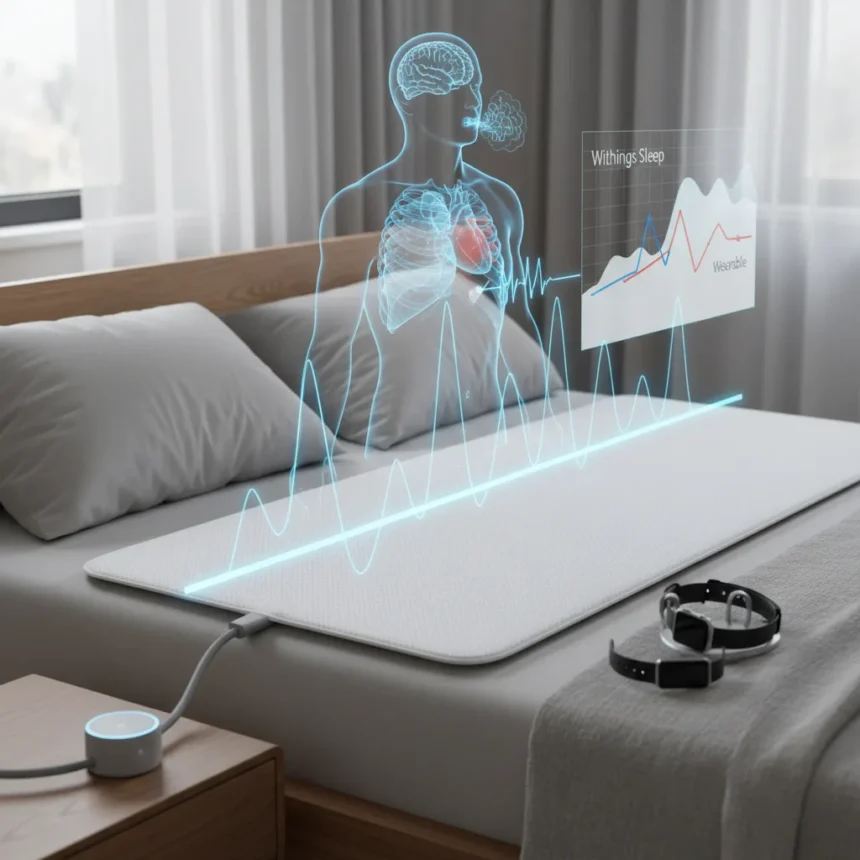
The Withings Sleep tracker mat is an under-mattress device using pneumatic sensors to monitor body movement, respiratory rate, heart rate, and sound patterns—without requiring skin contact or charging. Unlike wearable rings and watches, it sits beneath your mattress and connects to the Health Mate app to deliver nightly sleep scores, stage breakdowns, and breathing quality metrics.
Key Takeaways
- Withings Sleep tracker mat achieves 83% sleep-wake accuracy versus polysomnography clinical studies.
- Tracks light, deep, and REM sleep stages plus breathing disturbances and body movements in real time.
- Overestimates deep sleep but detects moderate-to-severe sleep apnea more reliably than Fitbit or Garmin.
- Cannot always distinguish daytime lounging from nighttime sleep, occasionally inflating scores.
- Amazon rating of 3.8 out of 5 from 2,184 reviews reflects strong accuracy with noted edge-case limitations.
Withings Sleep Tracker Mat Accuracy vs Clinical Gold Standard
The Withings Sleep tracker mat achieves 83% sleep-wake classification accuracy compared to polysomnography (PSG), the clinical gold standard for sleep studies, based on 400 nights of testing. This positions it as the closest consumer alternative to a real sleep lab without the clinical cost or inconvenience. A 2024 study published in peer-reviewed research confirmed high accuracy for overall sleep time and REM stage detection, with errors comparable to Fitbit and Oura. The mat’s pneumatic sensors detect respiratory patterns and movement intensity with enough precision to catch moderate-to-severe sleep apnea, though it should not replace formal clinical diagnosis.
However, the device has documented biases. It tends to overestimate deep sleep, particularly at the end of the night when light sleep dominates. In direct comparison testing, the Withings Sleep tracker mat recorded total sleep time at 443.6 minutes (SD 58.9) versus an Actiwatch reference at 449.0 minutes (SD 71.1), a bias of 7.6 minutes. Misclassification of light sleep stages occurred more frequently than deep or REM detection. These margins are tight enough for personal sleep tracking but not tight enough for clinical diagnosis.
How Withings Sleep Tracker Mat Compares to Wearables
The Withings Sleep tracker mat outperforms wearable rings and watches in one critical way: it does not rely on wrist movement or skin contact. When tested against the Oura Ring 4 over two weeks, both devices aligned on sleep timings and interruption patterns, but the Oura underestimated light sleep while the Withings device overestimated deep sleep. Against Fitbit trackers (Inspire and Versa), both showed similar overall accuracy, but Withings overestimates deep sleep while Fitbit underestimates it—a trade-off rather than a clear winner. Garmin Vivosmart showed comparable biases, with both devices underestimating long light sleep periods.


The architectural difference matters: wearables track sleep via accelerometer data on your wrist, which misses sleep if you remove the device or sleep with your arms still. The Withings mat tracks respiration and body position directly, making it harder to fool but also harder to adjust for personal sensitivity. Manual sensitivity tuning is possible through the app, allowing users to reduce false positives from daytime lounging.
Real Sleep Improvements: What Users Actually Report
The app’s nightly sleep score (out of 100) and stage breakdown encourage behavior change. Users report sleeping longer after identifying interruption patterns in the app graphs, sleeping deeper after adjusting bedroom temperature or reducing evening caffeine based on breathing quality metrics, and waking with better morning energy when sleep scores climb consistently. The Health Mate app displays sleep stages as stacked bar charts, breathing disturbances as markers, and body movement intensity as a separate graph—visual feedback that makes abstract sleep science concrete.



The device’s snoring and breathing disturbance detection has a known weakness: it can miss confirmed snoring, particularly light snoring that a bed partner hears but the sensors do not register. This limitation does not affect overall sleep quality tracking but undermines its value for sleep apnea screening. Users with confirmed sleep disorders should still pursue clinical testing rather than relying on the Withings mat as a diagnostic tool.
Setup and Real-World Usability
Installation is straightforward: slide the mat under your mattress, pair it with the Health Mate app via WiFi, and review your sleep score each morning. No charging is required, and the device integrates with smart home systems for automation (turning off lights when sleep is detected, for example). Amazon reviews averaging 3.8 out of 5 reflect consistent praise for ease of setup and nightly insight accuracy, balanced against frustration when the mat logs daytime naps or extended lounging as sleep, inflating daily scores.
The mat cannot distinguish intentional napping from nighttime sleep without manual correction. If you spend 30 minutes reading in bed before sleep, the sensors may log that time as sleep, requiring you to manually adjust the sleep window in the app. This friction is minor for nightly tracking but becomes annoying if you nap frequently or share a bed with a partner on different sleep schedules.
Is the Withings Sleep Tracker Mat Worth Buying?
If you want consumer-grade sleep insights without wearing a device every night, the Withings Sleep tracker mat delivers real value. Its 83% accuracy versus clinical polysomnography is genuinely impressive and significantly outperforms basic wearable estimates. The app’s visual breakdown of sleep stages and breathing quality gives you actionable feedback—you can identify whether poor sleep stems from frequent awakenings, shallow breathing, or simply not enough time in bed. For sleep optimization, that distinction matters.
The catch: it is not a medical device. Snoring detection is unreliable, deep sleep estimates are inflated, and it cannot diagnose sleep apnea on its own. If you suspect a sleep disorder, clinical testing is still necessary. But for tracking sleep trends, identifying personal sleep patterns, and building accountability around sleep duration and quality, the Withings mat is the most accurate consumer option available—and the only one that does not require you to wear anything to bed.
Does the Withings Sleep tracker mat work with other apps?
The Withings Sleep tracker mat connects exclusively to the Health Mate app. It does not sync directly to Apple Health, Google Fit, or other third-party health platforms, though Health Mate itself can export data. If you use multiple health tracking apps, this is a limitation worth considering before purchase.
Can the Withings Sleep tracker mat diagnose sleep apnea?
The Withings Sleep tracker mat can detect moderate-to-severe sleep apnea based on breathing disturbances, but it should not replace formal clinical diagnosis. Breathing pattern detection is accurate enough to flag problems, but clinical polysomnography remains the gold standard for apnea severity classification and treatment planning.
How often should I replace the Withings Sleep tracker mat?
The research brief does not specify a replacement timeline. The device is designed for long-term under-mattress use with no charging required, suggesting multi-year durability, but specific longevity claims are not available.
The Withings Sleep tracker mat succeeds because it measures what matters—how long you sleep, how deep that sleep is, and whether your breathing stays steady—without requiring you to remember to wear anything. Its 83% accuracy versus clinical sleep studies is the real story here, not marketing hype. For anyone serious about understanding their sleep, it is the closest you will get to a real sleep study without a hospital visit.
Where to Buy
441 Amazon customer reviews | $199.95 | $199.95
Edited by the All Things Geek team.
Source: Tom's Guide