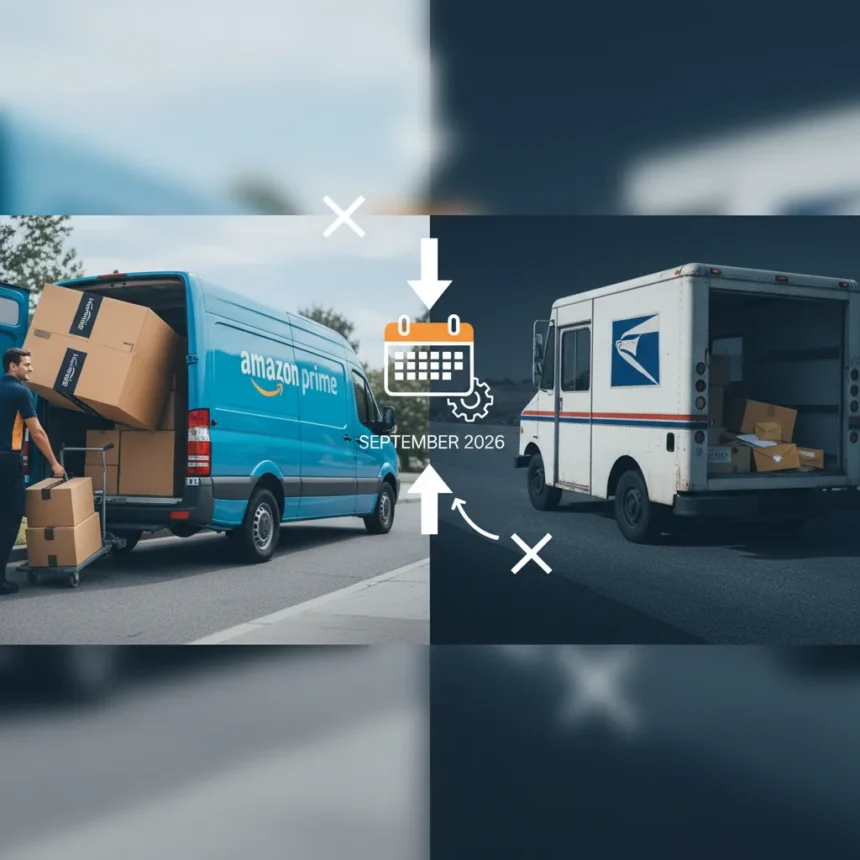
Amazon USPS delivery cuts represent a significant shift in one of retail’s longest-running logistics partnerships. Amazon has disclosed plans to reduce package volumes sent through the United States Postal Service by two-thirds from Amazon’s perspective, equivalent to a 20 percent cut in USPS’s total Amazon parcel handling, with the postal service retaining approximately 80 percent of its current Amazon volume.
Key Takeaways
- Amazon and USPS will reduce parcel volumes by 20 percent, with USPS retaining 80 percent of current Amazon packages.
- The existing USPS-Amazon contract expires September 30, 2026, and currently generates approximately $6 billion annually for USPS.
- About 15 percent of all USPS packages delivered in the US last year came from Amazon.
- Amazon delivered 6.7 billion packages last year, surpassing both UPS and FedEx in volume.
- Amazon negotiated for over a year to increase volumes with USPS before the postal service walked away in December.
The 30-Year Partnership Under Strain
Amazon USPS delivery cuts come after more than three decades of collaboration, including innovations like Sunday delivery that transformed how Americans receive packages. The partnership has been mutually beneficial—USPS generates roughly $6 billion annually from Amazon, a relationship that has supported the struggling postal service through years of financial turbulence. Yet the current contract expires September 30, 2026, forcing both parties to renegotiate as Amazon’s own delivery network grows increasingly competitive.
Amazon’s account for approximately 15 percent of all USPS packages delivered across the US last year, making it one of the postal service’s largest revenue sources. That concentration of volume gave Amazon significant leverage in negotiations, but also created risk for USPS if the e-commerce giant shifted its logistics strategy. Now that shift is happening, and the postal service faces the consequences of losing a substantial portion of that revenue stream.
Why Amazon Is Reducing USPS Volumes
Amazon USPS delivery cuts reflect the company’s broader strategy to control its own last-mile delivery network rather than relying on third-party carriers. Last year, Amazon delivered 6.7 billion packages globally, surpassing both UPS and FedEx in total volume and putting the company on pace to eventually exceed even USPS’s annual package count. Building proprietary delivery infrastructure gives Amazon control over speed, cost, and customer experience—advantages that external carriers cannot match.


The company negotiated with USPS for over a year to reach a deal that would increase, not decrease, volumes. According to Amazon’s official statement, the company engaged directly with Postmaster General David Steiner, his leadership team, and members of the USPS Board of Governors. Amazon claims it offered a proposal that would bring USPS billions in additional revenue, but the postal service “abruptly walked away at the eleventh hour in December” before Amazon could submit a formal bid in February 2026. That rejection forced Amazon to accelerate its shift toward its own network, resulting in the 20 percent reduction now being implemented.
The Financial Impact on USPS
Losing 20 percent of Amazon parcel volume threatens USPS at a vulnerable moment. The postal service has cited reduced transportation and workers’ compensation expenses as factors in recent financial results, but the organization remains under structural pressure from declining mail volumes and rising operational costs. A $6 billion annual revenue stream is not trivial—losing a fifth of that income forces USPS to either cut services, raise prices, or find alternative revenue sources.



USPS has not publicly responded with a detailed strategy to offset the Amazon USPS delivery cuts. The postal service’s silence suggests either acceptance of the outcome or ongoing negotiations behind closed doors. What remains clear is that the September 2026 contract expiration will be contentious, with both parties needing to decide whether the partnership is worth preserving on new terms.
Amazon’s Growing Delivery Network as a Competitor
The shift reflects Amazon’s evolution from e-commerce retailer to logistics company. By controlling its own delivery infrastructure, Amazon reduces dependency on USPS, UPS, and FedEx—carriers that have raised rates and sometimes struggled with peak-season capacity. Amazon’s 6.7 billion packages last year demonstrate the scale of its operation, and the company continues investing in warehouses, sorting facilities, and delivery vehicles to handle even larger volumes independently.
This vertical integration strategy mirrors Amazon’s approach in other areas: cloud computing with AWS, video streaming with Prime Video, and grocery retail with Whole Foods. In logistics, the company is essentially becoming its own carrier, which means USPS and other traditional carriers face erosion of their largest growth segment—e-commerce fulfillment. Amazon USPS delivery cuts are the visible result of a long-term structural shift in how packages move through the American economy.
What Happens After September 2026?
The September 30, 2026 contract expiration creates a critical inflection point. Amazon could negotiate a new agreement with USPS, but the company’s willingness to build its own network suggests it may be willing to walk away entirely. USPS, meanwhile, may be forced to accept less favorable terms or risk losing the account altogether. The postal service’s financial situation makes losing Amazon’s volume damaging but perhaps not catastrophic if management can stabilize other revenue streams.



Amazon’s February 2026 bid for USPS last-mile services remains unanswered, leaving open the possibility of a different contractual arrangement than the current model. Whether USPS responds to that bid, or whether Amazon simply continues reducing volumes as its network expands, will determine the shape of American package delivery for the next decade.
Is Amazon trying to completely abandon USPS?
No. Amazon aims to retain approximately 80 percent of its current USPS volume under the new arrangement, meaning USPS will continue handling a significant portion of Amazon packages. The 20 percent reduction reflects Amazon’s shift toward its own network for certain routes and package types, not a complete exit from the partnership.
How much revenue does USPS lose from the Amazon USPS delivery cuts?
If USPS loses 20 percent of Amazon volume and Amazon currently generates $6 billion annually, the reduction costs USPS roughly $1.2 billion per year until the contract expires in September 2026. However, USPS retains $4.8 billion in annual Amazon revenue, making it still the postal service’s largest customer relationship.
Why did USPS reject Amazon’s negotiation offer?
USPS has not publicly explained its decision to walk away from negotiations in December. Amazon claims the postal service rejected a proposal that would have increased volumes and brought billions in additional revenue, but USPS has offered no counter-statement. The reasons may involve operational capacity constraints, disagreement over pricing, or strategic disagreements about the partnership’s future direction.
Amazon USPS delivery cuts represent a watershed moment in American logistics. A 30-year partnership is being reshaped by Amazon’s growing self-sufficiency and USPS’s apparent unwillingness to meet the company’s terms. The outcome will ripple through the entire parcel delivery industry, forcing UPS, FedEx, and regional carriers to reassess their own relationships with Amazon and prepare for a future where the e-commerce giant relies less on traditional carriers and more on its own infrastructure. For consumers, the shift may mean faster Amazon deliveries in urban areas but potentially slower service in rural regions where Amazon’s network is less developed and USPS remains the primary option.
Where to Buy
Edited by the All Things Geek team.
Source: TechRadar