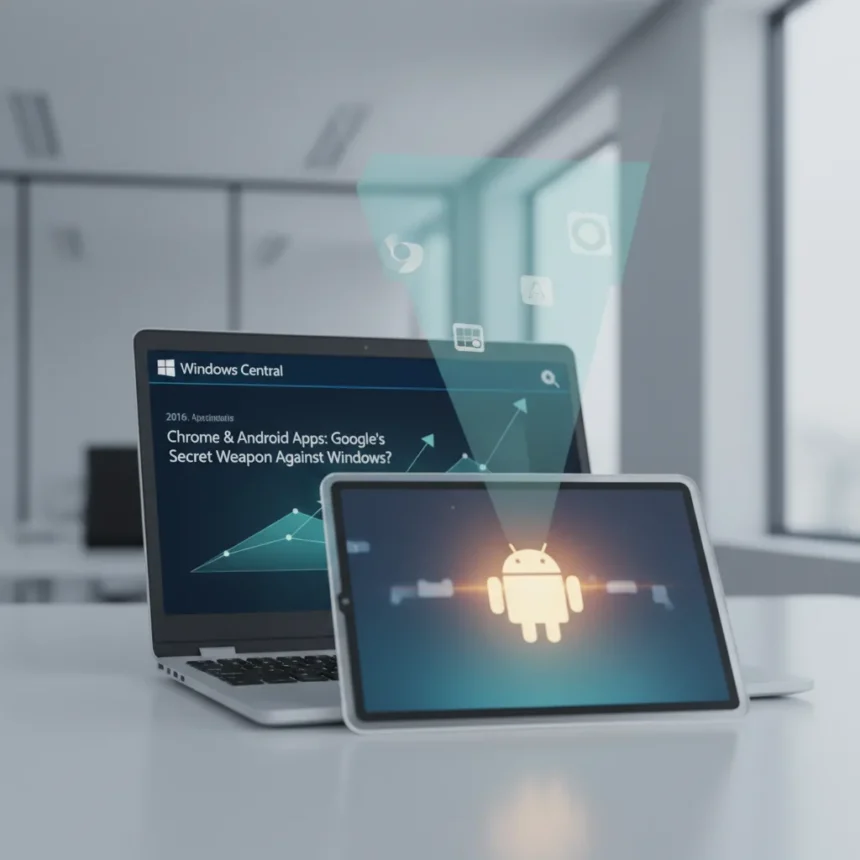
Google’s Android PC challenge to Microsoft is not new—it is a resurrected threat that Windows Central warned about nearly a decade ago. A 2016 story about Chrome and Android apps predicted exactly the competitive pressure Microsoft faces today as Google moves Android into the agentic era.
Key Takeaways
- A 2016 Windows Central warning about Chrome and Android apps has become relevant again today.
- Google’s Android PC push challenges Microsoft’s traditional Windows dominance.
- The Google Android PC challenge represents a shift toward agentic computing on mobile platforms.
- Microsoft faces renewed competitive pressure from Google’s ecosystem strategy.
- The 2016 prediction underestimated neither the timeline nor the threat’s eventual arrival.
Why the 2016 Warning Matters Now
The 2016 story warned that Chrome and Android apps posed a structural threat to Microsoft’s control of computing devices. At the time, the warning felt premature—Android was a mobile platform, Chrome was a browser, and Windows dominated PCs. But the prediction was not about immediate disruption; it was about architectural inevitability. Google’s platforms were designed to blur the line between mobile and desktop computing, and that blurring is now happening through Android PCs and the agentic era.
What makes the 2016 warning prescient is that it identified the mechanism: Google’s willingness to push lightweight, cloud-integrated operating systems and applications across device categories. The warning was not about a specific product launch in 2016 or 2017. It was about a long-term strategic threat that would compound over years. That threat is now materializing as Google repositions Android as a platform for PCs and agentic computing.
The Google Android PC Challenge Reshapes Device Strategy
The Google Android PC challenge represents a fundamental shift in how computing devices are built and distributed. Rather than accepting Microsoft’s decades-long dominance in the PC market, Google is attacking from a different angle: by making Android capable of running on larger screens and more powerful hardware, Google bypasses the need to compete directly with Windows in the traditional sense.


This strategy mirrors what Google did with Chromebooks in education and emerging markets. Chromebooks never beat Windows by being better versions of Windows—they won by being simpler, cheaper, and more integrated with cloud services. Android PCs follow the same playbook. They do not need to replicate every Windows feature; they need to be sufficient for the tasks users actually perform and deeply integrated with Google’s ecosystem of services and AI tools.
Microsoft’s response has been to double down on AI integration through Copilot and to maintain Windows as the platform for professional and gaming workloads. But the Google Android PC challenge does not target those segments first—it targets consumers and emerging markets where Windows is expensive and overkill. That is where the 2016 warning becomes uncomfortable for Microsoft: the threat does not arrive as a frontal assault on Windows’ core strengths; it arrives by making Windows irrelevant for an expanding class of users.


Agentic Computing Accelerates the Competitive Shift
The agentic era—where AI systems perform tasks autonomously on behalf of users—adds urgency to the Google Android PC challenge. Android’s tight integration with Google’s AI services gives it an architectural advantage over Windows in scenarios where users want their devices to act as intelligent agents. A user with an Android PC can have Google’s AI systems manage their calendar, compose emails, filter notifications, and perform other tasks smoothly because the entire stack is unified.
Windows, by contrast, is built on decades of legacy compatibility and fragmented third-party integrations. Copilot is powerful, but it is bolted onto an operating system designed for human-directed computing, not agentic workflows. This is not a criticism of Windows’ engineering—it is a recognition that architectural choices made for one era do not automatically suit the next.
Google’s Android PC challenge gains momentum precisely because agentic computing rewards unified ecosystems. If you are running Android, your device, your phone, your cloud services, and your AI assistant are all speaking the same language. That coherence is difficult to replicate when you are trying to layer agentic capabilities onto Windows, which was designed to run arbitrary third-party software from any vendor.
Microsoft’s Vulnerability Was Visible in 2016
The 2016 Windows Central story identified a vulnerability that Microsoft has never fully closed: the company’s dependence on x86 compatibility and legacy software support. This dependence is a strength when users need to run specialized desktop applications, but it becomes a liability when the market shifts toward simpler, cloud-first computing. Google does not have to support legacy Windows applications; it only has to support modern web and Android applications. That is a much lighter burden.



Microsoft has tried to address this through Windows on ARM, through Copilot integration, and through cloud services. But each of these efforts requires Microsoft to maintain backward compatibility while simultaneously innovating for a new computing paradigm. Google has no such burden. Android was designed for a post-PC world from the beginning, and the company can evolve it without the weight of decades of legacy code.
What the Google Android PC Challenge Means for Users
For consumers and businesses, the Google Android PC challenge creates real choice where there was once near-monopoly. Users in emerging markets can now consider Android PCs as genuine alternatives to Windows, not just as compromises. Users in developed markets may find that Android PCs are sufficient for their actual needs—email, web browsing, content consumption, and AI-assisted productivity—even if they lack the specialized software ecosystem of Windows.
This is not to say Android PCs will replace Windows. Professional software, gaming, and specialized workloads will keep Windows relevant for years. But the Google Android PC challenge shrinks the market that Windows dominates, which is exactly what the 2016 warning predicted. Over time, the market for general-purpose PCs running Windows shrinks, and the market for lightweight, cloud-integrated devices running Android grows.
Does the 2016 warning still apply today?
Yes. The 2016 story warned that Google’s ecosystem strategy would eventually challenge Microsoft’s device dominance, and that is precisely what is happening now through Android PCs and agentic computing. The timeline was longer than some expected, but the fundamental insight was sound.
How does the Google Android PC challenge differ from Chromebooks?
Chromebooks are cloud-first laptops running Chrome OS; Android PCs are full-featured computers running Android. Android PCs can run the full Google Play ecosystem, including desktop-optimized applications, whereas Chromebooks are primarily web-focused. This makes Android PCs a more direct competitor to Windows in terms of capability and flexibility.
Why didn’t Microsoft see this coming in 2016?
Microsoft did see it coming—Windows Central published the warning. But seeing a threat and being able to respond to it are different challenges. Microsoft was focused on defending Windows against Chromebooks in education and on maintaining compatibility with legacy enterprise software. The Google Android PC challenge was a longer-term architectural threat that required strategic patience, which is difficult to prioritize when quarterly earnings depend on current Windows revenue.
The 2016 warning proved prescient because it identified a structural shift, not a tactical surprise. Google’s Android PC challenge is now reshaping the device market in exactly the way the warning predicted. Microsoft’s response will determine whether Windows remains the default computing platform or becomes one option among several—and whether the company can compete in the agentic era as effectively as it did in the PC era.
Edited by the All Things Geek team.
Source: Windows Central