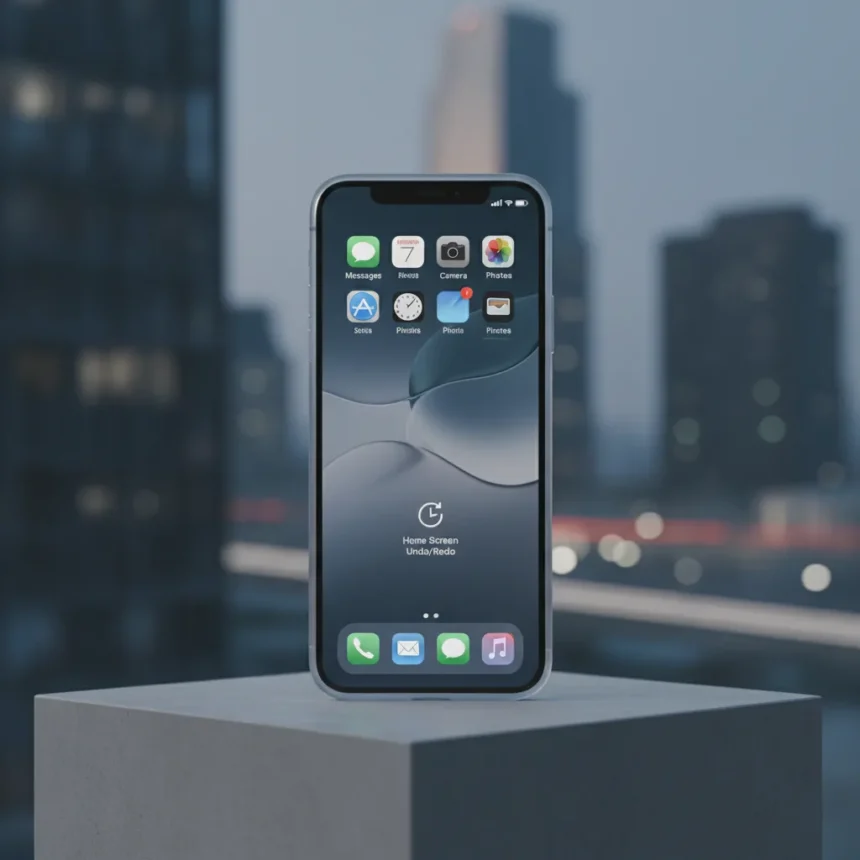
iOS 27 app updates will reshape how iPhone users interact with core applications, but Apple’s philosophy for this release prioritizes optimization and stability over flashy interface overhauls. The operating system, expected to be announced at Apple’s Worldwide Developers Conference in June 2026, represents a strategic shift away from major design revamps toward refining existing tools that millions use daily.
Key Takeaways
- iOS 27 app updates focus on Camera, Photos, and Siri with refined functionality rather than complete redesigns
- Home Screen Undo and Redo buttons let users instantly correct accidental app placement mistakes
- New Siri mode in Camera app integrates visual intelligence for scanning nutritional labels and business cards
- Siri gains chatbot capabilities similar to Google Gemini and ChatGPT for complex multi-turn conversations
- Liquid Glass interface changes are limited in scope, with only streamlined adjustments to transparency controls
Home Screen Tools That Actually Solve Real Problems
Apple is finally addressing one of iOS’s most frustrating quirks: the inability to undo a misplaced app icon or widget. iOS 27 app updates introduce Undo and Redo buttons directly in the Home Screen editing menu, letting users instantly restore an accidentally moved icon to its previous position. This single feature eliminates the clumsy workaround of manually dragging icons back to memory.
Beyond simple undo functionality, the update includes a layout comparison feature that lets users quickly switch between different Home Screen arrangements to find the most convenient setup. For power users who maintain multiple Home Screen configurations, this streamlines the selection process without requiring manual recreation of each layout.
Siri Gets a Personality Upgrade—and Real Conversational Smarts
The iOS 27 app updates bring Siri a complete visual overhaul with a new glow effect and system-wide presence through a rebuilt search gesture. More importantly, Siri now handles complex commands and back-and-forth conversations, functioning as a chatbot comparable to Google Gemini and ChatGPT rather than a simple voice command processor. This represents Apple’s deepest integration of conversational AI into its core operating system.


The redesigned Siri system moves beyond single-query responses. Users can ask follow-up questions, refine requests mid-conversation, and expect Siri to maintain context across multiple turns. For iPhone users accustomed to Siri’s limitations, this shift toward true dialogue-based interaction narrows the gap between Apple’s assistant and competitors that have emphasized conversational depth for years.
Camera App Gains Visual Intelligence as Native Feature
iOS 27 app updates integrate visual intelligence directly into the Camera app through a new Siri mode, joining existing Photo, Video, Portrait, and Pano modes. Previously, visual intelligence required users to long-press the Camera Control or access it via Control Center—a friction point that limited adoption. Native integration removes that barrier.


The Camera’s new Siri mode enables specific, practical use cases: scanning nutritional labels and automatically logging dietary data into Apple Health, or capturing business card details and syncing them to Contacts. These workflows target health-conscious users and professionals who currently rely on separate apps to bridge the gap between camera capture and data entry. All visual intelligence capabilities run on Apple Foundation Models, powering this functionality without reliance on external AI services.
Liquid Glass: Refinement, Not Revolution
Reports indicate iOS 27 app updates include streamlined Liquid Glass adjustments, but don’t expect a major redesign of Apple’s transparency interface system. Users will gain a dedicated slider to adjust transparency levels of interface elements, giving finer control over visual clarity versus aesthetic effect. This targeted improvement addresses usability without overhauling the feature entirely.
The decision to refine rather than reinvent Liquid Glass reflects Apple’s broader iOS 27 philosophy: quality over novelty. Transparency effects already work in iOS 18; iOS 27 makes them more customizable rather than fundamentally different. This conservative approach contrasts sharply with the Siri redesign and Camera integration, where Apple is making substantial architectural changes.
Photos App Improvements Remain Vague
Collections feature improvements are coming to the Photos app in iOS 27, though specific details remain under wraps. Apple has not yet disclosed what these enhancements entail, leaving room for speculation about whether the changes address organizational challenges users face or introduce new curation tools. Expect clarity only at the official WWDC announcement.



What iOS 27 App Updates Tell Us About Apple’s Direction
The iOS 27 app updates paint a picture of a company prioritizing user experience refinement over attention-grabbing feature announcements. Performance optimization, bug fixes, and improved battery life take precedence over major visual overhauls. This shift suggests Apple recognizes that iPhone users increasingly value stability and reliability over the promise of revolutionary features that often ship with bugs.
The focus on core app improvements—Camera, Photos, Siri—signals that Apple sees these as the battleground for iOS competitiveness. Rather than introducing entirely new categories of functionality, iOS 27 deepens what already exists, making each tool more capable and integrated into the broader ecosystem.
Will iOS 27 app updates finally make Siri competitive?
iOS 27 app updates give Siri conversational abilities and contextual awareness that bring it closer to Google Gemini and ChatGPT. However, competitive parity depends on execution—whether Siri understands nuanced requests, maintains conversation context reliably, and integrates smoothly across third-party apps. The foundation is there; the proof arrives only after release.
When will iOS 27 be announced and released?
Apple will announce iOS 27 at its Worldwide Developers Conference in June 2026. The full release date has not yet been confirmed, though Apple typically rolls out major iOS versions in September following WWDC announcements. Developer betas will likely arrive immediately after the WWDC keynote.
Are older iPhones getting iOS 27 support?
iOS 27 app updates emphasize optimization for older devices, suggesting broad device compatibility. However, Apple has not yet announced which iPhone models will support iOS 27. Historical patterns suggest support extends back 5-6 years, but specific device eligibility awaits official confirmation at WWDC.
iOS 27 represents Apple’s bet that iPhone users crave depth over breadth—smarter Siri, more capable Camera, better Home Screen control. Whether that philosophy resonates depends entirely on execution when the system ships later in 2026. Until then, these iOS 27 app updates remain promising rumors backed by credible reporting, not confirmed features.
Edited by the All Things Geek team.
Source: TechRadar