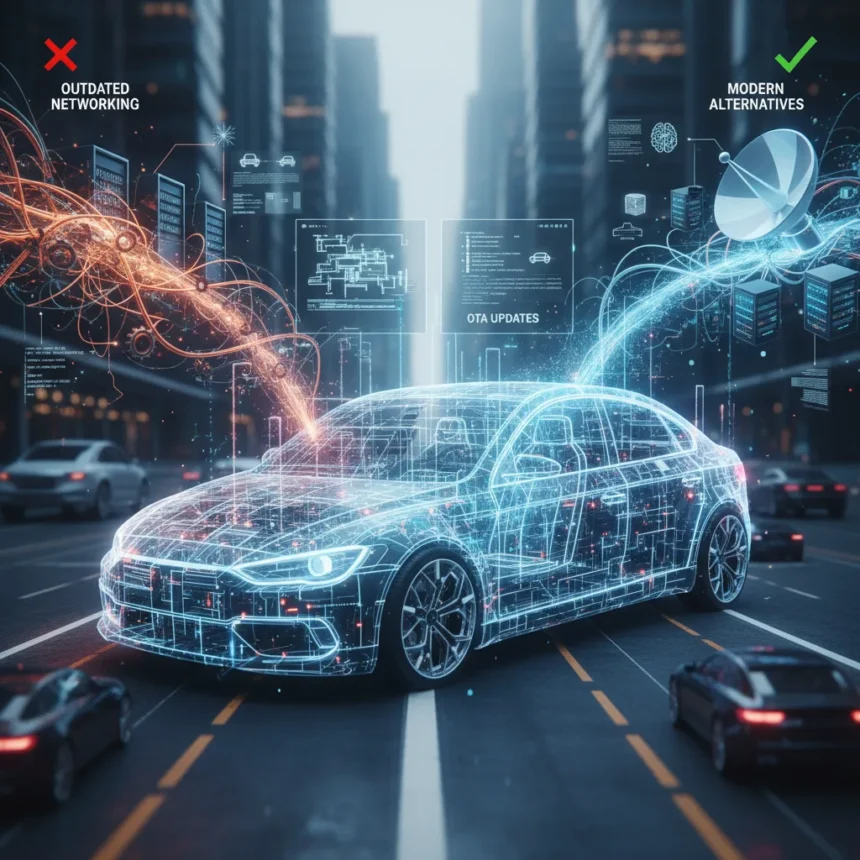
Software-defined vehicles architecture is the backbone of next-generation electric cars, yet most automakers are still building with yesterday’s constraints. A vehicle that can update its parking-assist algorithm over the air, push new infotainment features to owners, and reconfigure its entire electrical system without a dealer visit sounds like science fiction. It is not—but only if the underlying software strategy is right.
Key Takeaways
- Software-defined vehicles require deterministic, resilient systems; open source alone is insufficient for safety-critical performance.
- Traditional domain-controller architectures with static configurations cannot handle AI workloads, sensor fusion, and dynamic updates at scale.
- A single 8MP camera at 30fps saturates a 1Gbps Ethernet link, exposing network bottlenecks in conventional automotive designs.
- Ultra Ethernet enables programmable resource allocation and OTA updates without re-certification; TSN Ethernet requires months of re-validation for algorithmic shifts.
- Full software-defined vehicles from Tesla, Rivian, Lucid, and Volvo EX30 demonstrate that comprehensive OTA capabilities across drivetrain and infotainment are now table stakes.
Why Traditional Automotive Software Architecture Fails Modern EVs
Conventional automotive software relies on static domain controllers and fixed network configurations. Each subsystem—infotainment, powertrain, body electronics—operates in isolation, connected by Time-Sensitive Networking (TSN) Ethernet designed for deterministic, predictable data flows. This worked fine when cars were mechanical machines with software bolted on. It breaks down catastrophically when the car itself becomes software.
The data problem is immediate and physical. A single 8-megapixel camera streaming video at 30 frames per second saturates a 1-gigabit Ethernet link entirely. Add sensor fusion from lidar, radar, and multiple camera angles—requirements for autonomous or semi-autonomous driving—and traditional networks collapse. TSN was engineered for static schedules: you reserve bandwidth for known flows months in advance, submit designs for certification, and pray nothing changes. In a software-defined vehicle, everything changes constantly. Algorithms improve. Features ship over the air. New AI models replace old ones. The network cannot handle this dynamism.
The certification problem compounds the architectural failure. Under TSN, moving a parking-assist algorithm from one zone controller to another triggers a complete re-certification process that consumes months. The network topology is locked. The bandwidth allocations are locked. The software is locked. Change any variable and you restart certification from zero. This is not engineering conservatism—it is engineering paralysis, and it is incompatible with the pace at which software companies iterate.


Software-Defined Vehicles Architecture Demands Dynamic Networks
Modern software-defined vehicles architecture requires a fundamental shift: from managed scarcity to abundant, well-behaved capacity. Instead of static reservations, the network must allocate resources dynamically, responding to actual workload demands in real time. This is where Ultra Ethernet differs from TSN. Ultra Ethernet turns the network into a programmable resource rather than a fixed contract, enabling congestion management, flexible topologies, and runtime reconfiguration without hardware changes or re-certification.
The practical advantage is enormous. An OTA update that moves an algorithm between zone controllers works immediately under Ultra Ethernet. Under TSN, it does not work at all without months of re-validation. For an automaker shipping new features to millions of vehicles, this difference is the gap between competitive advantage and obsolescence. Tesla, Rivian, Lucid, Volvo with the EX30, and Chinese EV makers via Geely have already built full software-defined vehicles with comprehensive OTA capabilities spanning drivetrain logic, infotainment, and ecosystem integration. Their architecture decisions are now defining the industry baseline.



Centralized, zonal architectures replace the old domain-controller model. Instead of isolated subsystems communicating across fixed links, modern software-defined vehicles use a few powerful central compute nodes that handle AI inference, sensor fusion, and dynamic workload balancing. The network becomes the enabler of this flexibility, not the constraint. This is why the choice between TSN and Ultra Ethernet is not a networking detail—it is an architectural decision that determines whether a vehicle can evolve after it leaves the factory.
The Ecosystem Implications of Software-Defined Vehicles Architecture
Software-defined vehicles architecture extends far beyond the car itself. Full software-defined vehicles integrate phone apps, charging networks, repair ecosystems, financing platforms, and insurance services into a unified software experience. Tesla pioneered this model; Rivian, Lucid, and others have followed. General Motors is developing its own software-defined vehicle platform after abandoning Apple CarPlay and Android Auto integration, signaling that in-house control of the software stack is now essential to competitiveness. Mercedes is pursuing similar in-house development with MB.OS.
The shift reflects a deeper truth: vehicles are becoming software products that happen to have wheels. This means fewer in-house hardware components, more reliance on software for differentiation, and constant iteration via over-the-air updates. A vehicle that cannot update its core algorithms, reconfigure its electrical architecture, or deploy new features without a factory visit is already obsolete by software standards. The boundary between cars and phones is blurring—rumors of a Tesla phone and Xiaomi’s EV entry exemplify this convergence. Vehicles that embrace software-defined architecture will thrive in this environment. Those clinging to static, certified-once designs will not.
What Happens When Software Strategy Misaligns With Vehicle Design
Choosing the wrong software strategy creates cascading failures. A vehicle built on TSN architecture cannot iterate rapidly. New features require months of re-certification. Algorithms cannot shift between controllers without re-validation. Competitive features from software-native companies—Tesla, Xiaomi, or new EV startups—ship faster and iterate more aggressively. Over five to seven years, this compounds into a massive capability gap.



Safety and resilience are not sacrificed by choosing Ultra Ethernet and dynamic architectures. In fact, the opposite is true. Software-defined vehicles architecture built on modern networking standards enables continuous security updates, rapid patching of vulnerabilities, and real-time monitoring of system health. A vehicle locked into static, months-long certification cycles cannot respond to emerging threats. A vehicle with dynamic, programmable networks can push security patches to every car in the fleet within hours.
Is software-defined vehicles architecture only for luxury EVs?
No. While Tesla, Rivian, and Lucid have pioneered full software-defined vehicle implementations, the architecture is becoming table stakes across the industry. Volvo EX30 and Polestar models use Android Automotive as a foundation for software-defined features. Chinese EV makers, including those under the Geely umbrella, are building comprehensive OTA capabilities. The question is not whether software-defined vehicles architecture will become standard—it already is. The question is whether legacy automakers can transition fast enough to compete.
Can TSN Ethernet work for software-defined vehicles?
TSN Ethernet is adequate for domain-controller architectures with centralized on-ramps, but it is fundamentally inadequate for AI-driven, data-intensive software-defined vehicles. TSN cannot handle the burst traffic from AI workloads, the dynamic reconfiguration demands of modern software iteration, or the scale of sensor fusion required for autonomous features. It was designed for a different era of automotive design. Upgrading to Ultra Ethernet or equivalent dynamic networking standards is not optional for vehicles that need to compete in the 2025+ market.
The software strategy a car company chooses today determines whether it can innovate tomorrow. Static architectures, rigid certification processes, and isolated domain controllers were acceptable when vehicles changed once every five years. They are death sentences in a software-defined world where features ship monthly and algorithms improve weekly. The automakers that recognize this—and invest in dynamic, programmable software-defined vehicles architecture—will lead the next decade. The rest will spend their time re-certifying yesterday’s designs.
Edited by the All Things Geek team.
Source: TechRadar