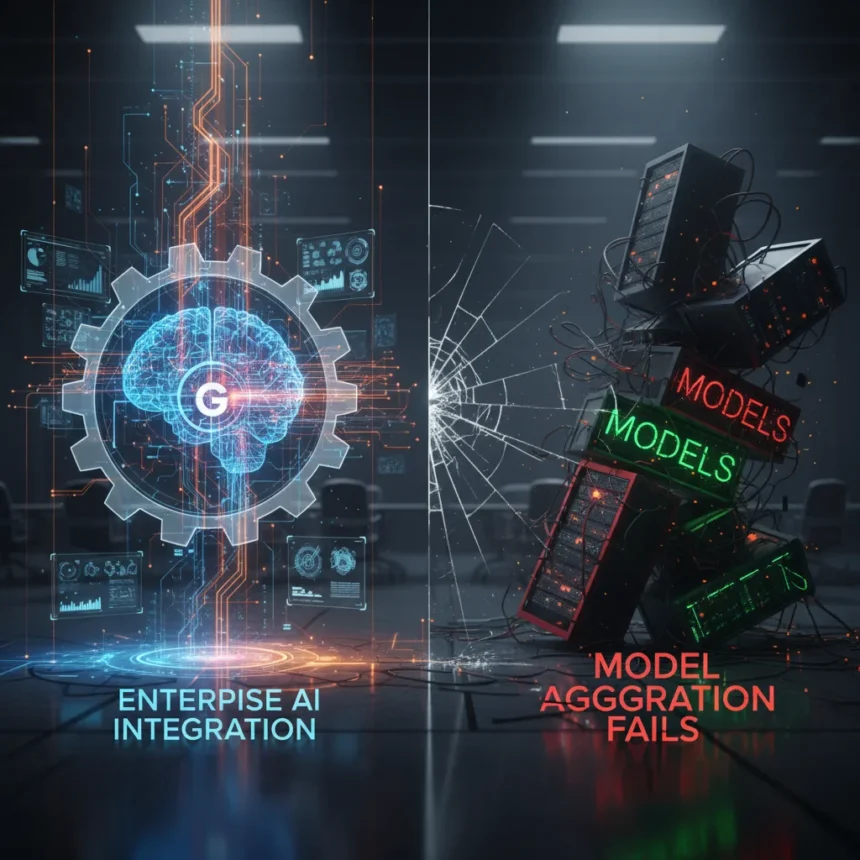
Enterprise AI integration is reshaping how organizations deploy artificial intelligence—and the shift away from model aggregation is dramatic. Rather than chasing the latest foundation models or stitching together multiple AI systems, forward-thinking enterprises are embedding intelligence directly into workflows, data systems, and business operations. The bottleneck is no longer capability; it’s orchestration.
Key Takeaways
- Enterprise AI integration focuses on embedding AI into existing workflows, not stacking multiple models together.
- Model orchestration fails without governance, clean data, and legacy system harmonization.
- Enterprises treat AI as a feature within tools like data fabrics, not as a standalone product.
- Forward-deployed engineers combine AI with domain expertise to solve high-stakes accuracy challenges.
- Model-agnostic infrastructure lets organizations swap providers without retooling entire systems.
Why Model Aggregation Misses the Mark
Model aggregation—combining multiple AI systems in hopes of better outcomes—sounds logical until execution begins. The reality is messier. Without governance structures, security protocols, clean data harmonization, and strategies for handling legacy systems and edge cases, aggregating models creates sprawl, not synergy. Many enterprises discover that bolting AI onto existing stacks introduces friction rather than efficiency.
The problem has a name: swivel-chair syndrome. Teams manually shuffle data between systems, feeding outputs from one tool into another, while bolted-on AI adds complexity without solving the underlying integration challenge. This manual choreography defeats the purpose of automation and introduces error-prone handoffs. The solution isn’t more models—it’s embedding AI directly into the systems where work actually happens.
Enterprise AI Integration Demands Workflow Embedding
What separates successful enterprise AI from failed pilots is simple: integration into existing workflows. Organizations that treat AI as a feature—an enabler woven into business processes—see real returns. Those treating AI as a product to deploy separately struggle with adoption, governance, and measurable impact.

Forward-deployed engineers work alongside domain experts to embed AI into workflows using clean, harmonized data. In healthcare, finance, and manufacturing, high-stakes accuracy demands this partnership. A data fabric like Cohesity Gaia, for example, uses retrieval-augmented generation (RAG) to ground AI responses in internal company knowledge rather than relying on generic model outputs. Stack Overflow’s internal system similarly retrieves company-specific knowledge to ensure AI responses stay anchored in organizational context.
Oracle’s approach with Fusion AI Agent Studio illustrates the shift: supervisor agents gather updates and assign tasks while specialist agents handle specific functions like resume screening or offer calculations, all collaborating through business data, APIs, and communication tools like Teams and Slack. This is AI built into the fabric of operations, not bolted onto the side.



The Infrastructure Shift: Model-Agnostic Systems
The most successful enterprises this year won’t be the ones betting on a single model provider—they’ll be the ones that built infrastructure flexible enough to use multiple models interchangeably. As model capabilities improve monthly and leadership changes, locking into one provider becomes a liability.
Integration platforms like Workato connect AI to over 1,200 applications, handling authentication, error recovery, and orchestration across complex enterprise ecosystems. Paired with model providers offering flexibility, this approach decouples the user interface from underlying models. Tools designed for model-agnostic deployment mean swapping providers doesn’t require retooling workflows. This architectural flexibility becomes critical as agentic AI—where machines act as autonomous agents rather than assistants—scales across organizations.
Governance and networking are equally critical. Multi-cloud and edge deployments demand unified operating models to prevent AI sprawl, unmanaged risk, and duplicated costs. As agentic AI extends into more autonomous decision-making, Zero Trust compliance and security governance become non-negotiable.
The Last-Mile Challenge: Vertical Integration
Even with robust integration platforms, enterprises face a last-mile problem. Micro-SaaS solutions targeting specific verticals—healthcare practice management, financial compliance, manufacturing scheduling—require AI talent or third-party platforms to bridge the gap between generic AI and domain-specific workflows. Organizations lacking in-house expertise increasingly turn to integration specialists or platforms that can handle this translation layer.



The shift is accelerating. A PwC survey found that while many Fortune 1000 companies already have AI embedded in workflows, nearly half are only now scaling to products and services. This gap between pilots and production represents the real competitive battleground: not which model is smartest, but which organization can integrate AI fastest and most securely into operations that drive revenue.
Can you use multiple AI models in enterprise systems?
Yes, but aggregation alone fails. Successful multi-model enterprises use model-agnostic infrastructure that treats models as interchangeable components within integrated workflows. This requires governance, clean data, and orchestration platforms that handle authentication and error recovery across systems.
What’s the difference between enterprise AI integration and model orchestration?
Model orchestration combines multiple models to solve a single problem; enterprise AI integration embeds intelligence across entire workflows, data systems, and operations. Orchestration is a tactic; integration is a strategy that includes governance, security, and legacy system harmonization.
How does RAG improve enterprise AI?
Retrieval-augmented generation grounds AI responses in internal company knowledge rather than generic model outputs. Stack Overflow’s internal system and Cohesity Gaia both use RAG to ensure AI stays anchored in organizational context, reducing hallucinations and improving accuracy for high-stakes decisions.
The future of enterprise AI belongs to organizations that stop chasing models and start building integration infrastructure. Model capability is no longer the constraint—workflow embedding, governance, and data harmonization are. Companies that embed AI into existing systems, treat it as a feature rather than a product, and maintain flexibility to swap providers will outpace those betting on any single model. The competitive advantage isn’t the AI; it’s the infrastructure that makes AI work at scale.
Edited by the All Things Geek team.
Source: TechRadar