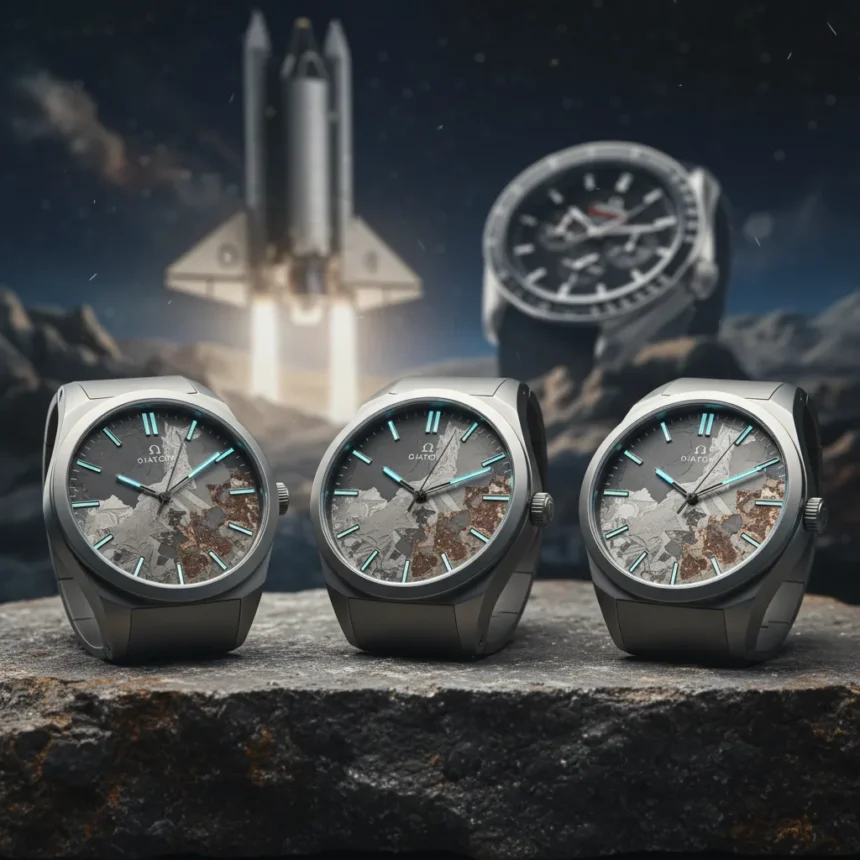
Diatom Terra Meteorite watches bring genuine extraterrestrial material to your wrist, using actual meteorite slices for dials instead of Earth-made components. While NASA’s Artemis II mission crew wore the Omega Speedmaster X-33 Gen 2, a mission-qualified but terrestrial timepiece, Diatom positions its collection as the true alternative for collectors who want real space material on their wrist.
Key Takeaways
- Diatom Terra Meteorite collection uses genuine meteorite slices with Widmanstätten patterns from 4.5-billion-year-old space rocks.
- Artemis II crew wore Omega Speedmaster X-33 Gen 2 (titanium ana-digi, NASA-issued) and Breitling Navitimer Cosmonaute B02 (mechanical, 24-hour dial).
- Diatom meteorite watches start around $2,200 for chronographs; limited editions reach $3,800+.
- Omega X-33 discontinued for consumers; secondary market prices $5,000–$7,000.
- Artemis II launched April 1, 2026, reviving NASA watch tradition but without actual space material.
Why Diatom Terra Meteorite watches matter now
Artemis II’s April 2026 launch reignited interest in space-qualified watches, but the mission’s official timepiece—the Omega Speedmaster X-33 Gen 2—is engineered for space, not sourced from it. Diatom Terra Meteorite watches capitalize on this gap by offering something the Omega cannot: actual meteorite material. The collection uses slices of the Muonionalusta meteorite from Sweden, a 4.5-billion-year-old iron-nickel alloy that crashed to Earth millennia ago. When cut thin for watch dials, these meteorite slices reveal distinctive Widmanstätten patterns—geometric crystalline structures that form only in space and cannot be replicated on Earth. This is not symbolic space heritage; it is literal cosmic material on your wrist.
The Artemis II crew—Reid Wiseman, Victor Glover, Jeremy Hansen, and Christina Koch—wore the Omega Speedmaster X-33 Gen 2 externally on their suits during the mission. This quartz ana-digi watch features titanium construction and modern avionics-style displays, optimized for mission readiness rather than traditional watchmaking. The crew also wore personal choices like the Breitling Navitimer Cosmonaute B02, a mechanical 24-hour dial watch with aviation and space heritage dating back to Scott Carpenter’s 1962 Mercury flight. Both are prestigious, both are mission-proven—but neither contains actual space material.
Diatom Terra Meteorite specs and collection models
Diatom Terra Meteorite watches feature high-end mechanical specifications that compete directly with traditional luxury sports watches. The collection includes automatic movements from Miyota or Sellita calibers, sapphire crystals, stainless steel or titanium cases in 38–42mm diameters, and water resistance rated to 100m or higher. Models include the Diatom Terra Meteorite Chronograph (around $2,200), the Diatom Terra Dual Time, and limited-edition runs of 50–100 pieces per variant, with premium editions reaching $3,800 and beyond. Each meteorite dial is unique—the crystalline patterns vary from slice to slice, meaning no two watches are identical.


The meteorite sourcing is verifiable and traceable. Diatom sources material from documented meteorite falls, primarily the Muonionalusta meteorite from Sweden, ensuring authenticity and rarity. This contrasts sharply with the Omega Speedmaster X-33 Gen 2, which, despite its Artemis II pedigree, uses conventional dial materials and Earth-sourced components. The Omega is mission-qualified through rigorous NASA testing protocols—a credential Diatom does not claim—but it does not offer the otherworldly appeal of actual space material.
How Diatom compares to Artemis mission watches
The Omega Speedmaster X-33 Gen 2 dominates NASA’s modern space program. This watch was selected for Artemis II because it combines analog and digital displays for redundancy, withstands extreme temperatures and radiation, and has proven itself in spaceflight since the Speedmaster’s Apollo-era debut. However, the X-33 is now discontinued for consumer sale; secondary-market examples fetch $5,000–$7,000, well above Diatom’s entry-level pricing. The Breitling Navitimer Cosmonaute B02, worn by male Artemis crew members, costs $8,000–$10,000 at retail and offers mechanical prestige with 24-hour dial functionality inherited from early space-program watches.



Diatom’s advantage is accessibility and novelty. At $2,200–$4,500, the collection offers genuine meteorite dials at a fraction of the secondary-market Omega’s cost and below new Breitling pricing. The meteorite material is the story—it is a conversation piece that neither the Omega nor the Breitling can match, despite their mission credentials. Diatom does not claim NASA endorsement or mission qualification; instead, it leans into the cosmic material itself as the differentiator. For collectors who prioritize extraterrestrial authenticity over mission provenance, Diatom Terra Meteorite watches deliver something neither Artemis-flown watch can: a piece of space you can wear and see.
Availability and where to buy
Diatom Terra Meteorite watches are available now through the Diatom website and select luxury retailers, with confirmed stock in the US and EU and global shipping options. The limited-edition runs mean inventory is finite—50–100 pieces per model variant—so popular configurations sell through quickly. Pricing ranges from approximately $2,200 for entry-level chronographs to $3,800+ for premium meteorite editions with additional complications or case upgrades. Unlike the Omega X-33, which is no longer in production for consumers, Diatom is actively manufacturing and releasing new meteorite dial variants, making it a realistic purchase option for those seeking space material now.
Should I buy a Diatom Terra Meteorite watch instead of an Artemis II Omega?
If you prioritize mission heritage and NASA qualification, the Omega Speedmaster X-33 Gen 2 is unmatched—but it is hard to find and expensive on the secondary market. If you want actual meteorite material and are willing to skip mission provenance, Diatom Terra Meteorite watches offer genuine cosmic appeal at accessible pricing. The choice depends on whether you value space-program credibility or extraterrestrial authenticity more.
What makes meteorite watch dials unique?
Meteorite dials display Widmanstätten patterns, geometric crystalline structures that form only in space over billions of years and cannot be artificially replicated on Earth. Each meteorite slice is unique, so no two Diatom Terra Meteorite watches have identical dials. This rarity and authenticity are what distinguish them from symbolic space watches like the Omega Speedmaster or Breitling Cosmonaute.



Are Diatom Terra Meteorite watches as durable as mission-flown watches?
Diatom Terra Meteorite watches meet conventional luxury watch durability standards—sapphire crystals, 100m+ water resistance, and proven automatic movements—but they are not NASA-tested like the Omega X-33. Meteorite material itself is extremely hard and stable, but the watches are designed as luxury dress-sports pieces rather than extreme-condition instruments. For daily wear and collector display, they are robust; for actual space missions, they lack the qualification the Omega carries.
Diatom Terra Meteorite watches occupy a unique position in the luxury watch landscape: they offer genuine space material at accessible pricing, without the mission credentials or secondary-market premiums of Artemis-era timepieces. For collectors who want to wear a piece of the cosmos without waiting for a secondary-market Omega or paying Breitling’s premium, Diatom delivers authenticity where Artemis watches deliver heritage. The question is not which is better, but which story you want your wrist to tell.
Edited by the All Things Geek team.
Source: T3