




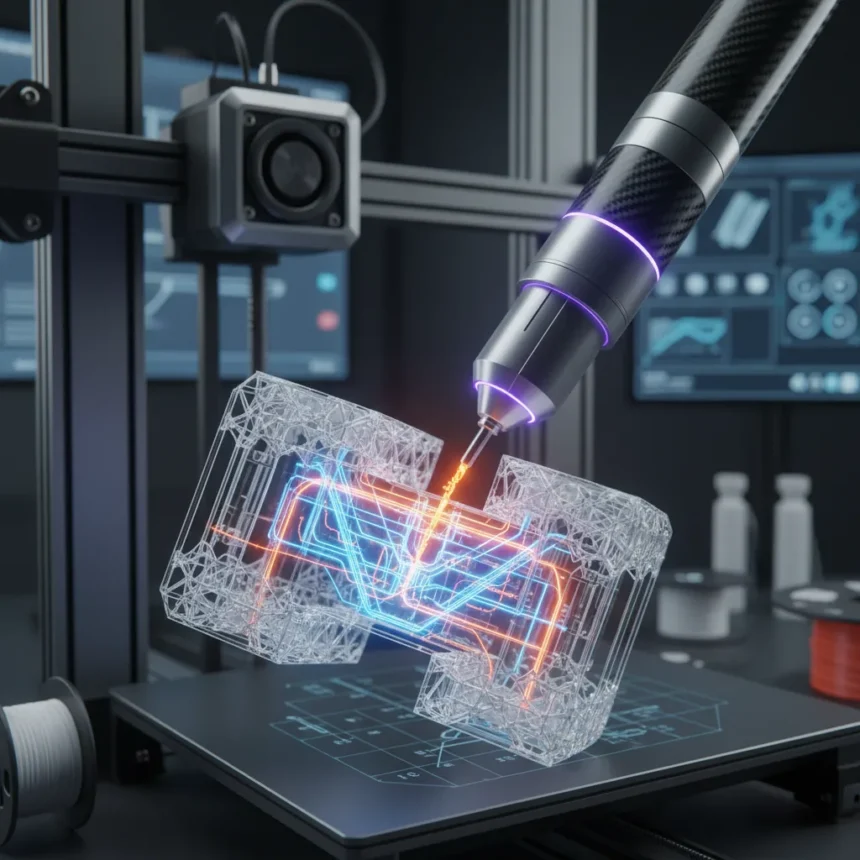
Microwave 3D printing electronics has finally crossed a threshold that researchers have chased for over a decade. In April 2025, engineers at Rice University published a breakthrough method that uses focused microwave energy to heat electronic inks and filaments during printing, enabling circuits to fuse inside objects without damaging temperature-sensitive materials around them.
Key Takeaways
- Microwave 3D printing electronics achieves heating precision down to 150 micrometers, roughly human hair width
- Meta-NFS technology concentrates microwave energy to selectively activate inks mid-print without surrounding material damage
- Enables hybrid devices like wireless sensors on bone implants, biopolymers, and living tissue
- Works with metals, ceramics, and thermoset polymers in desktop-size printers
- Overcomes barrier that has blocked multimaterial electronics integration for over 10 years
Why Microwave 3D Printing Electronics Matters Now
The core problem is ancient in 3D printing terms: you cannot heat electronic ink hot enough to activate it without melting or damaging the temperature-sensitive material underneath. A wireless strain sensor needs its circuits fused at high temperature, but the biopolymer substrate below it cannot withstand that heat. Light-based heating only works on surfaces. Traditional ovens lack precision. For a decade, this has been a dead end.
Yong Lin Kong, assistant professor of mechanical engineering at Rice University, and his team solved it by weaponizing microwave energy. Instead of blasting an entire print with uniform heat, they designed a metamaterial-inspired structure called Meta-NFS that focuses microwave radiation to a zone just 150 micrometers wide—narrow enough to heat only the ink you want to activate. The surrounding material stays cool.
How Microwave 3D Printing Electronics Actually Works
The process starts with filament coated in multi-walled carbon nanotubes (MWCNTs), materials that absorb microwave energy and convert it to heat. As you print normally, the MWCNTs localize at the interfaces between layers due to plastic flow. When you expose the printed object to focused microwaves, those nanotubes heat up to around 160°C for 60 seconds, boosting layer adhesion and fusing circuits without the surrounding material ever reaching dangerous temperatures.



The real innovation is the focusing mechanism. Meta-NFS concentrates microwave energy to sub-millimeter resolution, which means you can program the ink’s functional properties—electrical and mechanical—during the printing process itself. You are not just printing a shape. You are printing and simultaneously tuning what that shape does, all inside a desktop printer. No complex facilities. No manual post-processing.
Researchers demonstrated this with proof-of-concepts that read like science fiction: wireless strain sensors printed directly onto ultrahigh-molecular-weight polyethylene (the material used in joint replacements), bovine femur bone, and even living leaves. These are not theoretical. They printed them, activated the circuits with focused microwaves, and the sensors worked.



Where Microwave 3D Printing Electronics Stands Against Alternatives
The competitive landscape reveals why this matters. Previous attempts at multimaterial electronics relied on light-based heating, which only penetrates surfaces and works slowly on opaque structures. Graphite flake composites in shape-memory polymers can be heated via standard microwave ovens at 2.45 GHz, but that approach lacks precision and cannot target specific regions. An earlier precursor called locally induced RF (LIRF) welding, developed in 2017, used MWCNTs to strengthen layer adhesion in PLA, but it was never designed for electronics integration and lacked the focusing capability that Meta-NFS provides.
Microwave 3D printing electronics beats these alternatives on one critical dimension: selectivity. You can activate circuits in one part of a print while leaving adjacent materials untouched. This unlocks hybrid devices that were impossible before—a biopolymer implant with embedded sensors, a living plant with wireless monitoring, a ceramic part with internal metal traces.
What Comes Next for Microwave 3D Printing Electronics
The research is published, the proof-of-concepts work, and the technology fits on a desktop. What is missing is scale. The brief mentions Meta-NFS and a related LIRF patent pending, suggesting Rice is protecting the intellectual property, but there is no timeline for commercialization, no licensing announcements, and no partnerships with 3D printer manufacturers announced yet.
The gap between lab and market is real. Proof-of-concept sensors on bone and leaves are compelling, but they are not the same as FDA-approved implants or commercial biopolymer parts rolling off production lines. The researchers have solved the heating problem. They have not yet solved the biocompatibility, regulatory, and manufacturing scale problems. Those are next.



Still, this is the moment the field has been waiting for. Microwave 3D printing electronics removes the core technical barrier that has blocked hybrid device development for over a decade. What happens next depends on whether universities, manufacturers, and investors see the opportunity and move fast enough to capture it.
What materials work with microwave 3D printing electronics?
The technology works across metals, ceramics, and thermoset polymers. Microwaves penetrate these materials to heat fully encapsulated inks, which is why it works better than light-based methods that only affect surfaces.
Can you use microwave 3D printing electronics in a regular 3D printer?
Yes. The system is desktop-compatible and requires no complex facilities or labor-intensive manual processes. You print normally with MWCNT-coated filament, then expose the object to focused microwave energy.
How precise is the heating in microwave 3D printing electronics?
Meta-NFS achieves heating precision down to 150 micrometers, roughly the width of a human hair. This sub-millimeter resolution allows selective activation of inks without damaging surrounding materials.
Microwave 3D printing electronics is not a distant possibility—it is here, validated, and waiting for the manufacturing world to catch up. The barrier is broken. What comes next is up to the people who turn research into products.
This article was written with AI assistance and editorially reviewed.
Source: Tom's Hardware