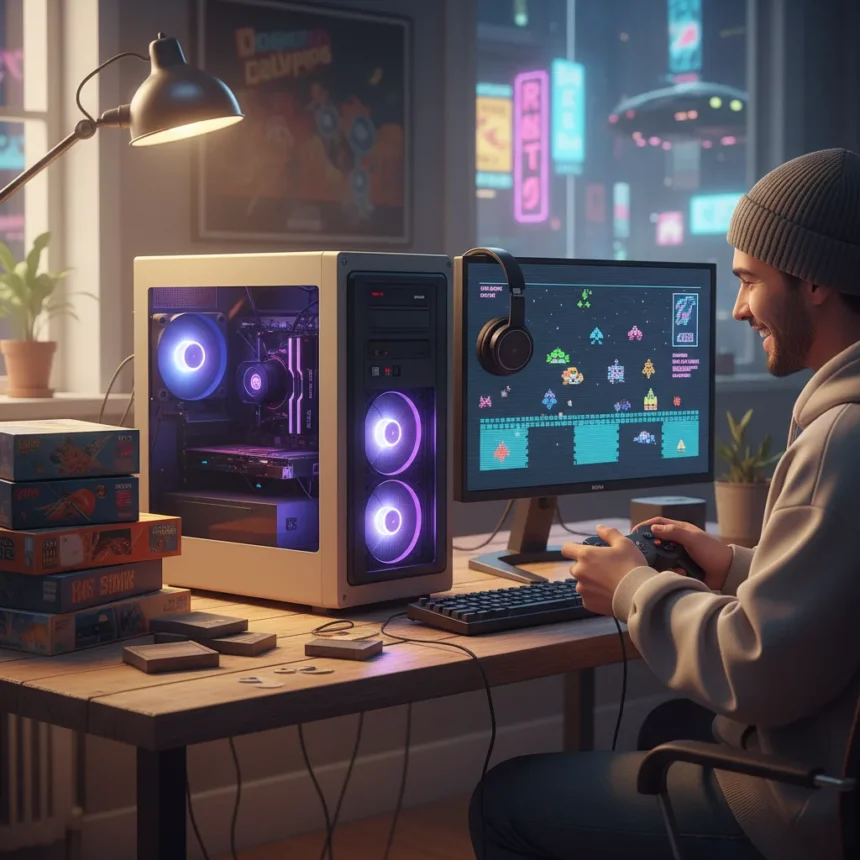
The retro gaming PC boom is reshaping how millions of gamers spend their time and money in 2026, driven not by pure nostalgia but by genuine frustration with modern gaming’s cost spiral. New games now command $70 to $80 at launch, paired with hardware that demands constant upgrades and premium pricing that locks casual players out entirely. Retro gaming has become the practical escape hatch.
Key Takeaways
- Modern games cost $70–80, while retro titles cost pennies and run on cheap hardware.
- CES 2026 saw major retro gaming reveals from Thermaltake, ACEMAGIC, AYANEO, 8BitDo, Atari, and MyArcade.
- AYANEO AM01 NES-styled PC estimated at $299.99 USD offers modern specs in retro packaging.
- ACEMAGIC Retro X5 includes AMD Ryzen AI 9 HX 370 and RetroPlay Box software to lower entry barriers.
- Handhelds like TrimUI Brick and RG35XXSP provide even cheaper alternatives to full retro PCs.
One YouTuber captured the mood perfectly: “Between $70 to $80 new games, overpriced hardware, and the constant pressure to keep up, a lot of us are getting quietly priced out of a hobby we love. Retro games have become the easiest way for me to enjoy gaming again, protect my wallet, and actually have fun while the modern industry calms down”. This is not sentimentality. It is economics.
Why the retro gaming PC boom is happening right now
The timing is not accidental. 2026 marks the moment when modern gaming’s cost-to-enjoyment ratio broke for millions of players. A single new AAA title at $70–80, combined with the pressure to upgrade graphics cards and processors every two years, has created an affordability crisis that even casual gamers notice. Retro games sidestep this entirely. A classic title costs a few dollars or nothing. It runs on decade-old hardware. There is no battle pass, no cosmetics, no pressure to optimize settings.
Hardware makers have noticed. CES 2026 became a showcase for retro gaming devices, with reveals from 8BitDo, Atari, MyArcade, AceMagic, Thermaltake, and AYANEO all signaling that the market is real and growing. These are not niche indie companies. These are established brands betting significant engineering resources on the trend.


The shift also reflects a genuine rejection of modern game design. Players are tired of live-service mechanics, battle passes, and games designed to extract maximum playtime rather than deliver complete experiences. Retro titles, by contrast, are finished products—no patches, no live events, no pressure to return tomorrow.
The hardware leading the retro gaming PC boom
Thermaltake launched the Retro 260TG chassis, a Micro-ATX case with a front design evoking early home computing aesthetics. The case supports up to nine 120mm fans and a 280mm radiator, plus a 6-inch LCD screen for displaying retro themes and pixel art—making it a statement piece that actually functions as a serious gaming platform. Thermaltake also released matching accessories, including an AIO liquid cooler with nostalgic design, creating a complete retro ecosystem.



ACEMAGIC took a different approach with the Retro X5, a mini PC that mimics the original Nintendo Entertainment System form factor. Inside sits an AMD Ryzen AI 9 HX 370 processor with AMD Radeon 890M integrated graphics and an AMD XDNA 2 NPU capable of up to 50 TOPS compute power. The company bundled it with RetroPlay Box, an all-in-one software solution designed to simplify classic gaming setup and lower barriers for newcomers. This is the key innovation: making retro gaming accessible to people who do not want to tinker with emulators and ROM management.
AYANEO revealed the AM01 at CES 2026, another NES-styled PC with an estimated retail price of $299.99 USD. The strategy is consistent across all three: modern internals wrapped in retro exteriors, with software and ecosystem design focused on ease of entry rather than technical complexity.
Budget alternatives and the path forward
Full retro PCs are not the only option. Handhelds like the TrimUI Brick, RG35XXSP, RG477M, and AYN Thor offer even cheaper entry points for classic gaming. These devices are available through retailers like Amazon and AYNtec as of early 2026, providing a spectrum of price points and form factors. A handheld might cost a fraction of a full PC while delivering the same core experience for most retro titles.
Building your own retro gaming PC remains viable, though the research brief does not detail specific component recommendations or step-by-step instructions. The principle is straightforward: source used hardware from 10-15 years ago, pair it with a modest modern storage solution, install emulators or original operating systems, and spend far less than a modern gaming rig would cost. The retro gaming PC boom is partly driven by the realization that high-end hardware is unnecessary for the games people actually want to play.



Is the retro gaming PC boom sustainable?
The trend reflects real economic and emotional pressures, not temporary hype. As long as modern games remain expensive and modern hardware demands constant upgrades, retro gaming will retain its appeal. The 2026 resolution trend of replacing doom scrolling with retro gaming suggests this is becoming a lifestyle shift, not a passing fad.
What is the cheapest way to start retro gaming?
Handhelds like the TrimUI Brick and RG35XXSP are the most affordable entry point, costing significantly less than full PCs. These devices come pre-loaded with classic games and require minimal setup. If you prefer a traditional computer experience, building a used PC from 10-15-year-old components costs far less than modern gaming hardware while playing everything you want.
Can I build a retro gaming PC myself?
Yes. The retro gaming PC boom has partly been driven by the realization that you do not need latest hardware to enjoy classic games. Used components from older generations are inexpensive and widely available, making DIY builds a practical option for budget-conscious gamers.
The retro gaming PC boom is not nostalgia wearing a costume. It is a rational response to pricing that has made modern gaming unsustainable for millions of players. Hardware makers are responding with purpose-built devices, handhelds are proliferating, and the community is thriving. In 2026, the cheapest way to have genuine fun gaming is to stop chasing the new and embrace what already works.
Where to Buy
Anbernic RG351V | available for about $110 at Amazon
Edited by the All Things Geek team.
Source: Windows Central