

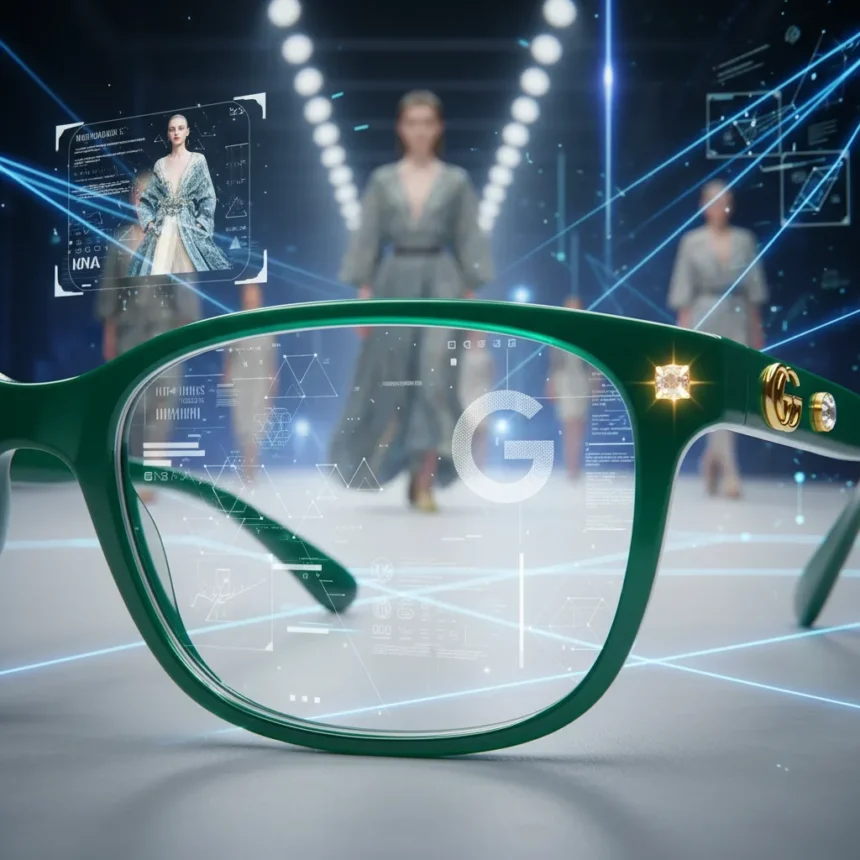
Gucci’s parent company Kering is partnering with Google to develop luxury smart glasses powered by Android XR, positioning the Italian fashion house as the first major luxury brand to enter the AI wearables market. Kering CEO Luca de Meo confirmed the collaboration during a Reuters interview at the company’s capital markets day in Florence, targeting a launch in 2027. The move signals how luxury conglomerates are betting on wearable technology to diversify revenue streams and compete with tech giants in a market once written off as a consumer failure.
Key Takeaways
- Gucci partners with Google to build Android XR smart glasses, targeting 2027 launch.
- Initiative aims to expand Gucci’s eyewear and jewelry segments, which represent limited current revenue.
- Devices will integrate cameras, microphones, and speakers for AI functionality.
- Direct competition with Ray-Ban smart glasses, which EssilorLuxottica produces with Meta.
- Google’s previous Glass effort failed due to lack of consumer adoption.
Why Luxury Brands Are Suddenly Betting on Smart Glasses
Gucci’s partnership with Google reflects a broader desperation in luxury fashion. Kering’s eyewear and jewelry divisions currently represent a small fraction of the conglomerate’s revenue, and Gucci itself faces slowing sales amid intense competition. Smart glasses offer a way to reinvent these categories—eyewear becomes a computing device, jewelry becomes a sensor. The timing is deliberate: as consumer adoption of AI accelerates, luxury brands see an opportunity to position themselves as lifestyle gatekeepers in the AI era, not just handbag makers.
The partnership also signals confidence in Android XR as a viable platform for consumer wearables. Google’s previous smart glasses venture, Google Glass, failed spectacularly and was discontinued due to lack of consumer adoption. That failure haunted the category for over a decade. Now, with AI as the killer app and Gucci’s design credibility backing the product, Google is betting it can succeed where it once stumbled. Luxury branding might be the missing ingredient that mass-market tech could not provide.
Luxury Smart Glasses Face Stiff Competition From Unexpected Rivals
Gucci will not enter an empty market. EssilorLuxottica, the eyewear giant behind Ray-Ban, has already partnered with Meta to produce Ray-Ban smart glasses, which combine style and functionality. Ray-Ban’s established distribution network and consumer trust in the brand give Meta a significant head start. Gucci’s advantage lies elsewhere: heritage, exclusivity, and the ability to charge premium prices. But Ray-Ban smart glasses are already in consumers’ hands, setting expectations and establishing the category.

The competitive dynamic also reveals a curious inversion in the tech industry. Five years ago, Meta and Google were racing to dominate AR and VR. Now they are outsourcing the actual product design to legacy brands—Meta to EssilorLuxottica, Google to Kering. This suggests that neither tech giant has cracked the industrial design problem that makes wearables actually wearable. Luxury fashion, for all its flaws, has spent centuries solving that problem. The partnership is not just about branding; it is about admitting that tech companies need fashion expertise to succeed in wearables.
What Gucci’s Smart Glasses Will Actually Do
The Gucci and Google smart glasses will integrate cameras, microphones, and speakers to enable AI interactions. Beyond those specifications, details remain sparse. The devices will run on Android XR, Google’s operating system for spatial computing, but the exact feature set is unconfirmed. What seems clear is that these are not augmented reality glasses in the sci-fi sense—they are more likely conversational AI devices that happen to be worn on the face, with visual and audio inputs powered by Gemini, Google’s AI model.


This functional ambiguity is intentional. Gucci benefits from mystery. The longer the company can control the narrative without showing a working prototype, the longer consumers can imagine these glasses as the ultimate luxury accessory. Once the device ships and people realize it is a slightly fancier way to talk to a chatbot, the magic dissipates. That tension between hype and reality will define the product’s success or failure.
Does This Partnership Actually Solve Gucci’s Sales Problem?
Here is the uncomfortable truth: a luxury smart glasses product, no matter how well-designed, is unlikely to reverse Gucci’s sales decline. Gucci’s core business—handbags, clothing, accessories—is where the money is. A niche wearable, even at premium pricing, cannot move the needle on a multi-billion-dollar fashion conglomerate. What the partnership does accomplish is signal to investors that Kering is thinking beyond traditional fashion. It is a halo play, not a revenue play. It generates headlines, attracts tech-savvy consumers, and keeps Gucci relevant in conversations about the future.
The real test is whether Gucci can actually ship a product that people want to wear. Ray-Ban smart glasses succeeded partly because Ray-Ban already makes sunglasses people buy. Gucci makes glasses too, but the brand is not synonymous with eyewear the way Ray-Ban is. Building a wearable that feels essential, not gimmicky, requires more than design credentials. It requires solving problems people actually have. Until Gucci and Google articulate what problem their smart glasses solve better than a phone in your pocket, skepticism is warranted.
When Will Gucci’s Smart Glasses Actually Launch?
Kering CEO Luca de Meo stated the target is 2027. That is roughly 18 months away at the time of announcement, which is a realistic but aggressive timeline for a completely new product category from a luxury brand with no prior wearables experience. Delays are common in hardware development, especially for first-generation products. Do not be surprised if launch slips into 2028. The company will likely start with limited availability in key markets before expanding globally, a typical luxury brand playbook.


How do Gucci’s smart glasses compare to Ray-Ban’s Meta glasses?
Ray-Ban smart glasses with Meta are already shipping and established in the market, while Gucci’s are still in development targeting 2027. Ray-Ban benefits from an existing eyewear customer base and Meta’s AI infrastructure, whereas Gucci is entering the category fresh but brings heritage and design credibility. Ray-Ban’s advantage is availability now; Gucci’s is the promise of luxury positioning and Android XR integration.
Will Gucci’s smart glasses fix the company’s slowing sales?
A niche wearable product is unlikely to meaningfully reverse Gucci’s broader sales challenges. The partnership is a strategic signal to investors and consumers that Kering is innovating, not a core revenue driver. Success will be measured in brand perception and long-term positioning, not immediate sales impact.
Gucci and Google’s partnership represents a calculated bet that luxury and AI can merge into something consumers actually want to wear. It is not a guaranteed success—Google Glass proved that tech alone cannot sustain a wearables category. But Gucci’s design pedigree and Google’s AI capabilities might finally crack the code that eluded both companies separately. The next 18 months will determine whether luxury smart glasses are the future of fashion tech or another expensive experiment destined for the clearance bin.
This article was written with AI assistance and editorially reviewed.
Source: Android Central