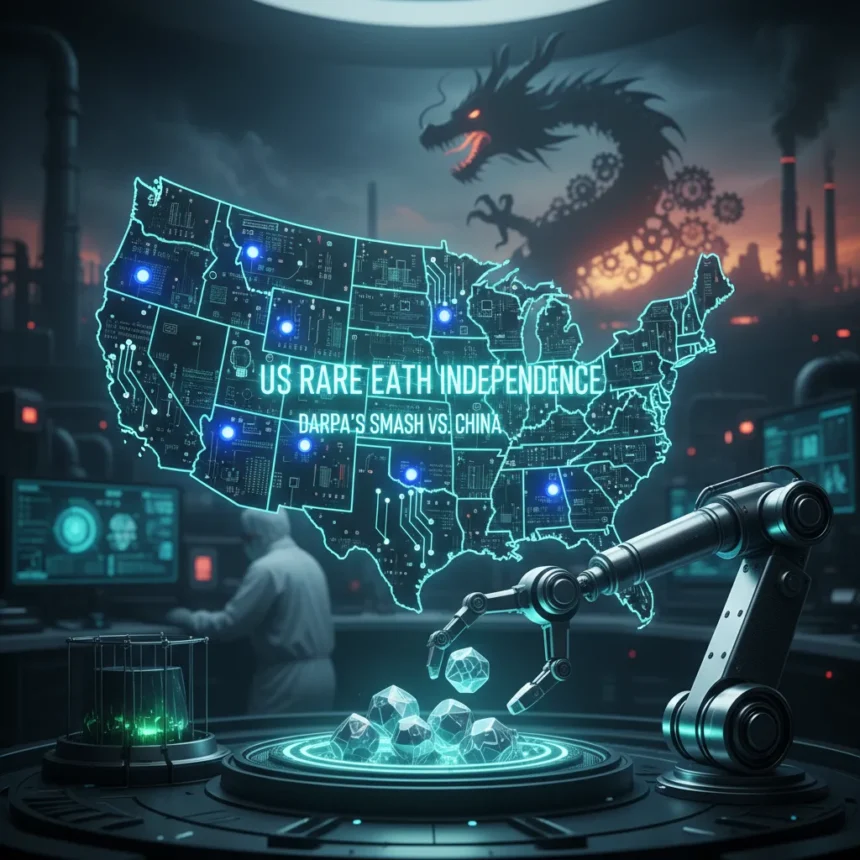
The US has abundant rare earth minerals buried in its soil. It cannot process them. That contradiction sits at the heart of America’s supply chain vulnerability, and it is exactly what DARPA’s Smash program aims to solve. Rare earth independence has become a national security imperative as China controls nearly the entire global processing infrastructure for these elements critical to semiconductors, defense systems, and advanced manufacturing.
Key Takeaways
- DARPA’s Smash program targets processing bottlenecks rather than building new mines.
- The US has abundant rare earth minerals but lacks domestic processing capacity.
- China’s near-monopoly on rare earth processing enables strategic supply chain control.
- Smash aims to extract multiple elements simultaneously with near-zero waste.
- Proposals are open nationally with a deadline of April 24, 2026.
Why Rare Earth Independence Matters Right Now
Rare earth independence is no longer theoretical geopolitics—it is a concrete industrial challenge. The US produces rare earth ore but ships it overseas for processing, then buys back the refined materials at whatever price China dictates. This dependency creates vulnerability during trade disputes, geopolitical tensions, or supply disruptions. Current US mining and processing methods focus on extracting a single valuable element from ore, discarding the rest as waste. It is economically inefficient and environmentally destructive. China, by contrast, has optimized its entire processing ecosystem to handle complex, multi-element extraction at scale, cementing its dominance.
DARPA’s Smash program attacks this problem from an unexpected angle. Rather than proposing new mines—which face permitting battles and environmental opposition—the initiative focuses on revolutionary processing technology. The program runs for 48 months across two phases and targets advanced technologies for efficient, scalable, near-zero-waste separation of elements from ore. The goal is simultaneous extraction of multiple elements from diverse feedstocks with higher yield, purity, and energy efficiency than existing methods.
How Smash Differs From Traditional US Rare Earth Processing
Traditional US rare earth processing is built around single-element optimization. Miners extract ore, refineries separate out the target element, and everything else becomes waste. This approach made sense when rare earth prices were low and environmental costs were externalized. Today, it is economically obsolete and strategically dangerous. Smash envisions a parallel processing model that recovers multiple valuable elements from the same feedstock simultaneously, dramatically reducing waste and energy consumption. The technology would scale to industrial mining operations, transforming the entire supply chain architecture rather than bolting improvements onto legacy systems.

This distinction matters because it means rare earth independence does not require massive capital investment in new mines. It requires breakthroughs in chemistry, materials science, and engineering—precisely the domains where DARPA has historically driven innovation. A single centralized mine represents a risk, as the program’s framing suggests. Distributed processing capacity built on advanced separation technology offers resilience and flexibility that centralized mining cannot match.
Can DARPA Actually Deliver Rare Earth Independence?
The honest answer is: nobody knows yet. Smash is in its solicitation phase, with proposals due April 24, 2026. The program has not produced working prototypes or demonstrated that its vision scales beyond laboratory conditions. DARPA solicitation DARPA-PA-26-04 requires applicants to present commercialization strategies with techno-economic and risk analyses, acknowledging that technical feasibility is only half the battle. Moving from a lab breakthrough to industrial-scale processing that competes with China’s entrenched ecosystem is a monumental leap.



The program’s ambition extends beyond rare earths alone. Smash targets efficient separation of elements across the entire periodic table, including copper and other critical metals. This breadth suggests DARPA is thinking long-term about a fundamental shift in how the US approaches materials processing. But it also increases technical risk—solving this problem for rare earths is hard enough without also solving it for every other element simultaneously.
Comparison to related DARPA efforts provides context. The agency previously funded SPREE (Separation and Purification of Rare Earth Elements), which targeted sustainable rare earth separation techniques. SPREE represented an earlier, narrower attempt at the same problem. Smash is more ambitious in scope but faces the same core challenge: turning research into industrial-scale reality. Success requires not just chemistry breakthroughs but also manufacturing scale-up, supply chain integration, and cost competitiveness with China’s entrenched players.
The Geopolitical Stakes Behind Rare Earth Independence
Why does the US government care this much about rare earth independence? Because China has weaponized processing capacity. During trade disputes, Beijing has threatened to restrict rare earth exports, knowing that no alternative supply exists at scale. Semiconductors, electric vehicles, wind turbines, and military systems all depend on rare earth elements. A supply disruption would cripple manufacturing across multiple sectors simultaneously. Rare earth independence removes that leverage.
Smash also aligns with broader circular economy and environmental goals. Current processing generates enormous waste streams and consumes massive amounts of water. Near-zero-waste processing would support domestic supply chains while reducing environmental harm. For a government trying to balance national security, manufacturing competitiveness, and environmental responsibility, Smash represents a rare alignment of all three.



What Happens If Smash Fails?
If the program does not deliver working technology by 2030, the US faces a difficult choice. It can continue relying on Chinese processing, accept the supply chain vulnerability, or invest in new domestic mines despite environmental and permitting challenges. None of those options is attractive. That pressure—the absence of a plan B—is both Smash’s greatest strength and its greatest risk. DARPA programs succeed or fail based on technical ambition and execution, not market demand. Rare earth independence has market demand. The question is whether the technology can keep pace with geopolitical urgency.
FAQ
What is DARPA’s Smash program designed to do?
Smash develops advanced technologies for efficient, scalable, near-zero-waste separation of elements from ore, aiming to enable simultaneous extraction of multiple elements from diverse feedstocks. The 48-month program focuses on processing breakthroughs rather than new mining operations.
Why does the US struggle with rare earth independence if it has the minerals?
The US produces rare earth ore but lacks domestic processing capacity. Current US methods focus on single-element extraction, discarding most material as waste, while China controls the global processing infrastructure. Smash aims to solve this processing bottleneck through advanced technology.
When can companies apply for Smash funding?
Proposals are open nationally with a deadline of April 24, 2026. The solicitation (DARPA-PA-26-04) is a full, open competition requiring applicants to demonstrate commercialization strategies alongside technical approaches.
Rare earth independence remains more aspiration than reality today. DARPA’s Smash program represents the US government’s bet that processing innovation can overcome China’s dominance where traditional mining and incremental improvements have failed. Whether that bet pays off depends entirely on whether the next generation of materials scientists and engineers can deliver breakthroughs on an aggressive timeline. The geopolitical stakes suggest they will try harder than ever before.
Edited by the All Things Geek team.
Source: TechRadar