





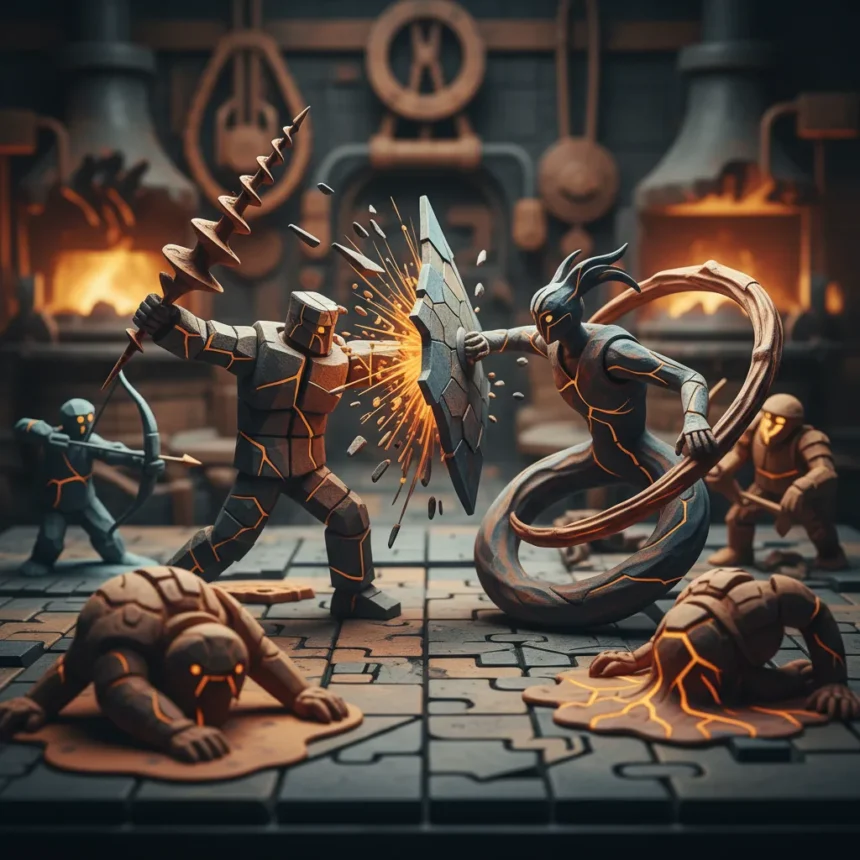
KILN’s sculpted art style is reshaping how developers think about the relationship between visual design and gameplay mechanics. Double Fine Productions, the studio behind Psychonauts and Broken Age, has spent years developing a game where artistic choices aren’t cosmetic—they are the foundation of every combat interaction, character movement, and environmental interaction.
Key Takeaways
- KILN uses sculpted art where object geometry directly drives collision detection and combat hit detection instead of generic bounding boxes.
- Double Fine bakes collision data directly from high-poly ZBrush sculpts into the game engine, ensuring visual accuracy matches mechanical precision.
- Weapon shapes determine attack arcs; character silhouettes affect dodge and block animations; environmental objects have physics based on their sculpted forms.
- The game evolved from internal game jam prototypes into a multi-year development cycle focused on making shape functionally matter.
- KILN targets Xbox Series X/S and PC, with expected Xbox Game Pass availability given Double Fine’s Microsoft ownership.
Why Shape Matters in KILN’s Combat System
Most games separate art from mechanics. A sword looks curved but swings in a generic arc defined by invisible code. A character model has an asymmetrical silhouette but dodges in standardized patterns. KILN inverts this entirely. Double Fine’s collision system is baked directly into the sculpts—no approximations. If a weapon looks sharp, it hits sharp. If a character’s armor juts out at an angle, that exact geometry determines which attacks it can block and which will slip through.
This approach emerged from Double Fine’s philosophy that artistic intent should drive mechanical behavior. The studio’s technical artists sculpt base meshes in ZBrush, then bake collision data directly from those high-poly sculpts into the game engine. The result is a combat system where every visual detail has functional weight. A curved sword doesn’t just look different—it sweeps in an arc that matches its sculptural form. An enemy with spiky protrusions doesn’t just appear threatening; those spikes determine how incoming attacks interact with its body.
How Sculpted Art Style Shapes Character Design and Animation
Character asymmetry in KILN isn’t decorative. Double Fine designed each character with unique sculpted silhouettes, and those differences directly impact how they move and fight. Animations are procedurally tied to mesh deformation, meaning a character’s shape contours actually drive how their limbs bend and flow. This creates a situation where two characters don’t just look different—they fundamentally play differently because their underlying geometry is distinct.
The studio’s animation pipeline reflects this commitment. Rather than applying generic rigs to different character models, Double Fine’s team rigs animations to deform along shape contours specific to each character. A broad-shouldered warrior blocks differently than a lean mage because their actual sculpted proportions dictate how their arms and torso move. This level of integration between art and animation is rare in game development, where studios typically treat character models as separate from their mechanical behaviors.
The Development Journey From Prototype to Polish
KILN didn’t emerge fully formed. The project started as an experimental prototype during Double Fine’s internal game jams, where developers tested whether shape-based collision could actually work as a core mechanic rather than a novelty. Those early prototypes evolved into a full combat prototype within three months, but the real work came next: a long development cycle dedicated to refining the feel of shape-responsive gameplay until shape wasn’t just visually interesting—it was the game itself.



This extended timeline allowed Double Fine to iterate on what “shape feel” actually meant. The studio tested collision fidelity repeatedly in the Unity engine, gathering feedback on whether players intuitively understood how a weapon’s geometry affected its reach and damage. They refined environmental interactions so that destructible props didn’t just look sculpted; they broke and collapsed in ways that matched their physical forms. The result is a game where every mechanic reinforces the central idea that shape matters.
How KILN Differs From Other Shape-Based Games
KILN isn’t the first game to play with sculpted visuals or physics-based collisions. Claybook uses shape-based physics in a sandbox, but KILN constrains that freedom into structured combat. Gang Beasts uses wobbly physics and soft-body characters, but KILN prioritizes precision—its sculpted collisions are exact, not chaotic. Even Double Fine’s own Grim Fandango remaster, which celebrated claymation aesthetics, treated art as presentation. KILN treats art as the mechanics themselves.
This distinction matters for how players experience the game. In a freeform physics sandbox, shape is a playground. In KILN, shape is a language. Every collision tells the player something about the world’s rules. A sharp edge cuts; a rounded surface deflects. A wide base provides stability; a narrow profile invites toppling. Players learn to read the environment’s sculpture the way they’d read a chess board—not for beauty, but for tactical information.
What This Means for Game Design Innovation
KILN represents a philosophical shift in how developers can approach the art-gameplay relationship. Rather than treating art direction and mechanical design as separate disciplines that meet at the end of production, Double Fine integrated them from the earliest prototypes. The collision system didn’t come after the character designs; the designs were built with collision in mind. Animations weren’t applied to finished models; models were sculpted with animation deformation in mind.



This approach has ripple effects. It means concept art isn’t just inspiration—it’s a technical specification. It means character designers need to think like gameplay programmers. It means environmental artists are essentially designing interactive puzzles through the shapes they create. For a studio willing to embrace this constraint, it opens new possibilities. For studios accustomed to separating disciplines, it represents a significant cultural shift.
When Will KILN Release?
Double Fine has not announced a specific release date for KILN. The game is in a polish phase following its long development cycle, suggesting a 2026 or 2027 window, though this is not confirmed. Given Double Fine’s ownership by Microsoft, KILN is expected to launch on Xbox Game Pass, alongside releases on Xbox Series X/S and PC platforms including Steam and the Windows Store.
How Does KILN’s Art Approach Compare to Traditional Game Development?
Traditional game development separates art and mechanics. A character artist sculpts a model; a programmer assigns it a generic collision box; an animator applies pre-built movement sets. KILN inverts this workflow. Double Fine’s approach requires constant collaboration between artists and programmers from day one, with collision data baked directly from sculpts and animations deforming along shape contours. This is more labor-intensive upfront but creates tighter integration between what players see and what they feel mechanically.
Will Other Studios Adopt KILN’s Shape-Based Design Philosophy?
KILN’s success could influence how other developers think about art-to-gameplay pipelines, but adoption will depend on whether studios are willing to restructure their production workflows. The approach works because Double Fine committed to it from prototype stage, not as a retrofit to existing pipelines. Studios like Claybook and Gang Beasts have explored shape-physics, but KILN’s precision-focused combat represents a distinct path—one that prioritizes sculpted authenticity over wobbly chaos or sandbox freedom. Whether this becomes industry standard or remains a Double Fine signature will depend on KILN’s critical and commercial reception.
KILN demonstrates that the boundary between art and mechanics is not fixed. A game where shape truly matters isn’t a technical achievement alone—it’s a design philosophy that demands every discipline in the studio commit to the same core principle. For players tired of generic hit detection and standardized animations, KILN’s sculpted approach offers something genuinely different: a game where what you see is exactly what you get, and what you get is the entire system.
Where to Buy
This article was written with AI assistance and editorially reviewed.
Source: Windows Central