






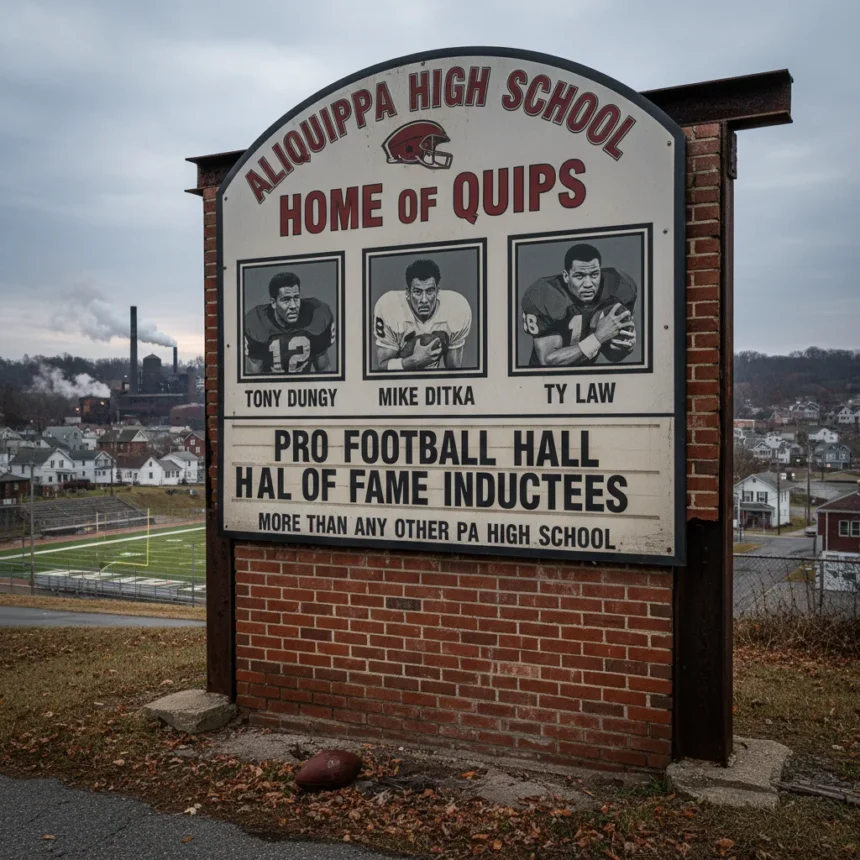
Hall of Fame High documentary tells the improbable story of Aliquippa High School in western Pennsylvania, a town whose population collapsed from over 26,000 in 1960 to just 9,238 by the 2020 census, yet somehow produced more Pro Football Hall of Famers than any other high school in the state. The film, produced by Dick’s Sporting Goods’ in-house studio Cookie Jar & A Dream, premiered at a private screening on April 22 at the Heinz History Center in Pittsburgh, arriving just as the 2026 NFL Draft approaches the city.
Key Takeaways
- Aliquippa High School has produced three Pro Football Hall of Famers—Mike Ditka, Ty Law, and Darrelle Revis
- The documentary premiered April 22 in Pittsburgh ahead of the 2026 NFL Draft
- Aliquippa’s population declined 65% since 1960, yet its football program remains dominant
- The Quips won their 21st WPIAL championship last season despite enrollment mismatches
- Ty Law directed the Hall of Fame High film documenting the school’s outsized NFL impact
Why Aliquippa’s Hall of Fame legacy matters now
The timing of Hall of Fame High documentary release is deliberate. Pittsburgh hosts the 2026 NFL Draft, and Aliquippa’s story—a high school in a post-industrial town that keeps producing elite professional talent—cuts against every narrative about American decline. The Quips aren’t a perennial powerhouse from a wealthy suburb with state-of-the-art facilities. They are a program that has thrived despite their community’s economic collapse.
Three Hall of Famers from a single high school is staggering. Mike Ditka, inducted in 1988, was a tight end who won Super Bowls as both a player and a coach; he originally wanted to be a dentist before football claimed him. Ty Law, inducted in 2019, became a New England Patriots cornerstone and later directed this very documentary. Darrelle Revis, inducted in 2023, was a shutdown cornerback for the New York Jets and Patriots, one of the most dominant defensive backs of his era.
Hall of Fame High documentary captures a shrinking town’s outsized reach
What makes Hall of Fame High documentary resonate is the paradox it documents. Aliquippa lost 65 percent of its population over six decades—a story replicated across the Rust Belt. Yet the Quips football program did not wither. Last season, they won their 21st WPIAL championship, a record, despite enrollment numbers that technically fit a smaller classification. The Pennsylvania Interscholastic Athletic Association forced them into Class 4A under a competitive balance rule, and Aliquippa won four of the previous five 4A titles anyway.



This is not a feel-good underdog story about overcoming poverty. It is a story about institutional excellence persisting through systemic decline. The Quips program has created a pipeline so efficient that three of its graduates reached the highest individual honor in professional football. No other Pennsylvania high school can claim that.
What separates Aliquippa from other football powerhouses
High school football programs across America produce NFL talent, but they do so from schools in thriving communities with resources and infrastructure. Aliquippa’s achievement is anomalous. The school sits in a town that experienced the full collapse of industrial America. Steel mills closed. Population hemorrhaged. Yet the football program remained a conveyor belt for elite talent.



Ty Law’s decision to direct Hall of Fame High documentary suggests the film itself is a reckoning with this contradiction. It is not just about celebrating three Hall of Famers; it is about understanding how a program in a declining town sustained excellence when the broader community around it struggled. That question—how does this happen?—is what makes the documentary culturally significant beyond football.
Does Aliquippa’s story change how we view the 2026 NFL Draft in Pittsburgh?
The 2026 NFL Draft coming to Pittsburgh, with Hall of Fame High documentary premiering weeks before, is not coincidental. Pittsburgh itself is a post-industrial city that reinvented itself. Aliquippa is Pittsburgh’s neighbor, with a similar history and a different outcome. One city diversified its economy; the other struggled. Yet Aliquippa’s high school football program remained a national force.
Watching Hall of Fame High documentary before the Draft invites viewers to ask harder questions about talent, community, and what it takes for a program to sustain excellence across generations. The Quips did not win championships because of wealth or demographic advantage. They won because something in the culture of that school and that town prioritized football excellence in a way that transcended economic circumstance.
Who directed Hall of Fame High and why does that matter?
Ty Law, one of the three Hall of Famers featured in the documentary, directed Hall of Fame High. This is significant. The film is not an outside perspective on Aliquippa’s legacy; it is an insider’s account. Law lived the experience of being a Quip, made it to the NFL, became a Hall of Famer, and then chose to return to document the program that launched his career. That choice suggests the story mattered to him personally—that the question of how Aliquippa did what it did warranted examination.



How does Hall of Fame High documentary compare to other sports documentaries?
Sports documentaries typically follow one of two templates: the triumph-against-odds narrative, or the institutional history. Hall of Fame High documentary appears to blend both. It is not just about three individual Hall of Famers; it is about a school and a town and how excellence persisted in the face of decline. That angle—examining a program’s culture and infrastructure rather than just celebrating individual talent—sets it apart from conventional high school sports films that focus on a single season or a single player’s journey.
What does Hall of Fame High documentary reveal about the Quips’ current program?
The Quips remain competitive at the highest level in Pennsylvania. Their 21st WPIAL championship last season, achieved despite enrollment mismatches that forced them into a larger classification, demonstrates that the program’s excellence is not a relic of past decades. The documentary likely explores both the historical Hall of Famers and the current roster, showing how the program maintains its pipeline even as the town’s population continues to shrink.
Why should you watch Hall of Fame High before the 2026 NFL Draft?
If you are anticipating the 2026 NFL Draft in Pittsburgh, Hall of Fame High documentary provides essential context. It tells the story of one high school’s outsized impact on professional football and asks why a town of 9,000 people has produced more Hall of Famers than schools in cities ten times its size. The documentary premiered in April 2025, and with the Draft approaching, it offers a lens through which to view Pittsburgh’s football culture and legacy.
Is Hall of Fame High documentary only for football fans?
Not entirely. While the film centers on football, its real subject is how a community sustains excellence amid decline. That is a question relevant beyond sports—it applies to education, culture, and institutional resilience generally. Viewers interested in Rust Belt narratives, American economic history, or how communities rebuild identity after industrial collapse will find the documentary speaks to themes larger than the game itself.
Hall of Fame High documentary arrives at a moment when Pittsburgh itself is in the spotlight, hosting the 2026 NFL Draft. Watching it before the Draft airs offers a deeper understanding of why Aliquippa’s story—three Hall of Famers from a town of 9,000—matters so much to the region and to professional football. The film is not just about celebrating past greatness; it is about understanding how a program in a shrinking town became a Hall of Fame factory.
This article was written with AI assistance and editorially reviewed.
Source: Tom's Guide