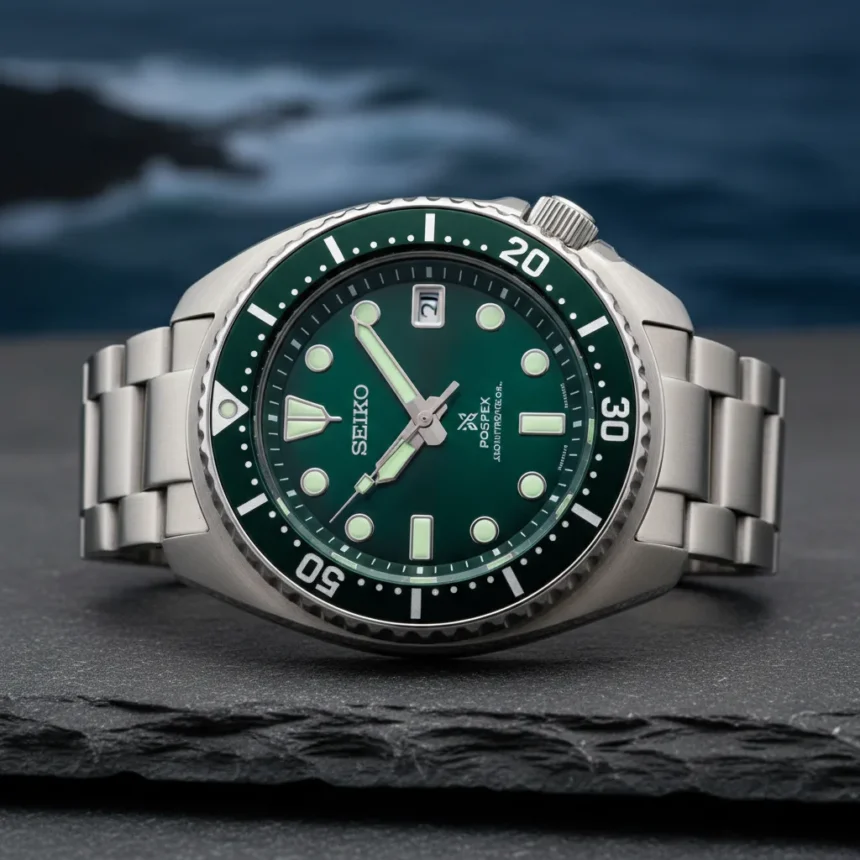
The Seiko green dive watch represents a striking departure from the black and blue dominance that has defined professional diving timepieces for decades. Inspired by Seiko’s groundbreaking 1968 Diver—the brand’s first one-piece case hi-beat diver with 300 meters of water resistance—this modern interpretation channels vintage aesthetics while challenging what a contemporary dive watch should look like.
Key Takeaways
- The green dial and strap offer an unconventional aesthetic for dive watches, departing from traditional black and blue options.
- The 1968 Diver was Seiko’s pioneering hi-beat diver with 300m water resistance, marking a watershed moment in dive watch history.
- Related Prospex models feature new short-pitch bracelet designs with micro-adjustable clasps, a first for the Prospex line.
- The Prospex 1968 Heritage Diver’s GMT variant in Seashadow black is limited to 500 units worldwide, with exclusives at Seiko’s London Bond Street boutique.
- Seiko’s Prospex collection celebrates 60 years of dive watch innovation across 1965 and 1968 heritage releases.
Why green breaks the dive watch mold
Dive watch tradition dictates restraint. Black dials command authority. Blue suggests the ocean. Green? Green feels almost heretical in professional diving circles, yet that unconventional choice is precisely what makes Seiko’s interpretation compelling. By returning to the 1968 Diver’s DNA—that pioneering one-piece case construction and hi-beat movement—while dressing it in forest green, Seiko signals that heritage does not require historical accuracy. It requires respect for the original’s engineering and the confidence to reinterpret its visual language.
The green dial paired with a matching green strap creates visual cohesion that avoids the jarring two-tone aesthetic that can plague modern watches. This is not a gimmick. Vintage dive watches, particularly military and professional models from the 1960s and 1970s, occasionally appeared in unconventional colors when function demanded it. Seiko’s green iteration feels like a logical evolution of that pragmatic tradition.
The 1968 Diver’s lasting influence on Seiko green dive watch design
Understanding why the Seiko green dive watch matters requires appreciating what the 1968 Diver accomplished. That original model introduced the hi-beat movement to diving watches—a technical achievement that improved accuracy and reliability in extreme conditions. The one-piece case construction eliminated potential water ingress points, setting a standard that professional divers demanded. Fifty-six years later, Seiko’s modern interpretation inherits that engineering philosophy while exploring aesthetic territory the original could never have occupied.

The Prospex line, which carries forward this heritage, has evolved to include thoughtful refinements. Recent 1965 and 1968 heritage variants introduced a short-pitch length bracelet with micro-adjustable clasps—a feature that marks the first time Prospex watches incorporated this level of wrist customization. These details matter to serious watch enthusiasts who understand that a diver’s comfort directly impacts its utility in the water. A watch that slips or shifts during a dive is a liability.
How the Seiko green dive watch compares to other heritage revivals
Seiko is not alone in mining its archive for contemporary designs. The Prospex 1968 Heritage Diver’s GMT variant in Seashadow black demonstrates an alternative approach to the same heritage source material. That model adds GMT functionality—a complication absent from the original—and features gold-tone detailing on indices, hands, and the unidirectional rotating bezel. It runs the 6R54 automatic GMT calibre movement, offering -15/+25 seconds per day accuracy and a 72-hour power reserve. It is limited to 500 units worldwide, with select units exclusive to Seiko’s London Bond Street boutique.



The green variant takes a different philosophy: simplicity over complication, color over ornamentation. Where the GMT model adds functionality and precious-metal touches, the green watch strips back to essentials and asks what visual impact alone can achieve. Both approaches are valid. The GMT appeals to travelers and collectors who value added utility. The green appeals to those who believe a watch’s design language should do the talking.
Prospex’s 60-year legacy and what it means for modern divers
Seiko’s Prospex collection marks six decades of dive watch innovation. The 1965 and 1968 models that anchor the current heritage releases represent different evolutionary moments in that timeline. Rather than treating these vintage designs as museum pieces, Seiko has refreshed them with modern manufacturing tolerances, contemporary materials, and—in the case of the green variant—a willingness to experiment with color.
This approach resonates with a generation of watch enthusiasts who reject the false choice between authenticity and modernity. A 1968-inspired watch does not need to look exactly like a 1968 watch to honor its legacy. It needs to capture the ethos: reliability, clarity, purposeful design. The Seiko green dive watch achieves that balance. It is recognizably rooted in the past while refusing to be imprisoned by it.
Is the Seiko green dive watch limited in availability?
Availability details for the green variant remain unclear from current announcements. However, Seiko’s approach with related heritage releases suggests scarcity may be part of the strategy. The Prospex 1968 Heritage Diver’s GMT in Seashadow black is limited to 500 units worldwide, with certain units exclusive to boutique locations like Seiko’s London Bond Street store. If the green variant follows a similar path, demand will likely exceed supply quickly.



How does the 1968 Diver compare to modern dive watches?
The original 1968 Diver’s 300-meter water resistance was exceptional for its time and remains more than adequate for recreational and professional diving today. Modern dive watches often exceed this depth rating, but the distinction between 300m and 600m becomes academic for anyone not regularly diving below 100 meters. What separates the 1968 design from contemporary competitors is not raw specifications but design language—the clarity of the dial, the proportions of the case, the purposefulness of every element.
What makes the green color significant for a dive watch?
Green represents an underexplored territory in dive watch aesthetics. While brands occasionally release green variants, most remain anchored to black, blue, or steel. The Seiko green dive watch takes a color that suggests growth, nature, and calm—qualities divers seek in the underwater environment—and commits to it fully through both dial and strap. This coherence transforms green from a novelty into a legitimate design choice, one that invites comparison to the watch’s functional heritage rather than distraction from it.
Seiko’s Seiko green dive watch ultimately succeeds because it understands that heritage revival is not about copying the past. It is about extracting the principles that made the original meaningful and applying them to a contemporary context. The 1968 Diver was revolutionary because it solved real problems for real divers. This modern interpretation solves different problems—the desire for distinctive design, the appeal of unconventional color, the satisfaction of owning a watch rooted in genuine innovation. By anchoring the green variant in the 1968 Diver’s proven engineering and philosophy, Seiko gives it credibility that pure aesthetics alone could never achieve. For collectors and divers seeking a watch that honors the past while refusing to be bound by it, the Seiko green dive watch makes a compelling argument.
Where to Buy
57 Amazon customer reviews | £9.99
Edited by the All Things Geek team.
Source: T3