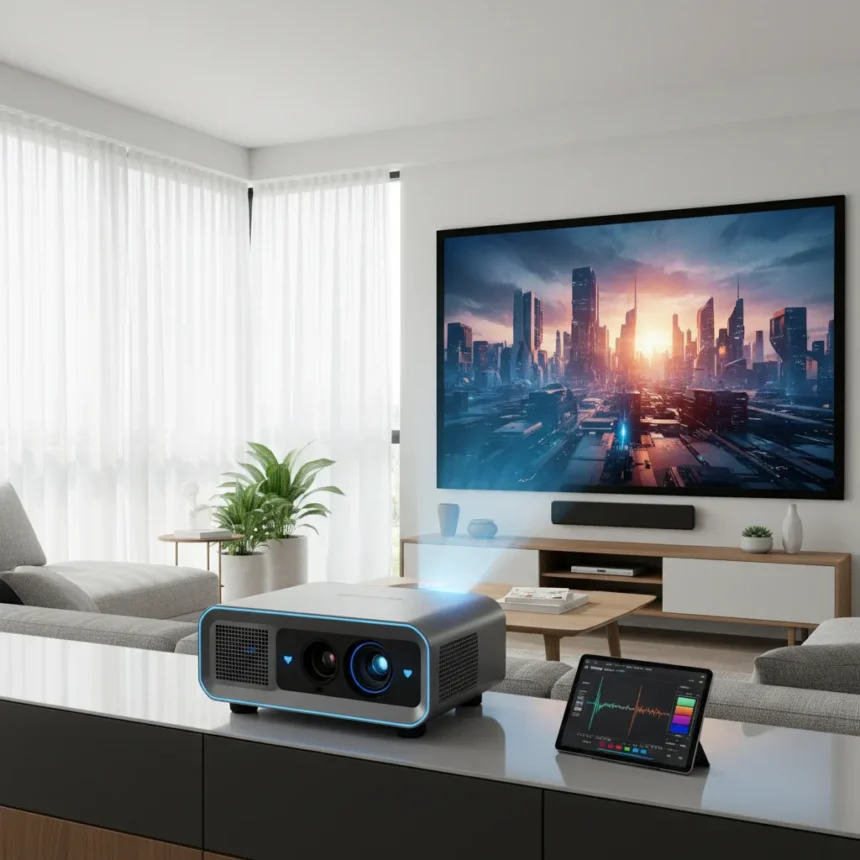
The Optoma UHZ78LV is a 4K UHD HDR DLP projector using RGB triple-laser technology, delivering 5000 lumens of brightness and targeting five-star models from Epson and Sony. It launches in early March 2026 and redefines what all-conditions projection means for home theater enthusiasts who refuse to hide their screens behind blackout curtains.
Key Takeaways
- 5000 lumens brightness with 98% DCI-P3 color coverage handles daylit rooms and high-ambient-light spaces.
- Triple RGB laser engine with 4,500,000:1 dynamic contrast and Dolby Vision support for premium image quality.
- Motorized 1.6x zoom, lens shift, and 360-degree projection mount on ceilings or desks without compromise.
- Gaming-ready with HDMI 2.1, 8.5ms input lag at 1080p/240Hz, and Auto Low Latency Mode for competitive play.
- Priced around £5,999, positioning it as a premium alternative to dual-laser Optoma models and competing projectors.
Why Brightness Matters More Than You Think
The Optoma UHZ78LV’s 5000-lumen output is not a vanity spec—it is the difference between a projector that works only in darkness and one that thrives in real homes. Most competitors demand blackout conditions or deliver washed-out images in ambient light. This projector does neither. With 98% DCI-P3 color coverage and up to 96% BT.2020 accuracy, the Optoma UHZ78LV maintains color fidelity even at full brightness, a feat most laser projectors struggle with. The triple RGB laser architecture ensures each color channel operates independently, eliminating the color shift and saturation loss that plague single-laser designs.
The dynamic contrast ratio reaches 4,500,000:1, meaning blacks stay deep and shadows retain detail even when the projector is cranked to maximum brightness. This is where the Optoma UHZ78LV separates itself from the crowd. You are not choosing between bright and accurate—you get both.
Dolby Vision and IMAX Enhanced Transform Content
The Optoma UHZ78LV’s Dolby Vision implementation is described as excellent, a rare compliment in the projector world where HDR often looks flat or oversaturated. The projector also supports HDR10+ and IMAX Enhanced, which uses Optoma’s proprietary DMR technology to optimize 4K HDR content for theatrical impact. If you own a 4K Blu-ray collection or stream Dolby Vision content, this projector renders it as the creators intended, not as a compromise.


Dolby Atmos audio passes through via eARC, meaning your projector becomes the hub for immersive sound without additional wiring complexity. For a projector in this price range, the multimedia integration is thoughtfully executed.
Installation Flexibility That Actually Works
The motorized 1.6x zoom eliminates the guesswork of lens throw calculations. You can position the Optoma UHZ78LV on a desk or ceiling, and the motor adjusts the image size without moving the projector itself. Lens shift and 360-degree projection capability mean this projector adapts to your room, not the other way around. Setup time drops dramatically compared to fixed-throw models, and future room changes do not require repositioning the entire system.



Gaming and Motion Handling
The Optoma UHZ78LV includes HDMI 2.1 with eARC, Auto Low Latency Mode, and input lag as low as 8.5ms at 1080p/240Hz. These are not afterthought features—they signal that Optoma designed this projector for modern content, not just cinema. Gamers switching from displays to projection will notice the responsiveness. Fast-paced shooters and fighting games are playable without the lag frustration that plagues older projectors.
How It Compares to Alternatives
The Optoma UHZ78LV is a direct upgrade from Optoma’s own UHZ68LV, which uses dual-laser technology and delivers 90% DCI-P3 color coverage. The jump to triple lasers and 98% DCI-P3 is measurable—colors pop with more precision, and the brightness advantage is substantial. Some users have noted that the JVC NZ500 may offer comparable performance at a similar price point, though that model lacks motorized zoom, a feature many installers consider essential for flexibility. The Optoma UHZ78LV targets Epson and Sony’s five-star flagships, and the feature set justifies the positioning—triple lasers, gaming features, and Dolby Vision support are not standard in that tier.
Laser Life and Long-Term Value
The laser engine is rated for 30,000 hours of operation. At eight hours daily, that is roughly a decade of use before any service consideration. This extends the projector’s relevance far beyond typical product cycles, making the premium price more defensible over the ownership lifespan.
Is the Optoma UHZ78LV worth the investment?
Yes, if you refuse to build a dedicated dark theater or need a projector that performs in mixed lighting. The Optoma UHZ78LV is the rare flagship that does not compromise on brightness, color accuracy, or gaming responsiveness. For buyers comparing it to Epson and Sony models, the triple-laser architecture and Dolby Vision implementation make a genuine case.



What is the difference between the Optoma UHZ78LV and UHZ68LV?
The UHZ78LV uses triple RGB lasers versus the UHZ68LV’s dual-laser design, delivering 98% DCI-P3 versus 90%, and maintaining superior color accuracy at high brightness levels. The newer model also includes gaming-focused features like HDMI 2.1 and lower input lag, making it more versatile for modern content.
Can you use the Optoma UHZ78LV in a bright room?
Yes. With 5000 lumens and color accuracy that holds up at full brightness, the Optoma UHZ78LV is built for ambient-light environments where most projectors fail. It is the core selling point—brightness without image degradation.
The Optoma UHZ78LV arrives in early March 2026 at approximately £5,999 and represents a rare breed of flagship projector: one that does not ask you to sacrifice your room’s character to enjoy great image quality. For home theater enthusiasts tired of choosing between brightness and accuracy, it is the answer.
Where to Buy
Edited by the All Things Geek team.
Source: What Hi-Fi?