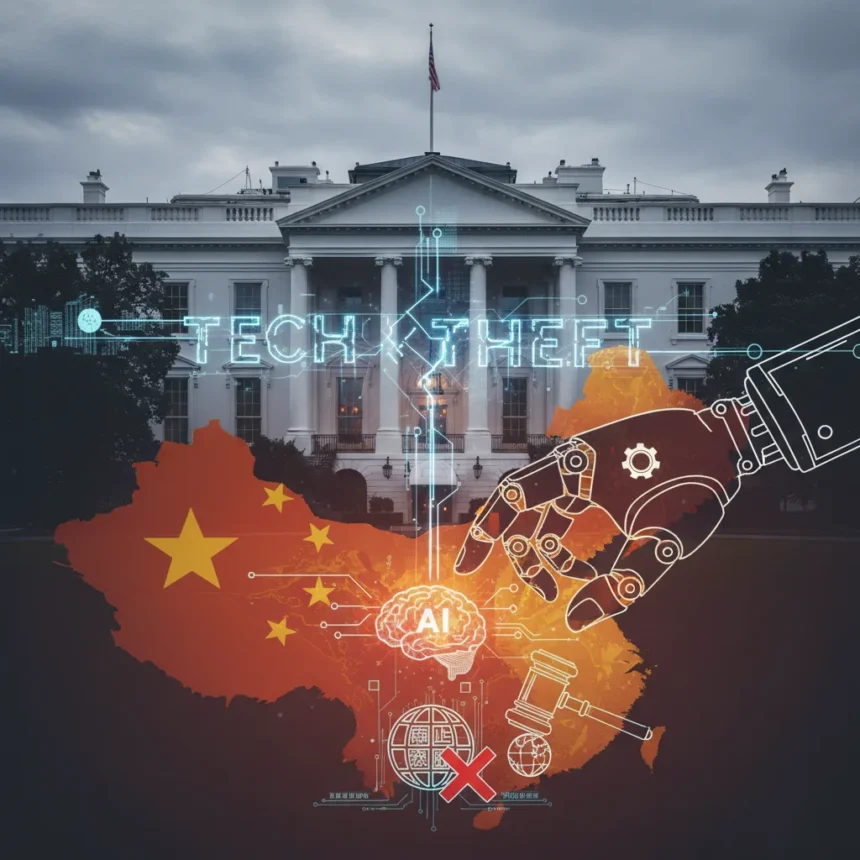
AI technology theft has become a flashpoint in US-China relations, with the White House alleging that foreign entities, primarily in China, are running coordinated campaigns to steal American AI models at industrial scale. On April 23, 2026, Michael Kratsios, the White House’s science and technology chief, announced the accusations in a memo to federal agencies and a post on X, framing the alleged theft as a direct threat to American innovation and national security.
Key Takeaways
- White House Director Kratsios accused China of running industrial-scale distillation campaigns to extract US AI models
- Distillation involves flooding AI systems with requests to train knockoff versions and strip security protocols
- Chinese entities use tens of thousands of proxies and jailbreaking techniques in coordinated theft operations
- House Foreign Affairs Committee unanimously backed sanctions on foreign actors stealing from closed-source US AI models
- Accusations come ahead of a planned Trump-Xi Jinping summit scheduled for May 14, 2026
How AI Technology Theft Works
The alleged distillation campaigns represent a sophisticated form of intellectual property theft. Rather than hacking into systems directly, foreign entities send a flood of requests to American AI models to extract their underlying capabilities. This process strips away proprietary information, security protocols, ideological safeguards, and truth-seeking mechanisms that distinguish US-developed models from knockoff versions. The stolen capabilities are then repurposed into competing systems without the investment or oversight that went into the originals.
According to White House allegations, these operations are not isolated incidents but coordinated campaigns using tens of thousands of proxies and sophisticated jailbreaking techniques to bypass security measures. Anthropic, one of the leading US AI companies, characterized the threat in stark terms: foreign labs that distill American models can then feed these unprotected capabilities into military, intelligence, and surveillance systems, enabling authoritarian governments to deploy frontier AI for offensive cyber operations, disinformation campaigns, and mass surveillance. This escalation from corporate espionage to national security threat explains the urgency of the White House response.
Evidence and Accusations Against Chinese Firms
The White House memo specifically targets distillation as a method used by Chinese entities to free-ride on American innovation without bearing development costs. OpenAI has accused DeepSeek, a Chinese AI firm, of using distillation to extract capabilities from US models like ChatGPT. Anthropic similarly claimed that China used mass-proxy distillation to siphon data for military, intelligence, surveillance, cyber operations, disinformation, and mass surveillance purposes. These accusations align with broader US intelligence assessments that Chinese technology theft costs the American economy between $400 and $600 billion annually, according to Senator Chuck Grassley, who raised the figure at a House Judiciary Committee hearing.



China has rejected the accusations. An unnamed Chinese official responded that the country firmly opposes the allegations and urged the US to respect facts, discard prejudice, and stop suppressing China’s technological development. This denial reflects the deep mistrust between Washington and Beijing over AI competition and intellectual property protection.
White House Plans for Enforcement and the May Summit
The White House announcement comes as part of a broader strategy to protect American AI innovation ahead of the scheduled May 14, 2026 Trump-Xi summit. The administration promises to take action through private sector engagement, best practices sharing, information exchange, and accountability measures against foreign distillation. This represents a shift from the July 2025 AI Action Plan, which emphasized prevention of adversaries free-riding on US innovation, to concrete enforcement measures.



Congress is backing the White House push. The House Foreign Affairs Committee unanimously supported a bill that would impose sanctions on foreign actors extracting key technical features from closed-source US AI models. One day before the White House memo, the House Judiciary Committee held a hearing titled Stealth Stealing: China’s Ongoing Theft of U.S. Innovation, signaling bipartisan momentum for a crackdown. These legislative efforts suggest that AI technology theft will remain a central issue in US-China relations and domestic tech policy.
Why This Matters Now
The timing of the White House accusations is not accidental. The May 14 summit between Trump and Xi Jinping represents a critical moment for US-China negotiations on technology, trade, and competition. By publicly accusing China of industrial-scale theft weeks before the meeting, the administration is setting a hard negotiating position and demonstrating resolve to American tech companies and Congress. The coordinated messaging from the White House, Congress, and major AI labs signals that AI security and intellectual property protection will dominate the agenda.
For American AI developers, the message is clear: the government is taking the threat seriously and will pursue enforcement. For Chinese firms, the threat of sanctions and diplomatic consequences raises the cost of continued distillation. Whether the May summit produces concrete commitments from Beijing to stop the alleged theft campaigns remains an open question, but the White House has signaled this is non-negotiable.
What happens if China ignores the White House warning?
If China continues distillation campaigns despite the White House warnings, the administration has indicated it will pursue sanctions against foreign actors and coordinate with private companies on defensive measures. Congressional support for sanctions legislation suggests that legal mechanisms exist to punish foreign entities engaged in AI technology theft.


How does distillation differ from traditional hacking?
Distillation is a legal gray area that exploits public-facing AI systems rather than breaking into private networks. It floods models with queries to extract their underlying logic, whereas hacking targets source code or internal systems directly. This distinction matters because distillation operates in the open, making it harder to prosecute under traditional cybercrime laws.
Is the US doing anything to protect its own AI models?
The White House has called for private sector engagement and best practices sharing to defend against distillation, though specific technical measures remain undisclosed. Companies like OpenAI and Anthropic are presumably implementing rate-limiting, query monitoring, and other defenses, but the coordinated nature of distillation campaigns suggests these measures face significant challenges.
The White House’s accusation that China is systematically extracting American AI technologies marks a turning point in how the US government treats intellectual property theft in the AI era. What was once a quiet corporate concern has become a matter of national security and diplomatic leverage. Whether enforcement action follows through on the threats made in April 2026 will determine whether this represents genuine policy shift or political theater ahead of the May summit.
Edited by the All Things Geek team.
Source: TechRadar