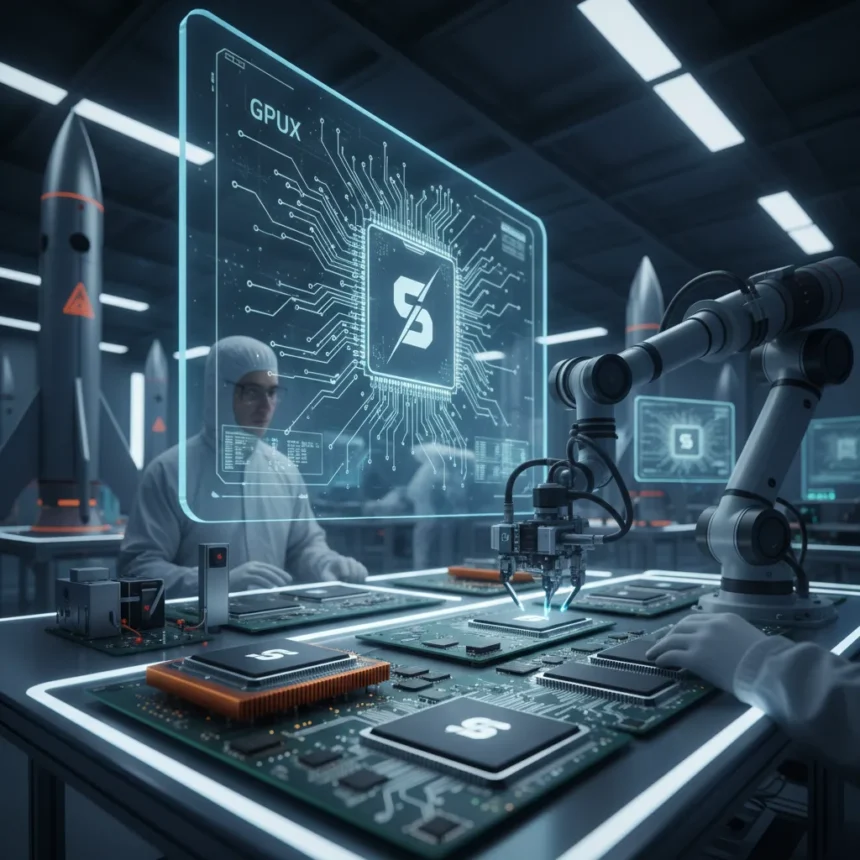
SpaceX GPU manufacturing is not about gaming graphics cards or consumer competition with Nvidia—it is about vertical integration of AI silicon for rockets, robots, and autonomous systems. Leaked excerpts from SpaceX’s confidential S-1 registration filing, ahead of a planned $1.75 trillion IPO expected in summer 2026, reveal that the aerospace company lists “manufacturing our own GPUs” as a substantial capital expenditure. This move signals a fundamental shift in how SpaceX plans to secure compute resources as it scales AI workloads across its business.
Key Takeaways
- SpaceX GPU manufacturing targets AI applications for cars, robots, and space-based data centers, not gaming or consumer use
- The company cites lack of long-term contracts with chip suppliers as a driver for in-house production
- Terafab, a joint venture with Tesla and xAI, will manage manufacturing using Intel’s 14A process node
- Elon Musk confirmed SpaceX will handle high-volume semiconductor manufacturing for silicon developed at Tesla
- These GPUs are specialized AI accelerators, similar to Google’s TPUs or Tesla’s AI5/AI6 chips, not broad-purpose graphics processors
Why SpaceX GPU Manufacturing Matters Right Now
The timing is crucial. SpaceX GPU manufacturing plans emerge as the company faces a critical constraint: chip supply shortages and dependence on external suppliers who may not prioritize aerospace and AI demands. By moving production in-house, SpaceX eliminates a bottleneck that could throttle growth in autonomous vehicles, humanoid robotics, and satellite internet infrastructure. The S-1 filing explicitly states: “We do not have long-term contracts with many of our direct chip suppliers”. That vulnerability is expensive. Building proprietary silicon removes the middleman and locks in supply for the next decade of growth.
This is not Nvidia territory. Nvidia’s GPUs excel at broad, general-purpose compute—gaming, data centers, machine learning research. SpaceX GPU manufacturing targets something narrower and more specialized: inference and training for specific workloads like autonomous driving, robotic control, and onboard satellite processing. Think of it as the difference between a Swiss Army knife and a scalpel. Both are tools, but they solve different problems.
The Terafab Partnership and Manufacturing Scale
SpaceX GPU manufacturing will happen through Terafab, a joint AI chip manufacturing complex involving SpaceX, its recently merged xAI unit, and Tesla. The partnership leverages Intel’s 14A process node—a mature, proven technology rather than bleeding-edge bleeding-edge silicon. Terafab aims for 1 terawatt per year of compute production capacity, a staggering figure that underscores the scale of ambition. Elon Musk confirmed that SpaceX will manage high-volume semiconductor manufacturing for silicon developed at Tesla, cementing the operational role.


This announcement follows Musk’s recent partnership with Intel for designing, fabricating, packaging, and testing ultra-high-performance chips at scale. The pattern is clear: Musk is building a vertically integrated semiconductor ecosystem. SpaceX GPU manufacturing is one piece of a larger strategy to own the entire stack—design, fabrication, and deployment—across his companies.
What SpaceX GPU Manufacturing Is Not
Do not expect SpaceX graphics cards for your gaming PC. The company is not competing with Nvidia GeForce, AMD Radeon, or Intel Arc. Consumer GPU markets demand massive software ecosystems, driver support, and compatibility layers that SpaceX has no interest in building. The term “GPU” in the S-1 filing may be shorthand for AI processors more broadly; the exact architecture and capabilities remain unspecified. What matters is the outcome: specialized silicon optimized for SpaceX’s own workloads, not off-the-shelf commodity chips.



This distinction matters for investors and observers. SpaceX GPU manufacturing is not a threat to Nvidia’s dominance in gaming or data center GPUs. It is a strategic insourcing move driven by supply constraints and the need for application-specific hardware. Companies like Google (with TPUs) and Tesla (with custom AI accelerators) have pursued similar paths, and SpaceX is following the same playbook.
Supply Chain Autonomy and the Broader IPO Context
The S-1 filing reveals a company preparing for massive scale. Listing SpaceX GPU manufacturing as a substantial capital expenditure signals confidence in revenue growth and a willingness to invest billions in infrastructure. The $1.75 trillion IPO valuation reflects expectations of Starship commercialization, Starlink expansion, and new revenue streams from AI-powered services. In-house chip manufacturing reduces dependency risk and improves margins on high-volume products.
This move also reflects geopolitical realities. Semiconductor supply chains are fragile and increasingly politicized. By manufacturing chips in-house, SpaceX reduces exposure to export controls, supply disruptions, and third-party leverage. It is a hedge against an uncertain future.
Is SpaceX building consumer GPUs?
No. SpaceX GPU manufacturing targets internal applications—autonomous vehicles, humanoid robots, and space-based data centers—not retail graphics cards. The company has no plans to compete in gaming or consumer markets where Nvidia dominates.



When will SpaceX GPUs launch?
No specific launch date has been announced. Terafab, the manufacturing partnership, aims for 1 TW/year compute capacity, but the timeline for reaching that goal remains unclear. Production will likely support internal SpaceX projects first.
How does this compare to Nvidia’s GPU strategy?
Nvidia manufactures general-purpose GPUs for gaming, data centers, and research. SpaceX GPU manufacturing is application-specific, targeting AI workloads for aerospace and robotics. The two companies operate in different markets with different objectives.
SpaceX GPU manufacturing is not a consumer story—it is a supply chain story. The company is betting that controlling its own silicon will unlock growth in autonomous systems, robotics, and space infrastructure. Whether Terafab delivers on its 1 TW/year target will determine whether this bet pays off. For now, it is a signal that SpaceX is thinking bigger than rockets and satellites. It is thinking about the silicon that powers them.
Edited by the All Things Geek team.
Source: TechRadar