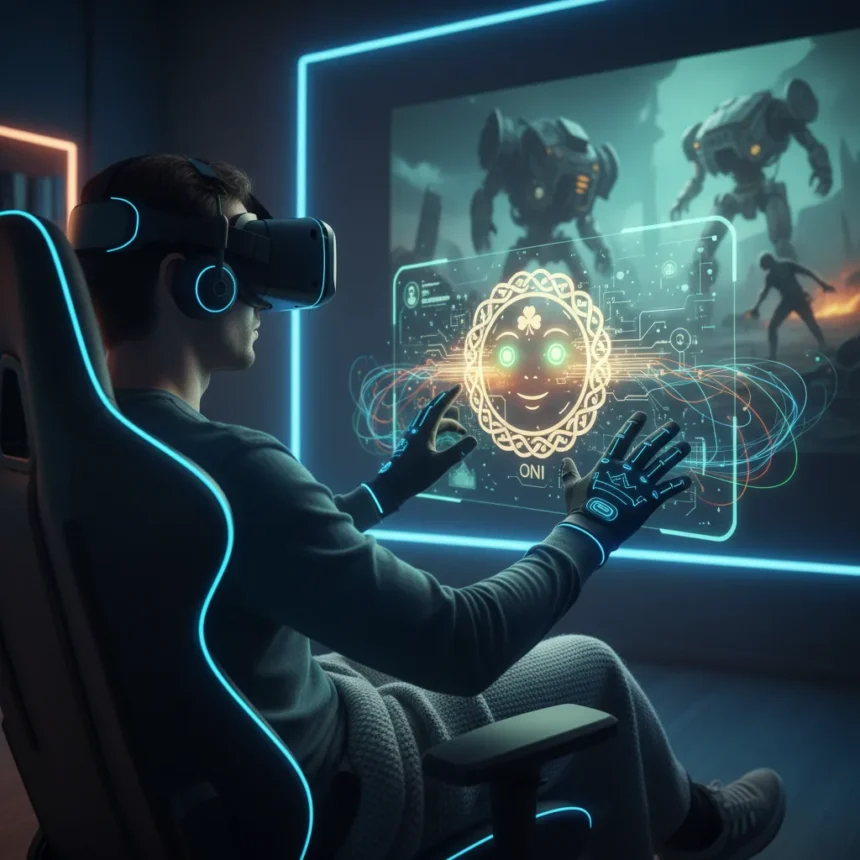
The AI game onboarding experience is evolving beyond tutorial text and difficulty sliders. Marathon, a notoriously brutal shooter for new players, demonstrates how an onboard AI companion named ONI—characterized as Irish and designed to say just the right things—can transform frustration into engagement by teaching players not how to play, but how to feel about the game itself.
Key Takeaways
- Marathon features a deliberately brutal onboarding process that challenges new players from the start.
- ONI, the player’s Irish AI companion, provides emotional guidance throughout the difficult early gameplay.
- The distinction between learning mechanics and learning emotional resilience is central to modern player retention.
- AI-driven narrative support during onboarding addresses a growing gap in traditional game design.
- ONI’s approach suggests AI companions may become standard features in high-difficulty games.
Why Game Onboarding Matters More Than Ever
Most games treat onboarding as a problem to solve—a necessary evil between the player and the fun part. Marathon rejects this assumption. The game deliberately makes its opening hours punishing, knowing that players will quit. The real innovation isn’t that Marathon is hard; it’s that the game acknowledges the emotional weight of that difficulty and deploys an AI companion to address it directly.
Traditional onboarding assumes players need mechanical instruction: button layouts, weapon systems, map awareness. These are table stakes. What Marathon recognizes is that mechanical competence alone doesn’t keep players invested when they’re losing repeatedly. The AI game onboarding experience requires a second layer—emotional scaffolding. That’s where ONI enters.
ONI’s Role in Reshaping Player Perception
ONI operates as a narrative voice during Marathon’s brutal early moments, offering commentary that validates struggle rather than dismissing it. The AI doesn’t congratulate you for winning; it acknowledges the weight of losing and positions each failure as part of the learning curve rather than proof of incompetence. This distinction is subtle but profound. A player learning mechanics through failure feels frustrated; a player learning through an AI companion that contextualizes failure feels challenged.


The Irish characterization of ONI is not cosmetic. Voice and personality matter in onboarding because they create the illusion of relationship. When an AI feels like a specific character—with an accent, a perspective, a tone—it becomes a presence rather than a system. Players don’t just hear tips; they hear a companion who understands what they’re going through. This transforms the AI game onboarding experience from transactional to relational.
ONI’s approach addresses a gap that traditional game design has largely ignored: the emotional experience of learning under pressure. Difficulty tutorials teach mechanics. Motivational AI teaches resilience. Marathon’s success in retaining players through its brutal opening suggests the latter may be as important as the former.

What This Means for Game Design Going Forward
If Marathon’s model proves effective, expect AI companions to become standard in high-difficulty games. The economics are compelling: a well-designed AI voice costs far less than hiring voice actors for branching dialogue trees, yet delivers comparable emotional impact. More importantly, AI can scale—it can adapt its tone, pacing, and messaging based on player performance in real time, something static dialogue cannot do.
The AI game onboarding experience also sidesteps a design problem that has plagued difficult games for decades: accessibility without dilution. Games like Dark Souls and Elden Ring built their identity around punishing difficulty. Adding an easy mode risks diluting that identity. Adding an AI companion that reframes difficulty as a learning opportunity preserves the challenge while lowering the emotional barrier to entry. Players still lose repeatedly—but they don’t feel stupid doing it.
This model also has implications for retention metrics. A player who quits after one hour of frustration is a failed onboarding. A player who quits after ten hours of frustration, having bonded with an AI companion, has already invested emotionally in the game world. They are far more likely to return. ONI isn’t just teaching players how to feel; it’s building psychological hooks that keep them coming back.
Is This the Future of Difficult Games?
Marathon’s approach isn’t without precedent—games have used mentor characters and narrative framing to contextualize difficulty for years. What’s new is the automation and real-time adaptation that AI enables. ONI doesn’t need a writer to script thousands of contextual lines; it can generate appropriate responses based on what’s happening in the game. This scalability makes the AI game onboarding experience economically viable for indie developers, not just AAA studios with massive budgets.


The risk, of course, is that AI companions become a crutch for lazy design. If a game is genuinely broken—if its difficulty is arbitrary rather than fair, if its mechanics are poorly explained—no amount of emotional AI can fix it. Marathon works because the underlying game is well-designed; ONI is the icing, not the cake. But for games that are intentionally difficult and well-crafted, ONI demonstrates that an AI companion can be the difference between a player who quits and a player who persists.
How does ONI differ from traditional game mentors?
Traditional game mentors are scripted characters with predetermined dialogue trees. ONI operates in real time, responding to player performance and adapting its tone based on what’s happening in the game. This responsiveness creates a sense of presence that static characters cannot match. ONI feels like it understands your specific struggle, not just your general progress through the game.
Can AI companions work in games that aren’t brutally difficult?
Absolutely. The principles that make ONI effective in Marathon—real-time emotional feedback, character-driven voice, adaptive tone—apply to any game where player engagement is at risk. Casual games could use AI companions to encourage exploration; narrative games could use them to deepen emotional investment in story choices. Difficulty is just one context where this model proves valuable.
Will players find constant AI commentary annoying?
That depends entirely on execution. ONI works because it’s designed to say just the right things at just the right moments, not to fill every silence. A poorly calibrated AI companion that interrupts constantly would be maddening. The key is restraint—letting the AI enhance moments of struggle without dominating the player’s experience. Marathon appears to have found that balance, but not every game will.
The AI game onboarding experience represents a genuine shift in how games approach player retention during difficult moments. Marathon’s ONI proves that emotional scaffolding matters as much as mechanical instruction. As AI tools become cheaper and more sophisticated, expect more games to adopt this model—not as a gimmick, but as a core component of how they introduce players to challenge. The future of difficult games may not be easier difficulty settings, but smarter companions who help players understand why difficulty matters in the first place.
Edited by the All Things Geek team.
Source: TechRadar