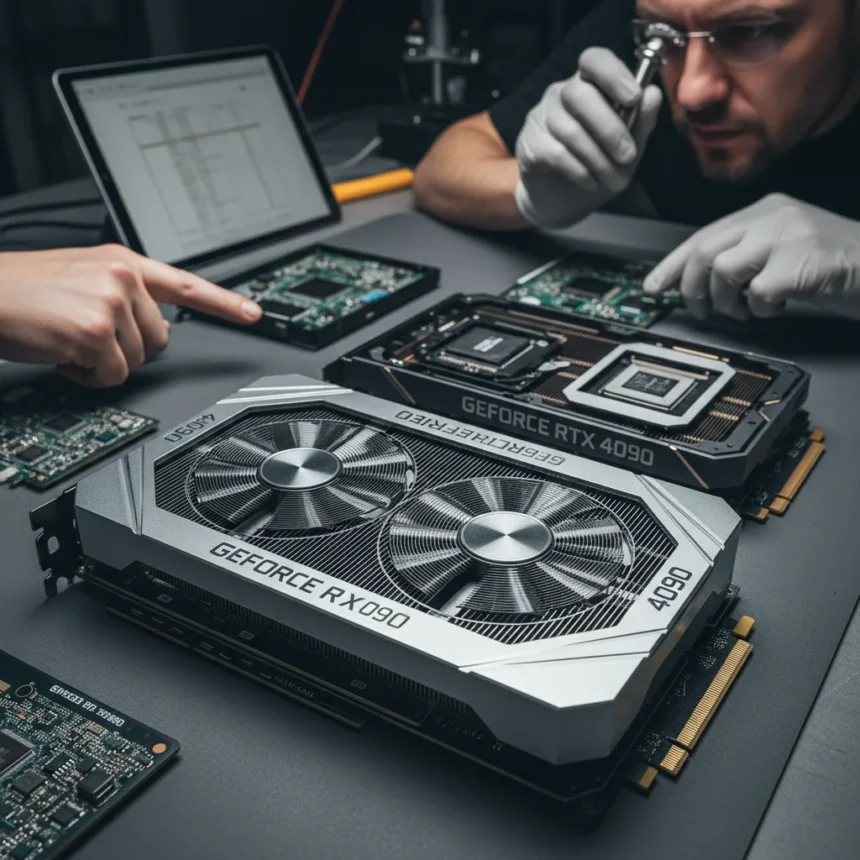
RTX 4090 counterfeits have reached a level of sophistication that is alarming even seasoned repair technicians. A repair shop recently received an Asus ROG Strix RTX 4090 that appeared legitimate at first glance—until the teardown revealed a factory-grade counterfeit operation. The scammers used laser-etching to mark stripped RTX 30-series chips with RTX 4090 branding, polished away original markings, and replaced memory with fakes that mimicked GDDR6X labels so closely that visual inspection alone cannot reliably distinguish them.
Key Takeaways
- RTX 4090 counterfeits use laser-etched RTX 30-series dies and fake memory chips that fool trained eyes.
- Scammers strip real RTX 4090 components for export to China due to restrictions, then resell modified 30-series cards.
- Fake memory chips are shaved flat and re-laser-etched with exact model numbers and date codes matching real GDDR6X.
- Repair technicians describe the fakes as ‘the best scam ever seen’ due to factory-level precision.
- Fakes are sold for around $1,394 each via overseas vendors, targeting unsuspecting US buyers.
How the RTX 4090 Counterfeits are Made
The counterfeit RTX 4090 manufacturing process demonstrates remarkable technical skill. Scammers begin by sourcing RTX 30-series GPUs—typically RTX 3090, RTX 3090Ti, or RTX 3080 models—and extracting the GPU die (the core processor chip). They then polish away the original GA102 markings from these 30-series chips and use industrial laser-etching equipment to mark them with fake AD102 branding, which is the actual die designation for the RTX 4090. The memory chips receive equally meticulous treatment: they are shaved to remove original markings, then laser-etched with exact model numbers and date codes that match genuine GDDR6X specifications, making them visually indistinguishable from authentic components.
What makes detection so difficult is the precision of the laser work. A repair technician examining one counterfeit noted that the scammers ‘lasers printed exact same model in the date code on all of them polished the core and laser etched 490 markings on it dropped a bit of solder everywhere and put it all in and shipped it out to the US market’. The solder work is deliberately sloppy to mimic factory assembly, but the laser etching itself is flawless. Real GDDR6X chips have curved tops; the fake memory appears shaved flat with suspicious uniformity. Under magnification, the differences become apparent—but most buyers never open their GPU to inspect it at this level.
Why RTX 4090 Counterfeits Exist at Scale
The root cause of this scam is export restrictions. Nvidia RTX 4090 GPUs are heavily restricted from export to China due to their compute performance and potential military applications. This creates two market pressures: Chinese demand for high-end GPUs cannot be legally satisfied through official channels, and legitimate RTX 4090 components become extremely valuable to scammers who can strip them for export. Rather than waste the stripped PCBs and memory, counterfeiters repackage them with fake dies and sell them back into the US market at full RTX 4090 prices—around $1,394 per card. The buyer believes they are getting a real flagship GPU; the scammer profits from both the arbitrage and the counterfeit markup.


A separate incident involving a Japanese repair technician revealed the scale of the problem. A customer sent four RTX 4090 GPUs for repair after purchasing them overseas for approximately $1,394 each (10,000 yuan). Three of the four were sophisticated counterfeits. One fake had a protruding capacitor—a telltale sign of RTX 30-series architecture—and wrong QR code positioning. Another exhibited mismatched substrate and frame components. Only one card was genuine, and even that one required repair for faulty GDDR6X memory and capacitor issues. The consistency across incidents suggests an organized operation, not isolated fraud.
Detection Challenges for RTX 4090 Counterfeits
Even trained repair technicians struggle to identify RTX 4090 counterfeits without opening the card. One repair expert stated: ‘Well, we’ve reached a point where the scam has gotten so good that even the trained eye cannot detect it… This is concerning, you know, to a trained eye such as myself’. The counterfeits fail immediately upon testing—the fake cards show dead shorts on the 1.8V power rail and zero thermal activity when voltage is injected—but this requires specialized equipment and expertise to diagnose. A casual buyer who powers on a counterfeit will see nothing; no BIOS splash, no fans spinning, just silence. By then, the card is already in their system and the seller has vanished.



The memory chips are particularly deceptive. Real GDDR6X memory has curved tops due to the manufacturing process; counterfeit chips are shaved flat and laser-etched so precisely that the date codes, model numbers, and even the tiny text are identical to genuine components. Only by comparing chip thickness, inspecting solder quality, and checking for missing RIT pads (resistor-inductor-transistor pads that real memory requires) can a technician confirm the fakes. Most buyers lack the tools and knowledge to perform these checks before purchase.
What This Means for GPU Buyers
RTX 4090 counterfeits represent a market-level threat to buyers purchasing from third-party sellers, particularly overseas vendors and resellers claiming to sell Amazon pallets or liquidation stock. The sophistication of the fakes means that visual inspection in product photos is unreliable. Buying from authorized retailers—Nvidia, Asus, or major domestic electronics chains—remains the safest option, though it typically means paying higher prices. Buyers purchasing used or discounted RTX 4090 GPUs from unfamiliar sellers should request detailed photos of the memory chips, die markings, and PCB serial numbers, and consider having the card inspected by a repair technician before committing to a purchase.
The scam also highlights a broader supply chain vulnerability. As long as export restrictions create artificial scarcity and price premiums, counterfeiters have financial incentive to invest in laser-etching equipment and manufacturing precision. Real RTX 4090 GPUs will continue to be stripped and exported illegally, and fake cards will continue to flood secondary markets. Nvidia’s restriction policy, while justified for national security reasons, has inadvertently created the conditions for one of the most sophisticated GPU counterfeiting operations ever documented.
Are RTX 4090 counterfeits common?
RTX 4090 counterfeits are not yet widespread in mainstream retail, but they are increasingly common in overseas markets and secondary seller platforms. The incidents documented involve organized operations with access to industrial laser-etching equipment, suggesting this is not casual fraud but rather a coordinated supply chain attack.



How can I verify my RTX 4090 is real?
Check the memory chip tops under magnification—real GDDR6X has curved tops, while counterfeits are shaved flat. Verify the die markings are crisp and consistent with Nvidia’s official documentation. Purchase only from authorized retailers and request proof of authenticity from sellers offering discounted cards. If you suspect a counterfeit, contact the retailer or manufacturer immediately.
What should I do if I bought a fake RTX 4090?
Contact the seller immediately and request a refund, providing evidence of the counterfeit (photos of memory chips, die markings, or repair technician reports). If the seller refuses, dispute the transaction with your payment processor or credit card company. Report the seller to the platform they used (eBay, Amazon, etc.) to prevent further fraud.
The RTX 4090 counterfeiting operation exposes a critical weakness in GPU supply chains: when demand far exceeds legal supply, sophisticated criminals will fill the gap with convincing fakes. Until export restrictions ease or Nvidia increases legitimate RTX 4090 availability in restricted markets, buyers must remain vigilant. The scammers have already proven they can fool even the experts—caution is the only reliable defense.
Edited by the All Things Geek team.
Source: Tom's Hardware