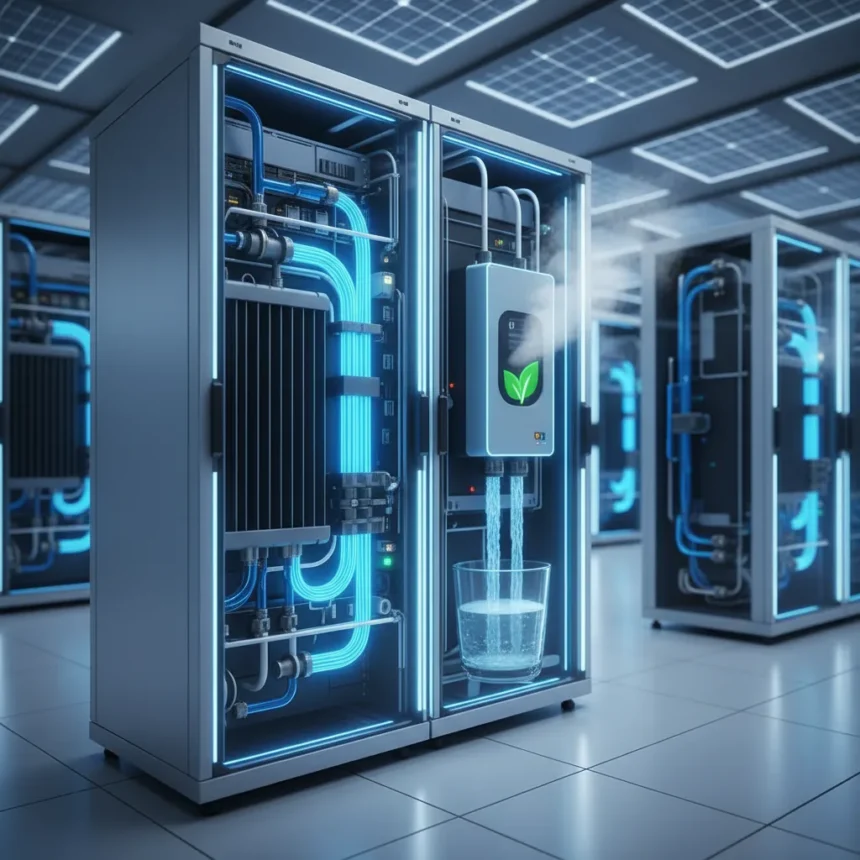
Saltwater cooling data centers represent a radical rethinking of how the industry handles its two biggest operational headaches: energy consumption and water depletion. Instead of dumping waste heat into the atmosphere or cooling towers, this salt-based system captures that heat to generate fresh water while simultaneously reducing energy demand. The result is infrastructure that becomes more efficient and economically feasible remarkably quickly.
Key Takeaways
- Saltwater cooling converts data center waste heat into fresh water, reversing traditional water consumption patterns.
- The system reduces energy use and operational costs compared to conventional cooling methods.
- Data centers powered by AI growth face mounting pressure on energy grids and freshwater supplies globally.
- Salt-based cooling achieves efficiency gains and cost recovery faster than competing cooling technologies.
- The approach addresses both sustainability and profitability simultaneously, making it economically viable at scale.
Why data centers desperately need saltwater cooling
Data centers consume roughly 1 to 2 percent of global electricity, and that figure is climbing sharply as artificial intelligence workloads explode. Cooling accounts for 30 to 40 percent of a data center’s total energy bill. Traditional cooling systems—evaporative coolers, chilled water loops, and air-conditioning units—dump enormous quantities of water into the atmosphere or return it contaminated to local watersheds. In water-stressed regions, this creates a genuine crisis: a single large facility can consume as much water as a city of 100,000 people.
The saltwater cooling hack flips this problem on its head. By leveraging salt’s thermodynamic properties to capture waste heat, the system generates potable water as a byproduct. This transforms a typical water-consuming process into a water-positive one, meaning facilities actually produce more clean water than they consume. For operators, the math is compelling: lower energy bills plus water credits or reduced municipal fees create a dual revenue stream.
How saltwater cooling achieves efficiency gains
The technology works by using salt-based solutions to absorb waste heat from server equipment, then leveraging the temperature differential to drive a thermodynamic cycle that separates salt from water. The salt is recycled back into the cooling loop, while the purified water can be used for facility operations, landscaping, or returned to local water systems. This closed-loop design means minimal losses and maximum resource recovery.

Compared to traditional evaporative cooling, which loses water to the atmosphere and requires constant chemical treatment, saltwater cooling eliminates those inefficiencies. Standard cooling towers also depend on ambient air temperature, making them less effective in hot climates—exactly where data centers are often built for cheap land and power. A salt-based system operates consistently regardless of outdoor conditions, delivering stable cooling performance year-round.
The economic advantage emerges quickly. Because the system reduces cooling energy demand and generates a marketable resource (water), payback periods compress dramatically. Operators report that the technology becomes an efficient and economically feasible solution within months rather than years, making capital investment decisions straightforward.



The broader sustainability angle
Data centers are not the only water-hungry infrastructure facing pressure. The renewable energy transition itself requires enormous quantities of water for solar panel cleaning and thermal storage systems. If data centers can flip from water consumers to water producers, they reduce systemic strain on freshwater supplies while simultaneously supporting the clean energy infrastructure needed to power them. This creates a virtuous cycle: efficient cooling enables more AI workloads, which can themselves accelerate clean energy deployment and optimization.
The technology also sidesteps a common pitfall in sustainability: the rebound effect. Improving efficiency sometimes leads to increased consumption, offsetting gains. But when cooling efficiency directly generates a valuable resource like water, the incentives align toward conservation rather than expansion, making the gains stick.
What still needs to happen
Saltwater cooling is not yet ubiquitous, which means the industry has not yet solved deployment at hyperscale. Questions remain about salt sourcing, long-term material degradation, and integration with existing infrastructure. Real-world pilot data from major operators would accelerate adoption. The technology’s economic case is strong, but only if facilities can actually capture and monetize the water they produce—which depends on local regulations and water markets.
For now, the saltwater cooling approach represents exactly the kind of dual-benefit innovation the industry needs. It does not ask operators to choose between efficiency and sustainability; it delivers both while improving the bottom line. As data center power demands continue climbing, this hack could shift from curiosity to standard practice far faster than traditional cooling technologies ever managed.



Can saltwater cooling work in any climate?
Yes. Unlike evaporative cooling, which loses effectiveness in humid or hot climates, salt-based systems operate consistently regardless of ambient conditions. The thermodynamic cycle depends on the salt solution and waste heat, not outdoor air temperature, making the technology viable globally.
How much water does saltwater cooling actually generate?
The research brief does not specify exact water recovery rates or volumes. The system captures waste heat to generate fresh water, but the amount depends on facility size, server load, and system design. Operators should expect facility-specific water generation metrics based on their cooling demands.
Is saltwater cooling more expensive than traditional cooling?
Initial capital costs may be higher, but the system achieves cost recovery quickly through reduced energy bills and water generation credits. The technology becomes economically feasible faster than competing cooling methods, making long-term operational costs substantially lower than traditional approaches.
The saltwater cooling hack solves a problem that traditional data center operators have accepted as permanent: the choice between high energy costs and high water consumption. By generating one resource while reducing demand for another, it proves that sustainability and profitability are not opposing forces but aligned incentives. As AI workloads push data centers toward crisis-level resource consumption, this approach offers a genuinely scalable path forward.
Edited by the All Things Geek team.
Source: TechRadar