





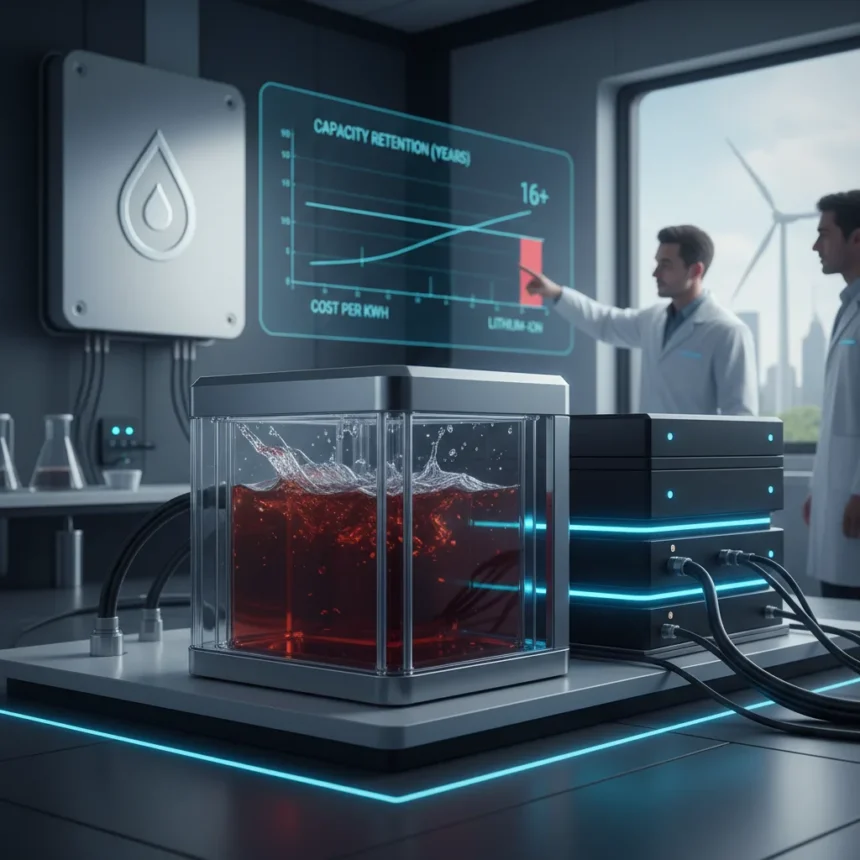
Iron battery technology is advancing faster than anyone predicted. Researchers at the Institute of Metal Research, Chinese Academy of Sciences, have developed an all-iron flow battery that operates for 6,000 charge-discharge cycles without any capacity loss—the equivalent of 16 years of daily operation. This breakthrough could fundamentally reshape how the world stores renewable energy and cuts the cost of grid infrastructure by orders of magnitude.
Key Takeaways
- Iron battery technology achieves 6,000 cycles with zero capacity loss and 99.4% Coulombic efficiency.
- Raw iron costs 80 times less than lithium, making iron battery technology dramatically cheaper for large-scale deployment.
- New electrolyte design uses alkaline chemistry with specialized iron complex that prevents material leakage and dendrite formation.
- Water-based electrolyte eliminates flammability risks inherent in lithium-ion systems.
- Positioned for grid-scale renewable energy storage, addressing intermittency in solar and wind power.
Why Iron Battery Technology Matters Right Now
The global energy transition is bottlenecked by cost and scarcity. Lithium supplies are finite, geographically concentrated, and expensive. Iron, by contrast, is the fourth most abundant element in Earth’s crust. The raw material advantage is staggering: iron costs over 80 times less than lithium as an industrial commodity. For grid storage—where you need massive capacity deployed across entire regions—that cost difference compounds into billions of dollars in savings. Iron battery technology directly addresses the affordability crisis that has slowed renewable energy adoption worldwide.
The Chinese Academy of Sciences team solved a problem that has plagued iron-based batteries for years: degradation and material crossover. Their iron battery technology uses a dual-protection mechanism at the molecular level. The electrolyte contains a specialized iron complex with rigid, bulky structure that physically shields the iron core from chemical attack, combined with a strong negative charge that creates an electrostatic repulsion force field. This design reduces active material crossover by two orders of magnitude compared to conventional iron flow batteries. The result is unprecedented stability.
How Iron Battery Technology Achieves Record Lifespan
The iron battery technology breakthrough hinges on electrolyte chemistry. Rather than organic solvents used in lithium systems, this design employs alkaline-based chemistry with a water-based electrolyte formulation that cannot explode. Over 6,000 test cycles, the battery maintained 99.4% Coulombic efficiency—a measure of how effectively charge moves through the system without leakage—while retaining 78.5% energy efficiency even at high power outputs. Zero capacity loss across all 6,000 cycles is unprecedented for iron-based systems.


Lead researcher Tang Ao explained the innovation: “We combined high steric hindrance with a negatively charged interface for the first time. This dual protection mechanism addresses both degradation and crossover at the molecular origin, which have long limited the lifespan of iron-based flow batteries.” The absence of dendrites—needle-like crystal formations that short-circuit batteries—means the system maintains perfect reversibility and stable structure indefinitely.
Iron Battery Technology vs. Lithium: The Real Cost Gap
Lithium-ion dominates portable electronics and electric vehicles because energy density per kilogram matters. But grid storage is different. You can afford heavier, bulkier systems if they cost a fraction of the price. Iron battery technology trades some energy density for radical affordability and safety. The water-based electrolyte eliminates thermal runaway and explosion risks that plague lithium-ion installations in populated areas. For utilities building multi-megawatt storage facilities, this safety advantage alone justifies the switch.



The lifespan comparison is equally decisive. Lithium-ion batteries degrade predictably; after 10-15 years, capacity drops to 80% of original. Iron battery technology’s 16-year zero-degradation lifespan means utilities can operate the same battery pack for two decades without replacement, spreading capital costs across a much longer asset lifetime. When you factor in material cost, manufacturing simplicity, safety, and longevity, iron battery technology becomes the rational choice for grid storage.
What Happens Next for Iron Battery Technology
The research team published their findings in Advanced Energy Materials in April 2025. The study demonstrates a working prototype, but the path from laboratory to commercial deployment typically takes 3-5 years. The Chinese Academy of Sciences stated that iron battery technology “offers a low-cost, long-life solution for large-scale energy storage.” No timeline for commercialization has been announced, and questions remain about manufacturing scale, integration with existing grid infrastructure, and real-world field testing under varied climate conditions.
The 16-year lifespan claim is based on accelerated cycling tests, not actual field operation. Real-world performance may vary depending on temperature, humidity, and discharge patterns. Still, the gap between iron battery technology and conventional iron flow batteries is so dramatic that even conservative estimates suggest a transformative impact on renewable energy economics.
Could Iron Battery Technology Replace Lithium Everywhere?
Not immediately. Lithium-ion will remain the standard for portable devices and vehicles because weight and energy density are critical. Iron battery technology is purpose-built for stationary grid storage, where size is irrelevant and cost per kilowatt-hour is everything. The two technologies will coexist for decades, each optimized for its use case.



When will iron battery technology be commercially available?
No commercial launch date has been announced. The research team at the Institute of Metal Research published their breakthrough in April 2025, indicating the technology remains in the prototype stage. Typical timelines for battery technology from lab to market deployment range from 3-5 years, but iron battery technology faces no known technical barriers to scaling.
How much cheaper is iron battery technology than lithium?
Raw iron costs 80 times less than lithium as an industrial material. The total cost advantage of iron battery technology extends beyond raw materials to manufacturing simplicity, safety systems, and lifespan. Grid-scale deployment could reduce energy storage costs by 70-80% compared to lithium-ion systems, though final pricing depends on manufacturing efficiency and supply chain maturity.
Iron battery technology represents a genuine inflection point for renewable energy. It removes the affordability barrier that has limited solar and wind adoption in developing economies. It eliminates safety risks that make lithium installations controversial in populated areas. And it delivers a 16-year operational lifespan that makes the economics of renewable storage undeniable. The real question is not whether iron battery technology will transform grid storage—it will—but how quickly utilities can transition existing infrastructure to accommodate it.
This article was written with AI assistance and editorially reviewed.
Source: TechRadar




