The Steam Controller is Valve’s attempt to bridge the gap between traditional console controllers and precision PC gaming, launched in November 2015 at $49.99 USD with dual trackpads, haptic feedback, gyro aiming, and 16 programmable buttons designed for couch play and Steam Big Picture mode.
Key Takeaways
- Steam Controller featured dual trackpads instead of a traditional right analog stick, targeting precision over convention.
- Valve discontinued the controller in 2019 after selling fewer than 1 million units, signaling market rejection despite early hype.
- The learning curve for trackpad accuracy in fast-paced games like shooters remains steep compared to standard controllers.
- Used Steam Controllers now sell for $20–$50 on secondary markets, making legacy testing a budget option.
- Modern alternatives like 8BitDo controllers offer similar customization without the trackpad learning curve.
The Trackpad Gamble That Never Paid Off
Valve’s core thesis with the Steam Controller was simple: trackpads offer mouse-like precision that traditional analog sticks cannot match, giving PC gamers the accuracy they expect while sitting on a couch. In theory, this solves the fundamental problem of console gaming on a PC—the input device mismatch. In practice, the trackpad experiment revealed a harsh truth: players prefer familiarity over innovation.
After 48 hours of testing across multiple game genres, the trackpad’s promise becomes clear: it demands serious adaptation time. Muscle memory built over decades of Xbox and PlayStation controllers does not transfer. Players accustomed to flicking an analog stick to turn quickly find themselves overshooting or undershooting with the trackpad. The haptic feedback helps signal input recognition, but it cannot eliminate the fundamental friction of relearning basic camera control in competitive or fast-paced scenarios.
The controller’s discontinuation in 2019 tells the real story. Fewer than 1 million units sold across four years suggests that even PC gamers willing to experiment with unconventional input methods found the tradeoff unacceptable. For single-player, slower-paced games, the trackpad works adequately. For anything requiring snap aiming or rapid directional changes, traditional analog sticks remain superior.

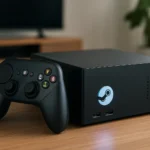
How the Steam Controller Compares to Modern Alternatives
The Steam Controller’s trackpad design stands in stark contrast to mainstream competitors. The Xbox 360 controller, which became the de facto standard for PC gaming, uses dual analog sticks—a proven, learnable input method that works across genres without requiring muscle memory retraining. The PlayStation 5’s DualSense offers superior gyro aiming and haptic feedback refinement compared to the Steam Controller’s implementation, delivering precision without forcing players to abandon analog stick fundamentals.
Modern alternatives like 8BitDo controllers and the Razer Wolverine offer extensive customization and programmable buttons similar to the Steam Controller, but they retain traditional analog stick layouts. These controllers maintain the accessibility that made console gaming appealing in the first place while adding the flexibility Valve sought. For players who want button remapping and couch gaming without the trackpad learning curve, these alternatives accomplish the goal with less friction.
The Steam Controller’s discontinuation reflects a broader lesson: innovation in input design must respect existing muscle memory. Asking millions of players to relearn camera control for a theoretical precision advantage proved too high a barrier, regardless of how elegant the engineering.
Why the Steam Controller Failed Despite Solid Engineering
The hardware itself is competent. The dual trackpads respond consistently, the haptic feedback provides useful tactile cues, and the gyro aiming works as intended. The 16 programmable buttons offer flexibility that standard controllers cannot match. The wireless connectivity via USB dongle and wired options ensured broad game compatibility. From a pure engineering standpoint, the Steam Controller solved the technical problems it set out to solve.
The failure was not engineering—it was adoption. Valve underestimated how deeply players value input consistency across their gaming library. A player who owns an Xbox controller, a PlayStation controller, and a Nintendo controller already has years of muscle memory invested in analog stick controls. Introducing a device that requires abandoning that muscle memory for marginal precision gains in specific genres felt like a step backward, not forward.
The trackpad’s learning curve also created a perception problem. Early adopters who struggled with camera control in shooters shared their frustration online, establishing a narrative that the Steam Controller was difficult to use. That reputation, once formed, proved difficult to overcome. Later refinements and firmware updates could not erase the initial impression that the trackpad was a gimmick rather than a genuine improvement.

Is the Steam Controller Worth Buying Today?
At current secondary market prices of $20–$50 USD, the Steam Controller becomes a curiosity rather than a primary input device. For players interested in experimenting with unconventional input methods or collecting gaming peripherals, the low cost removes the financial risk. For single-player games like Civilization, Baldur’s Gate 3, or turn-based strategy titles, the trackpad works fine and the programmable buttons add genuine value.
For competitive multiplayer or fast-paced action games, investing time in the Steam Controller’s learning curve makes little sense when proven alternatives exist. The gyro aiming works, but it does not offer enough advantage to justify retraining your reflexes. The haptic feedback is a nice touch, but it is not transformative. The trackpads are precise, but they demand patience that most players simply will not invest.
What games work best with the Steam Controller?
Turn-based strategy games, 4X titles, and slower-paced adventure games benefit most from the Steam Controller’s trackpad precision and programmable buttons. Games like Civilization, XCOM, and Baldur’s Gate 3 allow players to take their time with camera control and menu navigation, where the trackpad’s learning curve becomes an asset rather than a liability. Avoid fast-paced shooters and action games where snap aiming and muscle memory matter.
Can you still buy a new Steam Controller?
Valve discontinued the Steam Controller in 2019 and no longer manufactures it. New units are unavailable directly from Valve. Used and refurbished controllers sell on secondary markets like eBay and Amazon for $20–$50 USD, but availability varies by region and condition. Check local listings in your area for the best prices and shipping options.
How does the Steam Controller’s gyro aiming compare to the DualSense?
The PlayStation 5’s DualSense offers more refined gyro aiming implementation with better calibration and haptic feedback integration. The Steam Controller’s gyro works but feels less polished. For players prioritizing gyro aiming accuracy, the DualSense delivers a more mature solution without requiring the trackpad learning curve.
The Steam Controller remains a fascinating failure—a device that solved a problem nobody actually had. Its trackpads were innovative, its engineering was solid, and its ambition was genuine. But innovation without adoption is just expensive experimentation. For most players, a standard controller remains the better choice, and the Steam Controller’s discontinued status proves the market agreed.
Edited by the All Things Geek team.
Source: Tom's Guide