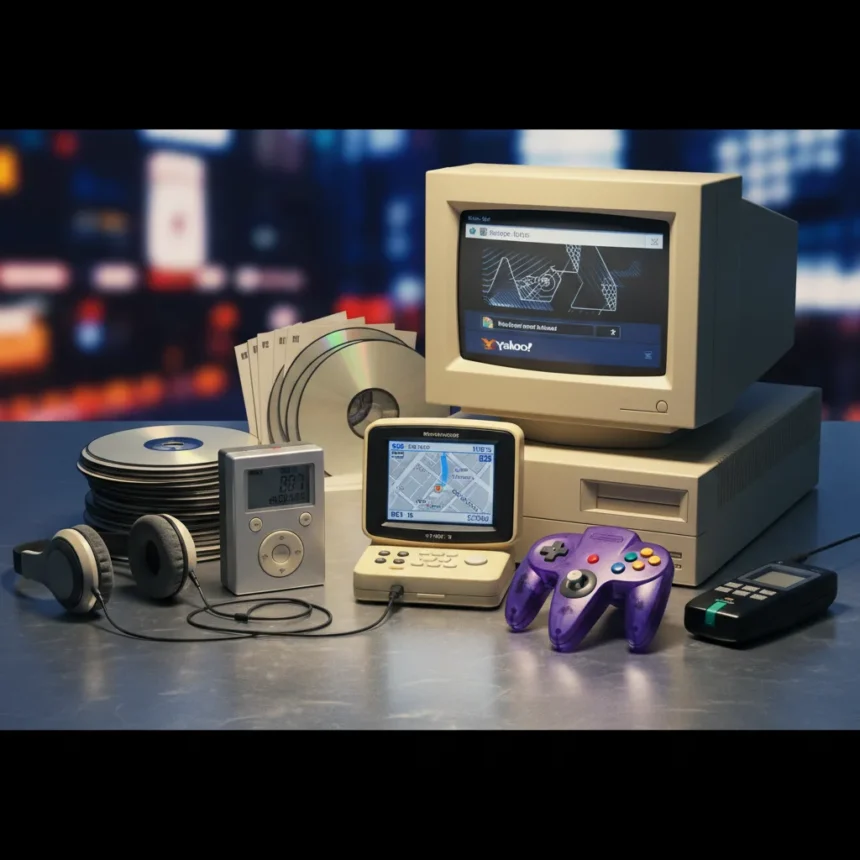
The 1990s were the most pivotal decade for gaming, mobile phones, communication, and cars, birthing 1990s tech innovations that reshaped how humans work, play, and connect. Three decades later, many of these breakthroughs remain functional in drawers and garages worldwide—relics of an era when the internet was still taking its first steps and mobile devices fit in your pocket rather than your hand.
Key Takeaways
- The 1990s introduced consumer sat-navs, MP3 players, satellite television, and flatscreen TVs for the first time.
- The World Wide Web and email emerged during this decade, fundamentally changing communication.
- GamesMaster, a gaming TV phenomenon, ran for seven series from 1992 to 1998 with millions of viewers.
- 1990s tech innovations spanned gaming consoles, mobile phones, and automotive technology simultaneously.
- Many 1990s devices remain functional today, making the decade’s innovations surprisingly durable.
How 1990s Tech Innovations Transformed Daily Life
1990s tech innovations did not arrive as isolated gadgets—they arrived as an ecosystem shift. Consumer satellite navigation systems debuted, ending the era of paper maps and wrong turns. MP3 players emerged, liberating music from the Walkman’s cassette tapes and Sony’s proprietary formats. Flatscreen televisions appeared in living rooms, replacing the bulky cathode-ray tubes that had dominated since the 1950s. Satellite television brought hundreds of channels into homes previously limited to terrestrial broadcasts. Each innovation addressed a specific friction point in daily life, and together they created the technological foundation for the 2000s and beyond.
The timing was crucial. The 1990s cultural moment—defined by Britpop, floppy-haired fringes, and a generation embracing consumer electronics—created demand for these products. Unlike the 1980s, when personal computers were still specialist tools, the 1990s saw technology become aspirational lifestyle objects. A sat-nav was not just navigation; it was a status symbol. An MP3 player was not just a music device; it was freedom.
The Web and Email: Communication Reimagined
The World Wide Web and email emerged in the 1990s as the decade’s most consequential innovations, yet they arrived quietly, without the marketing blitz that surrounded consumer electronics. Email transformed business communication from memo-based to instantaneous. The web transformed information access from library-bound to globally searchable. Neither invention was complete or polished—early web browsers crashed, email attachments failed, dial-up connections screamed—but the trajectory was unmistakable.


What made these innovations revolutionary was their accessibility. Unlike mainframe computing or early internet access, the web and email became tools ordinary people could use at home. This democratization happened faster than anyone predicted. By the late 1990s, having an email address was becoming a social necessity. By 2000, not having a web presence was a business liability. The infrastructure for modern remote work, social connection, and information sharing was built in this decade, even if the full implications took another 10 years to materialize.
Gaming in the 1990s: From Bedroom Culture to Mainstream
Gaming underwent a seismic shift during the 1990s, moving from niche hobby to cultural phenomenon. GamesMaster, a gaming television show that aired on Channel 4, epitomized this transformation. Produced by Hewland International and starring Sir Patrick Moore as a floating head with Dominik Diamond as master of ceremonies, the show ran for seven series from 1992 to 1998, reaching millions of viewers. This was not gaming content hidden in specialist magazines—this was prime-time television celebrating video games as entertainment.



GamesMaster’s existence proved that gaming had escaped the bedroom. The show featured challenges, reviews, and celebrity guests, treating games with the same production value as mainstream entertainment. For seven years, it defined how British television covered gaming culture. The show’s run from 1992 to 1998 spanned the entire transition from 16-bit to 32-bit consoles, from cartridge-based systems to CD-ROM gaming, from niche to mainstream. By the time GamesMaster ended, gaming was no longer something teenagers hid from their parents—it was something families watched together on television.
Mobile Phones and Automotive Innovation
The 1990s also witnessed the emergence of consumer mobile phones and satellite navigation in cars, two innovations that would define the following decades. Mobile phones transformed from brick-sized novelties in the 1980s to genuinely portable devices by the 1990s. Satellite navigation eliminated the need for passengers to navigate using paper maps, fundamentally changing the driving experience. These innovations did not reach their full potential until the 2000s and 2010s, but their foundations were laid in the 1990s.
What distinguishes 1990s tech innovations from earlier breakthroughs is their convergence. The decade did not produce one revolutionary device—it produced multiple categories of devices simultaneously, all aimed at making life more convenient, more connected, and more mobile. This convergence created the conditions for the internet boom and the subsequent smartphone revolution.
Why 1990s Tech Still Matters Today
Thirty years later, why do 1990s tech innovations still capture attention? Partly nostalgia, partly durability. Many 1990s devices still function. An old MP3 player still plays music. A flatscreen TV from 1995 still displays an image. This longevity contrasts sharply with modern electronics designed for planned obsolescence. But more importantly, 1990s tech innovations established the conceptual and technical foundations for everything that followed. The web did not invent itself in 2000—it was built on 1990s infrastructure. Email did not suddenly become essential in 2005—millions of people were already dependent on it by 2000.


The 1990s also represent a unique moment: the last decade before smartphones consolidated all these innovations into a single device. Sat-nav, MP3 player, email, web browser, camera, phone—all existed separately in the 1990s. A smartphone combines them into one object. In that sense, 1990s tech innovations were the last generation of single-purpose devices that mattered culturally. They were also the last generation of devices that required genuine technical knowledge to operate. Using an MP3 player meant understanding file formats. Using a sat-nav meant understanding how to input coordinates. This friction created a barrier to entry that also created genuine engagement and satisfaction.
Did the 1990s Really Change Everything?
The 1990s introduced multiple categories of consumer technology simultaneously, but whether this decade was truly more pivotal than others depends on perspective. The 1980s gave us personal computers. The 2000s gave us smartphones. The 1990s gave us the connective tissue—the web, email, and mobile phones—that made those other innovations useful. That connective role is genuinely important, even if it is less visible than a single breakthrough device.
Which 1990s tech innovations are still in use today?
Flatscreen televisions, satellite television systems, and email remain in widespread use. MP3 players have been superseded by streaming services, but the MP3 format itself persists in digital music. Sat-nav technology evolved into smartphone GPS, but the underlying concept remains unchanged. The World Wide Web is obviously still the foundation of internet use. Of all 1990s innovations, email and the web are the most directly continuous with modern usage.
What made GamesMaster culturally significant?
GamesMaster proved that gaming deserved mainstream television coverage. For seven series from 1992 to 1998, it reached millions of viewers and treated games with production value equivalent to other entertainment formats. It legitimized gaming culture at a moment when video games were still considered niche. The show’s success demonstrated that gaming had crossed from hobby to cultural phenomenon, paving the way for gaming to become the entertainment industry’s largest sector.
The 1990s tech innovations we celebrate today succeeded because they solved real problems—navigation without maps, music without tapes, communication without postal delays, information without encyclopedias. They were not perfect. They were often clunky, slow, and unreliable by modern standards. But they worked well enough to become essential, and they evolved into the technologies that define modern life. That is the real legacy of 1990s tech innovations: not the devices themselves, but the problems they identified and the solutions they pioneered.
Edited by the All Things Geek team.
Source: T3