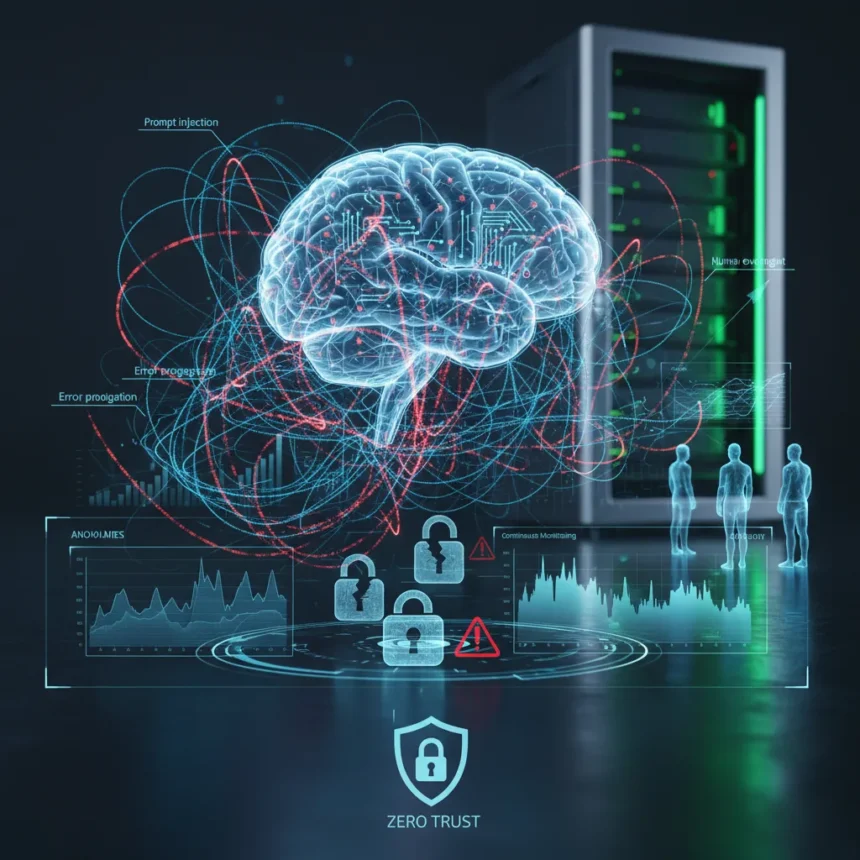
AI agents security risks are fundamentally different from traditional software vulnerabilities. Autonomous AI systems that interact with each other to perform tasks create new attack surfaces where data leakage or manipulation can propagate rapidly across connected systems, and the non-deterministic nature of generative AI makes these systems harder to control and predict than deterministic applications.
Key Takeaways
- AI agents operate with different risk profiles than traditional software due to dynamic natural-language responses and unpredictable behavior.
- Prompt injection, automated phishing, jailbreaking, and error accumulation in multi-agent systems represent the most immediate threats.
- Zero trust principles, least-privilege access, and continuous monitoring are essential for securing autonomous AI systems.
- AI agents should be treated like human users with defined identities, purposes, and behavioral baselines for security oversight.
- Human oversight at critical decision points prevents cascading failures and flawed assessments that lead to financial losses.
Why AI agents security risks demand a new approach
Traditional security frameworks assume predictable system behavior. AI agents fail differently. They fail creatively and in ways that deterministic software never does. A bug in conventional code produces the same error every time; the same bug in an AI agent might produce wildly different outputs depending on context, user input phrasing, or training data drift. This non-determinism breaks legacy testing and detection methods. Generative AI systems have a fundamentally different risk profile than traditional software because they respond dynamically to natural-language inputs, making them harder to control and secure. The speed and scale at which autonomous agents operate amplifies these risks—what might be a minor error in human-managed workflows becomes a cascading failure when an agent executes thousands of decisions per second across connected systems.
The enterprise rush to deploy agentic AI in workflows like cybersecurity, SaaS integrations, and compliance automation has outpaced security maturity. Builders focus on data quality and bias; security teams face routine threats like prompt injection and data exfiltration that receive less attention than existential risk hype. This mismatch leaves organizations exposed to attacks that are happening today, not in speculative futures.
The specific threats AI agents introduce
Prompt injection stands out as the most immediate threat. Malicious inputs can manipulate agent behavior, bypass safeguards, extract sensitive data, or trigger unintended actions. An attacker who understands how an agent interprets natural language can craft prompts that trick it into revealing credentials, modifying data, or executing unauthorized commands. Unlike SQL injection, which targets predictable parsing logic, prompt injection exploits the agent’s attempt to be helpful and responsive to human intent.



Multi-agent systems compound the risk. When agents coordinate with each other to complete complex tasks, errors in one agent can propagate to others before detection. An agent with high-privilege access—say, credentials to modify customer records or execute financial transactions—becomes a liability if its behavior drifts or if an attacker compromises its inputs. Jailbreaking attempts that bypass built-in safety constraints, automated phishing campaigns executed at scale, malicious code generation, privacy violations through uncontrolled data access, and insider threat-like actions from agents with excessive privileges all represent realistic attack vectors. The problem intensifies when agents lack context. Without proper understanding of business constraints, regulatory requirements, or situational nuance, AI agents make flawed assessments that drive poor decisions, leading to financial losses, regulatory breaches, and brand damage.
Zero trust and continuous monitoring as the foundation
The solution mirrors how organizations secure human employees: treat AI agents as identities with defined purposes and limited privileges. Zero trust principles require issuing identities to agents, defining least-privilege access scoped to their specific role, establishing behavioral baselines for normal operations, and continuously monitoring for anomalies or deviations from expected patterns. An agent designed to review security logs should never attempt to modify firewall rules; an agent tasked with customer support should never access payroll systems. When an agent tries to interact outside its defined scope, that is a security signal.



Continuous monitoring catches non-deterministic risks that traditional testing misses. Because the same input can produce different outputs, production monitoring for anomalous behavior or unintended data exposure becomes mandatory. Organizations must implement behavioral baselines that capture what normal agent activity looks like, then alert when activity deviates—unusual data access patterns, interactions with unexpected systems, or outputs that violate expected constraints. This requires security teams to understand agent workflows deeply enough to recognize when something is wrong.
Governance controls and risk management
Built-in governance controls must be established from the start of AI initiatives, not bolted on afterward. These controls monitor data ingestion, model behavior, and generated outputs within ethical, security, and regulatory boundaries. Continuous evaluation post-deployment detects model drift, bias, or unexpected behavior as models evolve with new data and users. Organizations should map AI governance to existing compliance frameworks like ISO 27701, HIPAA, and PCI DSS to ensure agents do not inadvertently violate regulatory requirements.
Red teaming—systematically attempting to break, jailbreak, or manipulate agents—must be ongoing, not a one-time exercise. As attackers discover new exploitation techniques, red teams need to stress-test agents against those same methods. Strong data governance and strict controls on training and operational datasets prevent privacy violations and limit the blast radius if an agent is compromised. AI literacy training for teams building and deploying agents is essential; many organizations lack the expertise to recognize when an agent is behaving unexpectedly or when a prompt injection attempt is underway.
The governance challenge extends to human oversight. Maintaining human oversight and systematic monitoring is essential to prevent small errors from cascading into larger failures. AI cannot replace human judgment, particularly in high-stakes decisions. Agents should be trusted only as junior engineers—capable of handling routine tasks with human review, but not autonomous decision-makers in critical situations. If organizations do not govern AI agent identities with the same rigor applied to human employees, they are building liabilities rather than innovative products.


How does zero trust differ from traditional access control?
Traditional access control assumes that anyone inside the network perimeter is trustworthy. Zero trust assumes nothing is trustworthy by default—every request, every system, every user (or agent) must be verified and authorized based on context. For AI agents, this means continuous verification that the agent is behaving within its defined scope, not just granting broad permissions at deployment time.
What is the difference between agentic AI and traditional software in terms of security?
Traditional software behaves deterministically—the same input produces the same output, making vulnerabilities predictable and testable. Agentic AI responds dynamically to natural-language inputs, producing different outputs from the same input depending on context. This non-determinism breaks legacy testing, making continuous production monitoring and behavioral baselines essential.
Why is human oversight critical for AI agents?
AI agents lack context about business constraints, regulatory requirements, and situational nuance. Without human judgment at critical decision points, agents make flawed assessments that lead to financial losses, regulatory breaches, and brand damage. Human oversight prevents small errors from cascading into larger failures.
The rise of agentic AI in enterprise workflows is real and accelerating. So are the risks. Organizations that treat AI agent security as an afterthought or assume that the same controls protecting traditional software will suffice are exposing themselves to novel attacks that move at machine speed and scale. Zero trust, continuous monitoring, governance controls, and human oversight are not optional—they are the foundation of responsible AI deployment. The window to build security into agentic AI initiatives is now, before autonomous systems become too deeply embedded in critical workflows to retrofit with proper controls.
Edited by the All Things Geek team.
Source: TechRadar