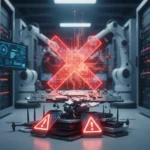
Robots public transport integration is rapidly becoming a cautionary tale about automation gone wrong. What transit agencies imagined as seamless efficiency has instead created operational nightmares, passenger confusion, and safety concerns that challenge the entire premise of deploying autonomous systems in crowded urban environments.
Key Takeaways
- Robots are malfunctioning on public transit systems, creating safety and operational hazards.
- Transit agencies face unexpected costs managing robot-related disruptions and passenger incidents.
- Autonomous systems designed for controlled environments struggle in unpredictable public spaces.
- The gap between robot capability and real-world transit demands is wider than vendors promised.
- Human oversight remains essential, contradicting the automation narrative.
Why Robots Are Failing Public Transit Systems
Autonomous systems deployed on buses, trains, and transit platforms are not performing as advertised. Robots malfunction in crowded conditions, create bottlenecks during peak hours, and sometimes pose direct safety risks to passengers. The problem is not theoretical—it is happening right now on operational transit networks where thousands of people depend on reliable service.
Transit agencies invested in robots expecting cost reduction and efficiency gains. Instead, they are managing robot failures, passenger complaints, and infrastructure damage. A single malfunctioning robot can cascade into system-wide delays. When a robot breaks down in a station or on a platform, human staff must intervene, disrupting the entire flow of passengers. The promised labor savings evaporate the moment something goes wrong.
The root issue is environmental mismatch. Robots function well in controlled factory settings with predictable variables. Public transit is the opposite—crowded, unpredictable, chaotic. A robot designed to move packages cannot navigate a rush-hour commute. Passengers behave unpredictably. Weather changes. Infrastructure varies. Real-world transit demands constant adaptation, something current robots simply cannot do reliably.



The Human Cost of Automation Failure
When robots malfunction on public transport, humans pay the price. Staff must manually override systems, physically remove broken robots, and manage frustrated passengers. This creates more work, not less. Transit workers report spending hours troubleshooting robot failures instead of performing their core duties. The automation paradox is fully visible here: systems meant to reduce labor demands are actually increasing them.
Passengers experience unpredictable service. A robot might block an escalator. Another might collide with luggage or wheelchairs. Elderly passengers and people with disabilities face particular challenges when robots occupy spaces designed for accessibility. Transit agencies cannot simply ignore these incidents—they create liability, safety violations, and public relations disasters.



The financial impact is substantial. Maintaining robots costs money. Repairing damage they cause costs more. Training staff to work alongside malfunctioning automation costs additional resources. Meanwhile, the core transit service—moving people reliably—suffers.
Robots Public Transport: A Comparison to Human-Centered Transit
Human transit staff, despite their flaws, adapt to chaos. They respond to emergencies. They help lost passengers. They handle unexpected situations. Robots cannot. A human conductor notices a passenger struggling with luggage and helps. A robot continues its programmed path, potentially creating a hazard.
Traditional transit systems, staffed by trained humans, maintain flexibility that automation cannot replicate. Yes, humans have bad days and make mistakes. But humans also exercise judgment, show compassion, and solve problems in real time. Robots execute instructions. When instructions fail—and they do, constantly—the system breaks.
The comparison reveals a fundamental truth: public transit is a human service. It requires human judgment, human flexibility, and human accountability. Replacing humans with robots does not eliminate these needs—it just transfers them to someone else who must now manage the robots.


What Transit Agencies Are Learning
Forward-thinking transit agencies are pumping the brakes on robot deployment. Early adopters are discovering that the costs of integration, maintenance, and disruption management outweigh any benefits. Some are scaling back robot programs entirely, redirecting budgets toward human staffing and infrastructure improvements.
The lesson is simple: automation works in controlled environments. Public transit is not controlled. Until robots can genuinely handle real-world complexity—crowded platforms, weather, unexpected passenger behavior, equipment failures—they are a liability, not an asset.
Some agencies are exploring hybrid models where robots handle specific, limited tasks under heavy human supervision. This approach acknowledges robot limitations while attempting to find narrow use cases where they might add value. But even this is cautious. The hype has deflated significantly.
Is robot deployment on public transit inevitable?
No. Many transit agencies are choosing not to deploy robots at all, recognizing that the technology is not ready for public-facing service. The inevitable narrative—that automation will eventually replace human transit workers—is being challenged by real-world failure. Technology does not always progress. Sometimes it stalls. Sometimes it fails. Robots on public transit may be one of those failures that takes years to reverse.
What went wrong with robot automation in transit?
Vendors oversold capabilities. Agencies underestimated real-world complexity. Nobody adequately planned for failure modes. The result is robots that work fine in demos but break constantly in actual operation. Poor planning, inflated expectations, and insufficient testing created a perfect storm of disappointment.
Will transit agencies keep using robots despite problems?
Some will, but many are already stepping back. Budget constraints, passenger safety concerns, and staff resistance are forcing reckonings. Agencies that invested heavily are now trapped managing expensive failures. New agencies considering robot deployment are watching these cautionary tales and making different choices.
The robots public transport story is not a future prediction—it is a present-day crisis. Transit agencies deployed technology they did not fully understand into environments far more complex than vendors acknowledged. The result is operational chaos, wasted resources, and a hard-won lesson: not every problem has a technological solution, and some of the most human services demand human workers. Automation hype meets reality, and reality is winning.
Edited by the All Things Geek team.
Source: TechRadar