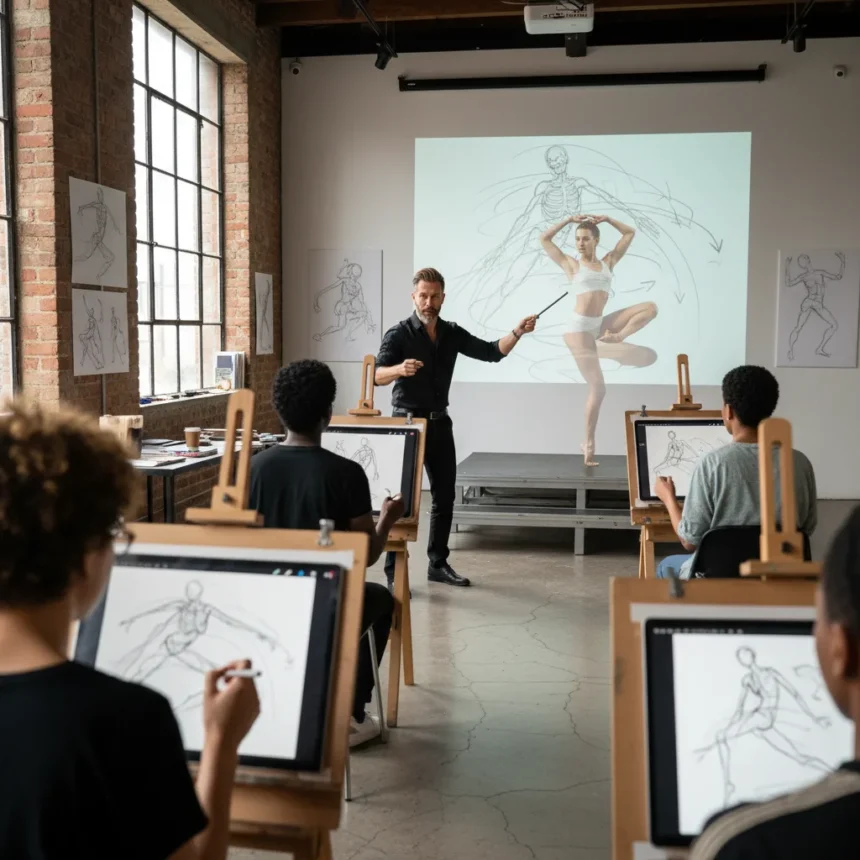
Figure drawing anatomy is not about memorizing bone names or muscle groups—it is about capturing movement and life on the page. A masterclass from ImagineFX teaches artists to think of anatomy as a tool for conveying action, not as an end in itself.
Key Takeaways
- Anatomy should serve the action, not dominate the figure drawing process
- Copying reference photographs does not automatically convey movement in your drawing
- The masterclass emphasizes analyzing and constructing over direct copying
- Core principle: compose anatomy specifically to show the intended action
- Drawing is the graphical interface to your imagination and creative vision
Why Figure Drawing Anatomy Matters for Movement
Most artists approach figure drawing anatomy by studying skeletal structure and muscle placement in isolation. The masterclass takes a different stance: anatomy exists to serve the gesture. When you understand how the body moves, you can position anatomical elements to emphasize that movement rather than simply rendering accurate proportions. This distinction separates lifeless technical drawings from figures that leap off the page.
The core instruction is direct: analyze and construct rather than copy. When working from a photograph of someone in motion, copying the pose does not automatically translate that action into your drawing. Instead, you must actively compose the anatomy to show the action. This requires understanding what anatomical elements communicate movement—how the spine curves, how weight shifts, how limbs extend or compress.
The Figure Drawing Anatomy Workflow: From Conception to Presentation
The masterclass structures figure drawing anatomy development across a clear progression. It begins with the initial inkling of an idea and moves through development stages toward final presentation. Each step applies core visual tools to develop your anatomical concept, but the emphasis remains on gesture and movement as primary rendering steps.

Rather than starting with anatomy, start with action. What is your figure doing? How does the body respond to that action? Once you establish the gesture, anatomy becomes the vocabulary for expressing it. This approach inverts the typical learning sequence. Instead of learning anatomy first and then trying to make it move, you establish movement first and use anatomical knowledge to reinforce it.
Drawing becomes the graphical interface to your imagination—the techniques taught in this masterclass enable you to translate your idea into a visual form that others can understand and feel. This is why gesture matters more than accuracy. A slightly inaccurate figure with powerful gesture reads as alive. A perfectly proportioned figure with static pose reads as a anatomy lesson, not a drawing.



Analyzing Reference Photos Rather Than Copying Them
Most beginning artists treat reference photographs as templates to trace or copy directly. The masterclass rejects this approach entirely. When you copy a photograph, you are reproducing the camera’s frozen moment. You are not creating a drawing—you are transcribing an image. The distinction matters because a photograph captures a single instant, often with awkward proportions created by the camera angle, lighting, and lens distortion.
Instead, analyze the reference. What is the core action? What anatomical elements communicate that action most clearly? You might exaggerate certain curves, shift weight distribution, or adjust proportions to make the action read more powerfully. This is not inaccuracy—it is interpretation. It is using your understanding of figure drawing anatomy to strengthen the gesture beyond what the photograph shows.
The phrase “we never copy; we analyse and construct” captures the philosophy. You are not a photocopier. You are an artist making intentional choices about how anatomy serves your vision.
Applying Figure Drawing Anatomy to Your Own Work
The masterclass framework moves from initial conception through development and into final presentation. At each stage, you apply your understanding of figure drawing anatomy not as a checklist but as a tool for expression. Early sketches establish gesture and action. Development stages refine the anatomy to support that gesture. Final presentation ensures that every anatomical choice reinforces the intended movement.



This means you should practice rendering figures from imagination, not just from reference. When you draw without a photograph, you must rely on your internalized understanding of figure drawing anatomy. You make choices about proportion, angle, and pose based on what communicates the action most clearly. This builds the intuition that separates strong figure artists from technical draftspeople.
How does figure drawing anatomy differ from life drawing?
Life drawing captures what you see in front of you—a model in a specific pose. Figure drawing anatomy uses anatomical knowledge to create figures that express action and character, whether from reference, imagination, or a combination. Life drawing is observation; figure drawing is interpretation using anatomical tools.
What are the core visual tools mentioned in the masterclass?
The masterclass references “core visual tools” for developing anatomical concepts but emphasizes that these tools serve gesture and movement. The specific tools are applied throughout the workflow rather than listed separately—they are the techniques you use to compose anatomy for action.
Should I memorize anatomy before learning figure drawing?
The masterclass suggests a different path: learn anatomy in context of gesture and action. Memorizing isolated facts about bones and muscles is less valuable than understanding how anatomical elements communicate movement. Start with gesture, then learn anatomy as the vocabulary for expressing it. This approach keeps anatomy connected to purpose rather than treating it as abstract knowledge.
Figure drawing anatomy becomes powerful when you stop thinking of it as a set of rules to follow and start using it as a language for expression. The masterclass teaches that your drawings will gain life and energy when anatomy serves the gesture, not the other way around. Master this principle, and your figures will move.
Edited by the All Things Geek team.
Source: Creativebloq