





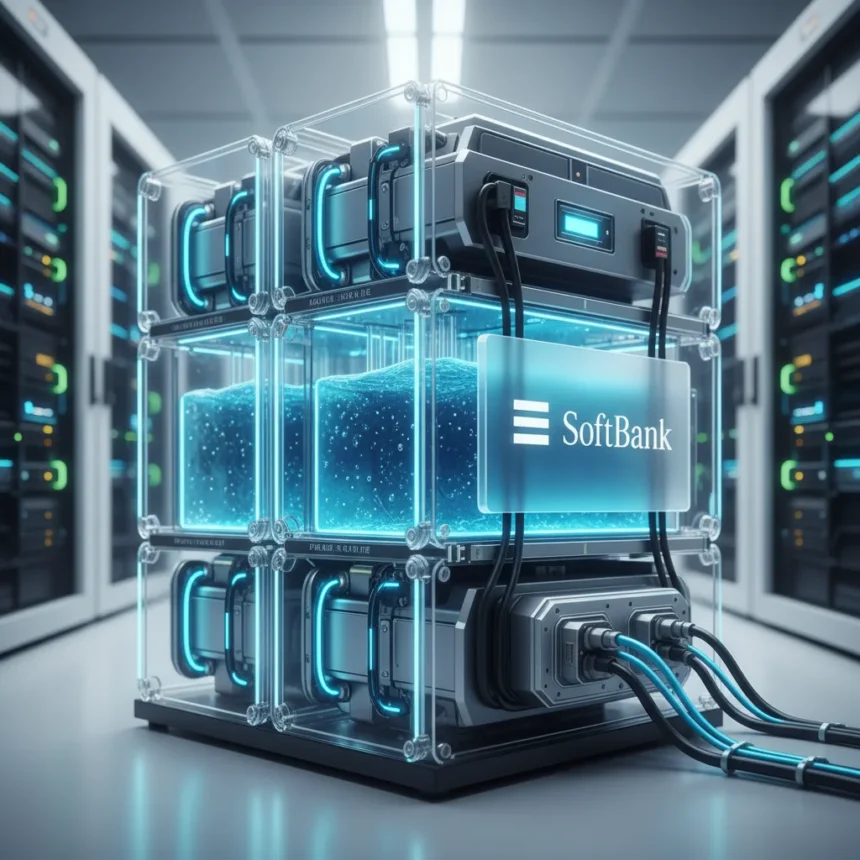
Water-based battery technology is emerging as a critical infrastructure play for AI data centers, and SoftBank is betting billions on it. The Japanese conglomerate is partnering with two South Korean startups—Cosmos Lab, a battery developer founded in 2021, and DeltaX Co., an AI firm specializing in battery design—to manufacture zinc-halogen batteries at its GX Factory in Sakai, Osaka Prefecture. The facility, built on a former Sharp LCD plant acquired by SoftBank in 2025, will house battery manufacturing alongside an AI data center and solar panel production, creating an integrated energy ecosystem for powering compute-heavy operations.
Key Takeaways
- SoftBank targets gigawatt-hour-scale battery production by fiscal 2028 using zinc-halogen chemistry with water electrolyte.
- Water-based design eliminates fire risk present in lithium-ion systems, addressing critical safety concerns in energy storage.
- Zinc and halogen materials are easily sourced in Japan, reducing dependence on rare metals like lithium and cobalt.
- Cosmos Lab’s proprietary electrode technology suppresses dendrite formation, extending battery lifespan beyond typical zinc-based systems.
- SoftBank projects 1 GWh annual production by 2030, equivalent to powering over 100,000 home energy storage units yearly.
Why SoftBank is building its own water-based battery technology
The AI infrastructure boom is creating an acute energy crisis. Data centers demand massive, reliable power supplies, and current battery solutions rely on supply chains vulnerable to geopolitical pressure and material scarcity. By developing water-based battery technology in-house, SoftBank addresses two critical vulnerabilities simultaneously: it secures a proprietary energy source and eliminates dependency on China-sourced rare metals like lithium and cobalt. The company’s new mid-term management plan, announced in May 2026, explicitly includes battery manufacturing as a core business line, with a target annual revenue of 100 billion yen from next-generation batteries.
The water electrolyte design is the key differentiator. Traditional lithium-ion batteries use organic solvents, which pose ignition and fire risks—a persistent problem in large-scale energy storage installations. Zinc-halogen batteries with water electrolyte eliminate this hazard almost entirely, making them safer for data center deployment where thermal runaway could compromise critical infrastructure. For SoftBank, this safety advantage translates directly into reduced insurance costs, simpler cooling requirements, and faster regulatory approval across markets.
How water-based battery technology works and its limitations
Zinc-halogen chemistry is straightforward: zinc serves as the anode, a halogen compound (iodine, bromine, or chlorine) forms the cathode, and pure water acts as the electrolyte. This design avoids the complex rare-earth supply chains that plague lithium-ion manufacturing. However, zinc batteries have historically suffered from a critical flaw—dendrite formation. Zinc ions accumulate on electrodes as needle-like crystals, degrading performance and shortening lifespan compared to lithium-ion systems.



Cosmos Lab’s proprietary technology tackles this problem through microscopic electrode patterning that suppresses dendrite growth. The approach is elegant: by controlling the physical structure of the electrode surface, the company prevents zinc ions from clustering into destructive crystal formations. This innovation extends cycle life significantly, though SoftBank acknowledges that energy density remains below lithium-ion standards—a gap the company is actively addressing through ongoing research into higher-density variants.
The trade-off is clear. Water-based batteries sacrifice some energy density for safety, cost, and supply-chain resilience. For stationary applications like data center backup power and renewable energy storage, this trade-off is acceptable. For mobile devices or vehicles requiring high energy density in compact form, lithium-ion remains superior. SoftBank is positioning water-based technology for exactly the right use case: large, stationary, grid-connected systems where safety and cost matter more than weight.



SoftBank’s production roadmap and market implications
Manufacturing begins in fiscal year 2027 (starting March 2027) at the Sakai facility, with mass production at gigawatt-hour scale targeted for around fiscal 2028. The initial deployment will power SoftBank’s large-scale AI data center co-located at the same site, serving as both a real-world test bed and a proof-of-concept for enterprise customers. By 2030, SoftBank aims to scale production to 1 GWh annually—enough to manufacture over 100,000 home energy storage units per year, positioning the Sakai plant as Japan’s largest battery manufacturing facility.
This timeline is aggressive but achievable. SoftBank is investing tens of billions of yen into the project, signaling serious capital commitment. The company is also developing parallel battery chemistries: second-generation designs targeting 600Wh/kg energy density, all-solid-state variants, and metal-air batteries with even higher theoretical capacity. This portfolio approach hedges the risk that any single chemistry will dominate the market, giving SoftBank optionality as the energy storage landscape evolves.
For the broader industry, SoftBank’s move signals that lithium-ion dominance is fragmenting. Startups like Cosmos Lab are proving that alternative chemistries can compete on safety and cost. If SoftBank’s manufacturing reaches scale, it could trigger a wave of competitors developing zinc-based, sodium-ion, and flow batteries for stationary storage. That competition would finally break the lithium-ion monopoly that has persisted for two decades.
Is water-based battery technology ready for commercial deployment?
Yes, but with caveats. Cosmos Lab’s dendrite-suppression technology is proven at laboratory scale, and SoftBank’s integration of the battery with its own AI data center provides a controlled test environment. However, real-world performance at gigawatt-hour scale remains unproven. Manufacturing defects, thermal management challenges, and integration issues could emerge during the ramp-up to 1 GWh annual production. SoftBank’s timeline assumes no major setbacks, which is optimistic but not impossible given the company’s manufacturing expertise.


The bigger question is market adoption. SoftBank can produce batteries, but can it compete against entrenched lithium-ion suppliers on price and reliability? The company’s initial focus on powering its own data centers is smart—it avoids the chicken-and-egg problem of needing customers before proving the technology. Once SoftBank demonstrates that water-based batteries can reliably power commercial AI infrastructure, third-party data center operators, renewable energy companies, and grid operators will have a compelling reason to diversify away from lithium-ion dependence.
What happens to water-based battery technology after 2030?
SoftBank’s 1 GWh production target by 2030 is substantial but still modest compared to global lithium-ion capacity, which exceeds 500 GWh annually. The company’s long-term strategy likely involves licensing its technology to other manufacturers, particularly in Japan and Southeast Asia, to accelerate adoption without bearing the full capital burden of additional factories. The 100 billion yen revenue target suggests SoftBank views batteries as a profitable business line, not just a cost center for its data center operations.
The geopolitical dimension is crucial. Japan has minimal lithium and cobalt reserves but abundant zinc and halogen resources. By establishing a domestic battery industry, SoftBank helps Japan reduce critical mineral dependency and creates a strategic advantage in global AI infrastructure competition. This aligns perfectly with Japan’s government push for energy independence and semiconductor self-sufficiency.
Will water-based batteries replace lithium-ion entirely?
Unlikely. Lithium-ion will remain dominant for mobile and automotive applications where energy density and weight are non-negotiable. Water-based batteries excel in stationary storage, grid stabilization, and backup power—markets that are growing rapidly but remain smaller than the mobile device market. The future energy storage landscape will be pluralistic, with different chemistries optimized for different applications. SoftBank is betting that the stationary storage market is large enough to justify billions in capital investment, and the numbers support that bet.
When will SoftBank’s water-based batteries be available to consumers?
Home energy storage units powered by SoftBank’s zinc-halogen batteries could reach the Japanese market by 2029 or 2030, assuming manufacturing ramps as planned. Global availability will follow later, likely starting with Asia and eventually expanding to Europe and North America. Pricing will be critical—if SoftBank can undercut lithium-ion on cost while matching safety and reliability, adoption will accelerate. If water-based batteries cost significantly more, they will remain niche products for customers prioritizing safety over price.
SoftBank’s water-based battery initiative is not a moonshot—it is a calculated bet on a proven chemistry that solves real problems in AI infrastructure. The company has the capital, manufacturing expertise, and strategic motivation to succeed. Whether water-based batteries become a major industry force depends on execution, market adoption, and whether competitors can replicate Cosmos Lab’s dendrite-suppression breakthrough. The next three years will be critical in determining whether SoftBank has found a sustainable alternative to lithium-ion dominance.
Edited by the All Things Geek team.
Source: Tom's Hardware




