



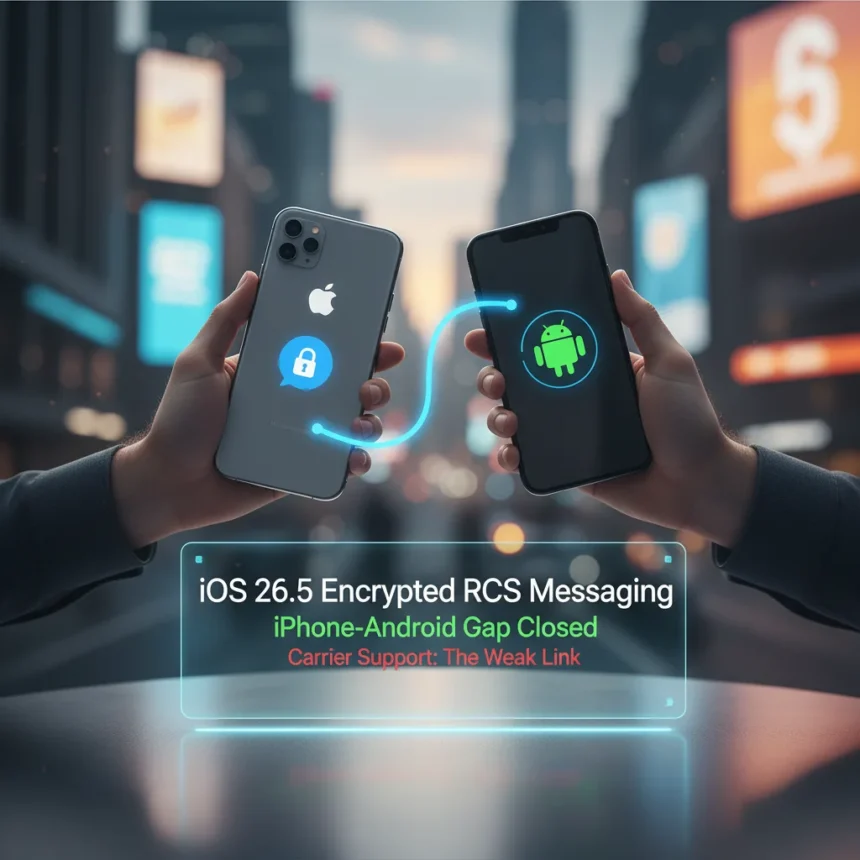
Encrypted RCS messaging just arrived on iPhone. Apple released iOS 26.5 on May 11, 2026, introducing end-to-end encryption for RCS chats between iPhones and Android devices, marking the first time Apple’s Messages app offers native cross-platform encryption without requiring a third-party app.
Key Takeaways
- iOS 26.5 enables end-to-end encrypted RCS messaging by default between iPhone and Android users
- Secure RCS chats display a lock icon; encryption works in the native Messages app with no app switching
- Feature requires compatible carriers and regional RCS support—not universal like iMessage
- Rollout began May 11, 2026, in beta; public availability depends on carrier infrastructure
- iOS 26.5 also includes 50+ security fixes and Maps/CarPlay updates
What Encrypted RCS Messaging Actually Changes
Encrypted RCS messaging replaces the old, unencrypted RCS that Apple added in iOS 18.1 back in 2024. When you send an encrypted RCS message, Apple and Google cannot read it—nor can carriers or any third party intercepting the data in transit. The Messages app marks these conversations with a lock icon so you know encryption is active. Encryption turns on automatically for new and existing RCS conversations, though you can control it in settings if needed.
This closes a meaningful privacy gap. Before iOS 26.5, iPhone-to-Android messaging meant either using SMS (completely unencrypted) or switching to WhatsApp or Signal. Now, the default Messages app handles it natively. No app download. No friction. That matters for people who message Android users daily and want privacy without extra steps.
How iOS 26.5 Encrypted RCS Messaging Compares to iMessage
iMessage has offered end-to-end encryption since 2011, but only for iPhone-to-iPhone conversations. It runs on Apple’s servers, bypassing carriers entirely. Encrypted RCS messaging works differently: it still travels through carrier networks, which means it depends on carrier infrastructure and regional support. This is the real limitation. You cannot assume every iPhone-Android chat will be encrypted the way you can assume every iPhone-to-iPhone chat is.


WhatsApp and Signal offer E2EE across all platforms, but they require users to install and adopt a separate app. Encrypted RCS messaging wins on convenience—it is built into the default messaging app on both iOS and Android. You do not need to convince your contacts to download anything. That architectural simplicity is why this matters, even though iMessage remains more universally encrypted within Apple’s ecosystem.
The Carrier Dependency Problem
Here is where encrypted RCS messaging stumbles. The feature only works if your carrier supports RCS and your region has enabled it. Availability varies by country and carrier network. If your carrier has not rolled out RCS infrastructure, you fall back to SMS—which is unencrypted. Apple and Google announced the rollout on May 11, 2026, but full availability depends on carrier cooperation globally, which is slower and patchier than a pure software update.



This is not a flaw in the encryption itself—it is a structural limitation of RCS as a carrier-dependent protocol. Unlike iMessage, which Apple controls end-to-end, encrypted RCS messaging requires buy-in from telecommunications companies with varying incentives and timelines. In regions where carriers have already deployed RCS, the feature works immediately. In others, you are waiting.
What Else iOS 26.5 Brings
Beyond encrypted RCS messaging, iOS 26.5 includes over 50 security fixes, new Pride wallpapers, and updates to Maps and CarPlay. The App Store also saw subscription tweaks, though specifics are limited. These are incremental improvements rather than headline features, but the security patch count suggests Apple addressed meaningful vulnerabilities.
Should You Update to iOS 26.5?
If you regularly message Android users and your carrier supports RCS, update immediately. Encrypted RCS messaging is a genuine security upgrade. If your carrier has not yet deployed RCS, the feature will not help you yet—but the 50+ security fixes are reason enough to update. There is no downside to installing iOS 26.5.
Will encrypted RCS messaging work with my carrier?
That depends on your carrier and region. RCS availability is rolling out gradually. Check with your carrier to confirm RCS support in your area. If your carrier has already deployed RCS, iOS 26.5 will enable encryption automatically. If not, you will continue using SMS for Android chats until RCS infrastructure arrives.



How does encrypted RCS messaging differ from iMessage encryption?
Both use end-to-end encryption, but iMessage is Apple-controlled and universal across all iPhone-to-iPhone chats. Encrypted RCS messaging depends on carrier networks and regional support, so availability is inconsistent. iMessage offers stronger guarantees of encryption; RCS encryption is opt-in by carrier infrastructure.
iOS 26.5 represents real progress on cross-platform messaging security. For the first time, iPhone and Android users can exchange encrypted messages in the default app without installing Signal or WhatsApp. That is meaningful. But do not mistake it for a universal solution. Encrypted RCS messaging is only as good as your carrier’s willingness to support it, and that support is still patchy globally. If your carrier is ready, this is a genuine upgrade. If not, you are still waiting.
Edited by the All Things Geek team.
Source: TechRadar