




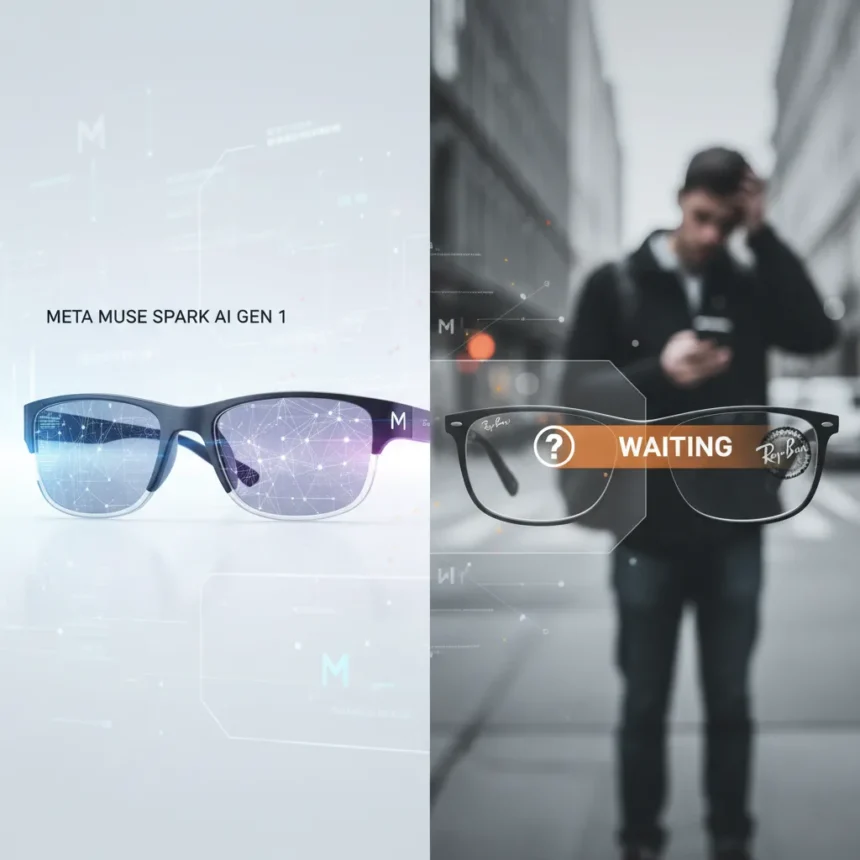
Meta Muse Spark AI Glasses Gen 1 has arrived with a significant software update that marks a divergence in Meta’s wearables strategy. The feature rollout prioritizes the original AI Glasses model while leaving Ray-Ban Display users waiting for their own implementation. This selective deployment reveals the complexities of bringing advanced AI features to hardware that shipped at different times with different capabilities.
Key Takeaways
- Meta Muse Spark AI Glasses Gen 1 now has the new AI feature available
- Ray-Ban Display does not yet support Muse Spark functionality
- The rollout timeline for Ray-Ban Display remains unannounced
- Feature parity between Meta’s wearable lines remains incomplete
- This update signals Meta’s prioritization strategy for its glasses ecosystem
What Meta Muse Spark AI Glasses Gen 1 Actually Gets
Meta Muse Spark AI Glasses Gen 1 is the original AI-powered glasses from Meta, designed to integrate AI capabilities directly into wearable form factor. The new update brings Muse Spark functionality to this device, expanding what users can do with voice commands and AI interactions through the glasses interface. This represents a tangible capability upgrade for owners of the first-generation hardware.
The arrival of Muse Spark on Meta Muse Spark AI Glasses Gen 1 means the device now supports enhanced AI-driven features that were previously unavailable. Owners can expect deeper integration between their glasses and Meta’s AI systems, though the exact scope of these capabilities depends on the specific implementation Meta has chosen for this hardware generation. The update is live now, not staged or pending further rollout phases.
Why Ray-Ban Display Remains Sidelined
Ray-Ban Display, Meta’s partnership with Ray-Ban that brought smart glasses to a wider audience, does not yet support Muse Spark functionality. This creates a notable gap in feature parity between Meta’s two major wearable lines. The reasons for this delay likely stem from hardware differences—Ray-Ban Display was designed with different processors and capabilities than the AI Glasses Gen 1, making direct feature porting non-trivial.



Meta has not announced a timeline for bringing Muse Spark to Ray-Ban Display. This absence of clarity is frustrating for Ray-Ban Display owners who expected feature convergence across Meta’s wearables. The delay suggests that either the feature requires hardware capabilities Ray-Ban Display lacks, or Meta is prioritizing the AI Glasses line as its flagship wearable platform. Without an official statement, speculation fills the void—but the fact remains that Ray-Ban Display users are excluded from this update indefinitely.
What This Reveals About Meta’s Wearables Strategy
The selective rollout of Muse Spark highlights a critical tension in Meta’s wearables approach. The company is simultaneously pushing two distinct product lines—the AI Glasses as a premium, feature-rich device, and Ray-Ban Display as a more mainstream, fashion-forward option. Updates like this one expose the reality that these are not interchangeable platforms; they are separate ecosystems with different technical foundations and, apparently, different development priorities.


Meta’s decision to ship Muse Spark on AI Glasses Gen 1 first signals that the original AI Glasses remain the company’s testbed for advanced features. Ray-Ban Display, despite its stronger market positioning through Ray-Ban’s brand recognition, takes a back seat in the feature race. For consumers, this creates a dilemma: the more fashionable Ray-Ban option may lag behind the more niche AI Glasses in capability. This is the opposite of how most tech ecosystems mature, where mainstream products eventually reach feature parity with specialized predecessors.
Should You Wait for Ray-Ban Display Support?
If you own Ray-Ban Display, the question is whether to wait or accept that Muse Spark may never arrive on your device. Meta’s silence on a timeline is telling. Companies that plan to ship a feature typically announce a date or at least a quarter; the absence of any commitment suggests internal uncertainty about feasibility or priority. Betting on Ray-Ban Display receiving Muse Spark in the near term is a risky assumption.
For potential buyers, this update reinforces that the AI Glasses Gen 1 is Meta’s serious AI wearable, while Ray-Ban Display is positioned as a consumer-friendly smart glasses option without the latest AI features. If AI capabilities matter to you, the AI Glasses Gen 1 with Muse Spark support is the current choice. If you prioritize design and brand heritage, Ray-Ban Display remains a solid option—just don’t expect it to lead in AI features anytime soon.
Is Muse Spark exclusive to Meta Muse Spark AI Glasses Gen 1?
No, Muse Spark is not exclusive to the AI Glasses Gen 1. However, it is currently only available on that device. Ray-Ban Display and other Meta wearables do not yet support it, though Meta may expand availability in the future. The exclusivity is temporary, not permanent—but with no announced timeline, Ray-Ban Display users should not hold their breath.


What hardware differences prevent Ray-Ban Display from running Muse Spark?
Meta has not publicly detailed the specific hardware limitations preventing Ray-Ban Display from supporting Muse Spark. The two devices have different processors, memory configurations, and power management systems, any of which could be a blocker. Without Meta’s technical breakdown, the exact reason remains speculation, though the gap suggests the devices are more different under the hood than their similar form factors suggest.
Will Ray-Ban Display ever get Muse Spark?
Meta has not announced whether Ray-Ban Display will receive Muse Spark support. The absence of any commitment—even a vague promise—suggests uncertainty on Meta’s part. Ray-Ban Display owners should assume Muse Spark is not coming unless Meta makes an explicit announcement. Betting on future feature parity has proven risky in Meta’s wearables division.
The rollout of Muse Spark to Meta Muse Spark AI Glasses Gen 1 while Ray-Ban Display waits underscores a hard truth about Meta’s wearables strategy: feature parity is not guaranteed, and hardware generation matters more than brand recognition. If you want the latest AI capabilities, the AI Glasses Gen 1 is where Meta is placing its bets. Ray-Ban Display remains a solid consumer device, but it is no longer on the cutting edge of Meta’s AI ambitions.
Edited by the All Things Geek team.
Source: Android Central