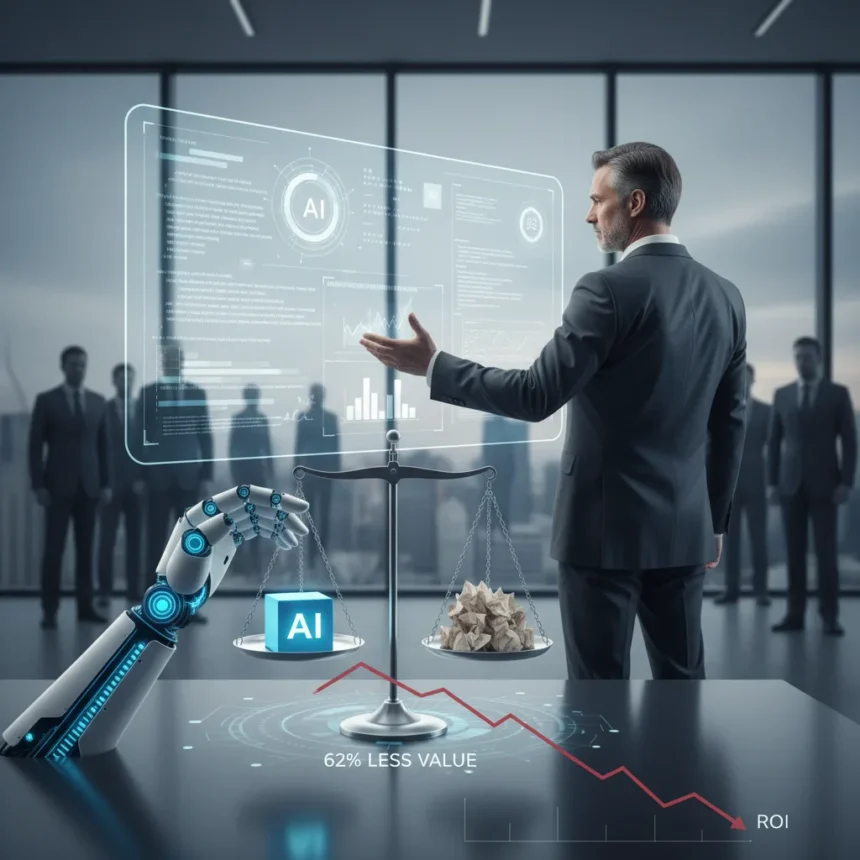
AI adoption executives value human workers less, according to a survey showing a troubling shift in corporate priorities. Sixty-two percent of executives report that using AI has made them value human workers less, even as only 28% say AI has delivered consistent return on investment across their organizations. The gap between executive enthusiasm and actual business results reveals a dangerous pattern: companies are cutting costs by devaluing staff while failing to prove the technology works.
Key Takeaways
- 62% of executives admit AI adoption has reduced how much they value human workers
- Only 28% of executives report consistent ROI from AI implementations
- 50% of leaders say AI has already helped reduce headcount at their organizations
- 43% of workers fear AI will cause widespread job losses within five years
- 51% of UK business leaders view AI primarily as a cost-cutting tool for staff reduction
The ROI Problem Behind Executive Devaluation
The statistics reveal a fundamental contradiction in corporate AI strategy. While executives are openly admitting they value humans less after adopting AI, the technology is not delivering the financial returns that would justify such a shift. When only 28% of executives report consistent ROI, the remaining 72% are essentially betting on a technology that has not proven itself in their own organizations. This gap between confidence and results is where worker anxiety originates.
The problem deepens when examining how executives are using their AI savings. Fifty percent of leaders say AI has already helped reduce headcount, and 43% of managers expect fewer entry-level roles due to AI replacement. These are not hypothetical concerns—they are happening now. The shift from valuing human expertise to treating it as expendable happens quickly once cost-cutting becomes the primary AI use case. Executives are not waiting for ROI proof; they are cutting first and justifying later.
How AI is Reshaping Hiring and Entry-Level Opportunity
The devaluation of human workers extends directly into hiring practices, where AI is creating barriers for candidates while simultaneously failing to improve outcomes. In a study of UK hiring practices, 47% of candidates were interviewed by AI, yet 82% were not informed upfront that they would face an AI interviewer. Worse, 30% of candidates walked away from the process entirely upon discovering AI involvement, with another 19% prepared to leave.



This pattern shows that AI adoption executives value human workers less not just in retention but in recruitment. Entry-level positions are particularly vulnerable. The 43% of managers expecting fewer entry-level roles reflects a strategic choice: use AI to filter candidates cheaply rather than invest in training junior talent. This creates a long-term talent pipeline problem that executives are not discussing publicly. When companies stop hiring entry-level workers, they stop developing future leaders—but that cost is invisible until it arrives.
Worker Fear Versus Executive Confidence
The disconnect between executive optimism and worker anxiety is stark. While executives are devaluing humans based on AI adoption, 43% of workers fear automation will cause widespread job losses within the next five years, and 25% believe their own job is at risk from AI. This is not paranoia; it is a rational response to what executives are openly admitting.



The fear is not uniform across income levels. High earners—those in the top income quartile—use AI defensively, with 62% leveraging it for validation and error prevention, compared to only 38% of mid-level workers. This suggests a two-tier workforce emerging: senior staff using AI as a safety net to protect their positions, while junior and mid-level workers face replacement risk. The executives devaluing human workers are protecting themselves first.
The Hidden Cost of AI Implementation
Beyond the visible job cuts, AI adoption is creating what researchers call hidden workloads. According to occupational medicine research, AI does not simply replace work—it often increases complexity and creates new error-correction tasks that slow overall productivity. Workers are spending more time validating AI outputs, fixing mistakes, and managing systems that were supposed to simplify their jobs.
This dynamic explains why executives see cost savings while reporting low ROI. The spreadsheet shows fewer headcount costs, but it does not capture the hours spent debugging AI decisions, rewriting AI-generated content, or managing the organizational friction created by devaluation. The true cost of AI adoption executives value human workers less is not just in layoffs—it is in the invisible burden placed on remaining staff.
Why Entry-Level Hiring is Taking the Biggest Hit
Fifty-one percent of UK business leaders view AI as a way to cut staff investment, and the easiest target is entry-level hiring. Entry-level roles require training investment, mentorship time, and tolerance for learning curves. AI promises to eliminate that cost by automating candidate screening and, eventually, junior work itself. But this strategy has a generational cost: without entry-level hiring, companies stop developing the mid-level talent that becomes tomorrow’s leaders.


The 43% of managers expecting fewer entry-level roles are not just cutting costs today—they are betting that AI will handle those functions forever. If AI fails to deliver, or if business needs shift, these companies will face a talent shortage of their own making. The executives devaluing human workers are not accounting for the long-term structural damage.
What This Means for Workers and the Job Market
The candid admission from executives that AI adoption has made them value human workers less is the most honest part of this trend. It removes the pretense that AI is about augmentation or upskilling. For many executives, it is about cost reduction, and humans are the cost to be reduced. Workers are right to be concerned. The job market is not adapting to AI adoption—it is being reshaped by it, with entry-level roles and mid-level positions facing the most pressure.
The question for workers is not whether AI will change employment. It will. The question is whether they will be among the high earners using AI defensively to protect their positions, or among the 43% of workers fearing widespread job losses. The answer depends largely on whether they can develop skills that executives cannot easily automate or outsource.
Is AI really replacing human workers right now?
Yes, but unevenly. Fifty percent of leaders say AI has already reduced headcount, and 43% expect fewer entry-level roles due to AI replacement. The cuts are happening now, particularly in hiring, customer service, and content generation. However, the replacement is not universal—high-income professionals are using AI defensively rather than facing replacement, creating a two-tier job market.
Why are executives devaluing human workers if AI ROI is low?
Because cost reduction is the primary goal, not productivity improvement. When only 28% of executives report consistent ROI, the remaining 72% are justifying AI investments through headcount cuts rather than proven business returns. Cutting staff is a visible, immediate cost saving, even if it does not improve overall organizational performance.
What should workers do about AI adoption and job security?
Focus on skills that complement AI rather than compete with it. High earners are using AI defensively for validation and error prevention—they are learning to work with the technology rather than against it. Workers who develop expertise in AI oversight, prompt engineering, and quality assurance are positioning themselves as essential to AI implementation rather than replaceable by it. Entry-level workers should prioritize roles in AI training, data labeling, or AI governance, where human judgment remains irreplaceable.
The admission that executives value human workers less after AI adoption is a watershed moment for employment. It strips away the optimistic rhetoric and reveals the actual business logic driving implementation. For workers, the message is clear: AI adoption is real, job displacement is accelerating, and waiting for executives to upskill their workforce is not a viable strategy. The time to adapt is now, before the 43% of managers expecting fewer entry-level roles turns into a permanent talent pipeline collapse.
Edited by the All Things Geek team.
Source: TechRadar