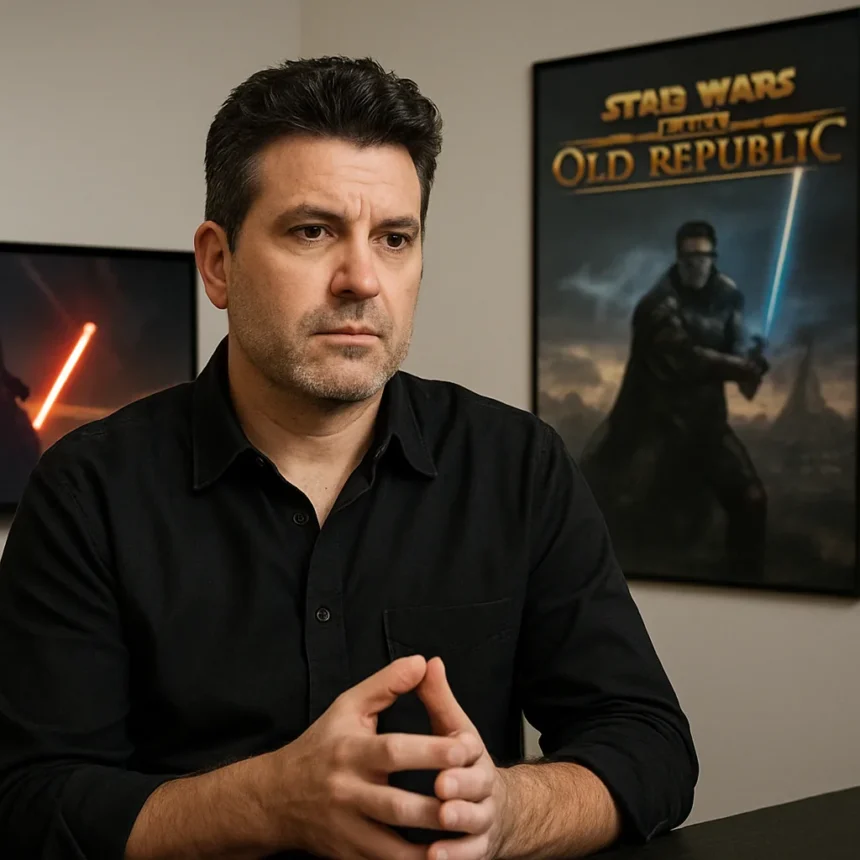
Casey Hudson, director of the upcoming Star Wars: Fate of the Old Republic and founder of Arcanaut Studios, has made a clear stance against AI in game development. In a recent Bloomberg interview, Hudson stated he finds AI creatively soulless and is deeply unimpressed with its potential applications in game creation.
Key Takeaways
- Casey Hudson explicitly rejects generative AI for Star Wars: Fate of the Old Republic development
- Hudson calls AI creatively soulless and struggles to see where it helps in game development
- The project emphasizes a human-first approach with talented team members
- Game entered pre-production late in 2025 and is still staffing up
- No generative AI will be used in any aspect of the game’s creation
Why AI in Game Development Falls Short for Hudson
Hudson’s rejection of AI reflects a broader skepticism in the industry about generative tools. When asked about AI’s role in his ambitious Star Wars RPG, Hudson was blunt: I just find AI to be creatively soulless. He elaborated that he personally struggles to imagine where generative AI would even be helpful in the game development process. This stance contradicts the growing trend of studios experimenting with AI for asset generation, dialogue writing, and procedural content creation.
The director’s position matters because it challenges assumptions that AI efficiency drives the project’s scope. Some industry observers speculated that Hudson’s team could deliver such an ambitious, sprawling RPG only by leveraging generative tools. Hudson’s explicit rejection of AI addresses that directly: the game will be built the traditional way, through skilled artists, programmers, writers, and designers working collaboratively.
A Human-First Approach During Pre-Production
Arcanaut Studios entered pre-production on Star Wars: Fate of the Old Republic late last year, and the team is still in active hiring mode. Hudson’s commitment to avoiding AI signals his development philosophy: make a great game with great people, without relying on algorithmic shortcuts. This approach runs counter to efficiency-focused studios exploring how generative AI might accelerate timelines or reduce labor costs.



The timing of Hudson’s remarks is significant. As generative AI tools proliferate across entertainment and software development, Hudson’s public rejection serves as a counterweight to industry hype. His willingness to state that he finds AI creatively soulless gives voice to creators who share similar reservations but may feel pressure to adopt the technology anyway.
What This Means for Star Wars: Fate of the Old Republic
The game’s development will rely entirely on human creativity and craftsmanship. No generative AI will be used in writing, character design, environment creation, or any other production phase. For a project described as ambitious and sprawling, this commitment requires Hudson to build a team large and talented enough to handle the workload without algorithmic assistance.



Hudson’s stance does not mean the game will ignore modern tools entirely—game engines, motion capture, and other established technologies will likely play their role. Rather, Hudson is drawing a line at generative AI specifically, viewing it as incompatible with the creative vision he wants to achieve. The Old Republic franchise has always been defined by rich storytelling and character depth; Hudson’s rejection of AI suggests he believes human writers and designers are essential to maintaining that legacy.
Does Rejecting AI Put Star Wars: Fate of the Old Republic at a Disadvantage?
No. Hudson’s decision reflects confidence in his team and the creative process. While some studios use AI to accelerate asset generation or handle routine tasks, many successful games continue to rely entirely on human talent. The trade-off is longer development timelines and higher labor costs, but the payoff is creative control and originality—qualities Hudson clearly values above speed.
Will Other Game Studios Follow Hudson’s Lead on AI?
Unlikely in the near term. Most major publishers are experimenting with generative AI in some capacity, whether for marketing, voice work, or background assets. Hudson’s public rejection is notable precisely because it is contrarian. However, if Star Wars: Fate of the Old Republic delivers a critically acclaimed, creatively rich experience without AI, it could embolden other directors to make similar choices.
When Will Star Wars: Fate of the Old Republic Release?
Hudson has not provided a specific launch window. The project is still in pre-production with team staffing ongoing, so a release date remains distant. Expect years of development before any announcement.


Casey Hudson’s unambiguous rejection of AI in game development stands out in an industry increasingly eager to adopt generative tools. His view that AI is creatively soulless reflects a principled stance: some creative work demands human judgment, intuition, and originality that algorithms cannot replicate. Whether that philosophy proves commercially viable will become clear once Star Wars: Fate of the Old Republic finally arrives.
Edited by the All Things Geek team.
Source: Windows Central